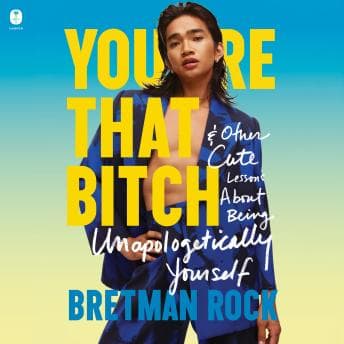

"Bitch, I was serving lunch in the cafeteria on Monday and flying to a photoshoot in LA on Friday."
I had to pause the audiobook. Not because I was shocked—I teach high school, nothing shocks me anymore—but because I genuinely needed a moment to process the sheer audacity of that sentence. And I mean audacity in the best possible way.
Let me be clear about something: I had no idea who Bretman Rock was before this book landed in my queue. My students would be horrified. They'd probably stage an intervention. But here I am, a 50-something English teacher who assigns Faulkner and argues about the Oxford comma, absolutely charmed by a memoir from a beauty influencer who uses the word "bitch" approximately four hundred times.
This is why we still read—or listen to—memoirs. They surprise us.
When Your Students Could Teach You Something
I started this during a particularly brutal stack of sophomore essays on The Great Gatsby. (No, Jaylen, the green light does not represent Gatsby's favorite color.) And something strange happened: Bretman's voice cut through my grading-induced fog in a way that felt almost medicinal.
Here's what I didn't expect—the kid has genuine comedic timing. Not internet-funny, but actually funny. The kind of timing that comes from understanding that a pause is punctuation. When he delivers a punchline about his childhood in the Philippines, he lets it breathe. When he's about to say something outrageous about his early fame, there's this little vocal lift that signals: buckle up.
What struck me most was the structure. Each chapter ends with these "how-to" sections on being a better person, and I kept thinking about how I'd teach this if it were assigned reading. The framework is deceptively simple—personal story, cultural context, life lesson—but it works because Bretman commits fully to each element. He's not hedging. He's not performing humility he doesn't feel. The honesty is almost confrontational.
The Immigrant Story You Weren't Expecting
Compare this to, say, Educated or any of the prestige memoirs we hand out like vitamins to book clubs. Hell, even Uncle Tom's Cabin follows that same playbook—pain as proof of authenticity. Those books earn their weight through suffering and redemption arcs. Bretman's doing something different. He's telling a first-generation immigrant story—Filipino kid moves to Hawaii, navigates American culture, finds fame through sheer personality—but he refuses to make it tragic.
There's pain here. You hear it in his voice when he talks about family struggles, about being different, about the cost of visibility. But he doesn't dwell. He pivots to joy with the same energy my students use to change subjects when I ask about their homework.
If you loved The House on Mango Street for how it captured cultural identity through vignettes, this is its chaotic, glitter-covered, Gen-Z spiritual successor. Cisneros would probably be confused. I think she might also be delighted.
What Bretman's Actually Arguing
Beneath all the "bitch" and the beauty tips and the influencer drama, there's a genuine thesis here: authenticity as armor. Bretman figured out early that the best defense against a world that wants to categorize you is to be so completely yourself that you become uncategorizable.
My students would hate this. They'd say it's obvious. They'd roll their eyes at another "be yourself" message.
But they'd be wrong. Because Bretman isn't saying "be yourself" in that empty, motivational-poster way. He's saying: being yourself is a daily, exhausting, sometimes terrifying choice. And here's exactly how I made that choice, over and over, in specific situations you might recognize.
That specificity matters. This isn't abstract self-help. It's a case study.
Six Hours of Pure Personality
Author-narrated memoirs live or die on voice, and Bretman's voice is the whole show. He doesn't just read—he performs. The emotional range is real. When he's being funny, you laugh. When he gets serious at chapter endings, the shift feels earned rather than manipulative.
At six and a half hours, it's the perfect length. Long enough to feel substantial, short enough that the energy never flags. Runnin' with the Devil has that same relentless energy—different world, same commitment to never letting the audience get bored. I listened at 1.0x because—as I tell anyone who'll listen—the author chose those words, and I choose to hear them properly. But I'll admit: Bretman's delivery has a natural pace that doesn't need adjustment.
Worth Pausing the Faculty Meeting For
Fans of Bretman Rock, obviously—this is his personality distilled into pure audio form. But also: anyone who's tired of memoirs that take themselves too seriously. Anyone who wants to understand what "influencer culture" actually means to the people living it. Teachers like me who want to understand what our students are consuming. Skip it if profanity bothers you, or if you need a traditional narrative arc with rising action and climax. This is essays, not epic.
I finished the last chapter while walking the lakefront with Denise. She asked what I was smiling about. I tried to explain Bretman Rock to a woman who thinks TikTok is a clock sound.
She said, "So you liked it?"
Yeah. I really did. My students would be proud. (They'd also be insufferable about it, but that's a different problem.)