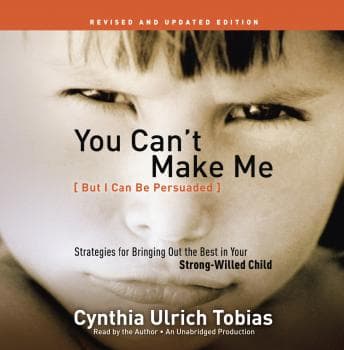

Look, I'm going to be honest about something that's a little embarrassing for a guy who's spent two decades in a high school classroom: I almost didn't listen to this book because the title felt like something I already lived every single day. "You Can't Make Me" — that's not a book title, that's what I hear from period three when I assign anything longer than a tweet. But Denise picked it up on a recommendation from her sister, and I figured at three and a half hours, I could knock it out during Saturday morning errands and our afternoon walk along the lakefront. So there I was, pushing a cart through Costco, nodding along to Cynthia Tobias like she was personally narrating my last parent-teacher conference.
And then something happened. Somewhere between the bulk paper towels and the frozen section, I stopped thinking about my students and started thinking about myself.
The Mirror You Didn't Ask For
Here's what caught me off guard: Tobias isn't just writing about strong-willed kids from a clinical distance. She is one. Was one. Still is, clearly. She's got eight years of teaching high school under her belt — which immediately earned my respect — and six years in law enforcement, which frankly explains a lot about her no-nonsense delivery. When she talks about the strong-willed child's need for why before compliance, she's pulling from both sides of the desk. She'll describe a scenario where a parent draws a hard line — "Because I said so" — and then she'll explain, with the patience of someone who's clearly had to learn this the long way, why that phrase is basically gasoline on a fire for these kids.
The framework she keeps returning to is control. Not seizing it, not surrendering it — sharing it. She makes this distinction between the what and the how that genuinely shifted something in my thinking. The parent (or teacher — she addresses us directly, bless her) decides what needs to happen. The strong-willed child gets input on how it happens. It sounds simple. It is simple. But I've watched enough power struggles implode in my classroom to know that simple isn't the same as obvious.
What I didn't expect was the section where she interviews actual strong-willed adults reflecting on their childhoods. That hit different. These aren't hypothetical case studies — they're people describing what it felt like to be the "difficult" kid, the one teachers labeled as defiant when they were really just wired to question everything. I paused the audiobook during one of those reflections and just... stood there in the kitchen. Because I've been that teacher. I've written those comments on report cards.
Tobias Behind the Mic (And the Faith Factor)
She narrates it herself, and here's where I have mixed feelings. Tobias reads like a speaker, not a performer. Her delivery is warm, confident, conversational — basically like a really good workshop presenter who happens to be recording. You can hear her smile during some of the anecdotes. But it's not narration in the way I usually think about it. There's no real vocal range, no dramatic shifts. It's competent and authentic, which for a parenting book is probably exactly right, but I never forgot I was listening to someone read their own material.
Now — the religion piece. This book is published by WaterBrook, and Tobias comes from a Christian perspective. There are references to faith, to God's design for these spirited kids. If that's your framework, it'll feel like home. If it's not, the practical strategies still hold up — the faith elements are present but not load-bearing for the advice itself. I ran into a similar situation with Brush of Wings, where the faith framework is woven throughout — worth knowing going in, but it didn't stop me from finding something real in it. I'd have appreciated a heads-up before I started, so consider this yours.
At 3 hours and 33 minutes, it's lean. Almost too lean in places — I wanted her to go deeper on the blended family section and the bit about parents who disagree on discipline approach. Those felt like they deserved full chapters rather than the abbreviated treatment they got. The "Strong-Willed Child Emergency Kit" at the end is genuinely useful though. Practical, immediate, no fluff. The kind of thing you'd screenshot if this were a PDF.
Who Needs This (And Who Might Not)
Parents in the trenches with a kid who argues about everything from bedtime to seatbelts — this is for you. Teachers too, honestly. I'm already rethinking how I handle my most combative students, and that's saying something after twenty years of thinking I had it figured out. But if you're looking for deep developmental psychology or evidence-based research citations, this isn't that book. It's experiential, anecdotal, and practical. Think "wise friend who's been there" rather than "peer-reviewed study."
And if you're a strong-willed adult who's never had someone explain your own brain to you? Yeah. Clear your Saturday morning.
Worth Pausing the Faculty Meeting For?
Close. Not quite. It's too short and too surface-level in spots to justify a full credit when you could grab it on sale or through a library app. But the core insight — that strong will isn't the enemy, and that control is a negotiation, not a conquest — that's stayed with me longer than most full-length books I've listened to this year. Tobias didn't change my teaching overnight. But she made me reconsider whether the kid arguing with me in fifth period is the problem, or whether my approach is. And at my age, that kind of reconsideration doesn't come cheap.
(My students would hate this. Actually — no. My strong-willed students would love it. They'd feel seen. That might be the highest compliment I can give.)