
Can a book simultaneously make you roll your eyes and take notes? Because that was pretty much my entire experience with You Are a Badass.
I was chopping onions for a chana masala — the kind of elaborate Sunday cooking project where I need something in my ears to stop my brain from drafting research methodology sections — when Jen Sincero started telling me about my "Big Snooze." The subconscious self that keeps you stuck. And I paused, knife mid-air, because that's actually... not wrong. The concept maps onto what we'd call schema maintenance in cognitive psychology. The idea that we have deep cognitive structures that resist change, that actively sabotage new behaviors because they threaten our existing self-concept. Sincero calls it your Big Snooze. My dissertation committee would call it cognitive schema preservation. Same phenomenon, wildly different packaging.
And that's kind of the whole deal with this book.
When Your Best Friend Takes a Psychology 101 Class
Here's what Sincero gets right: the 28 bite-sized chapters work beautifully for audio. Each one is essentially a mini case study — here's a limiting belief, here's how it manifests, here's an exercise to challenge it. The research actually shows that self-sabotaging behaviors often stem from identity-protective cognition, and Sincero nails this intuitively even when she doesn't use the clinical language. Her bit about how we unconsciously create circumstances that confirm our worst beliefs about ourselves? That's confirmation bias meets self-fulfilling prophecy, and she explains it better than most intro psych textbooks I've assigned as reading.
But then — and you knew this was coming — she starts talking about "the Universe" like it's a cosmic Amazon Prime delivering your desires if you just vibrate at the right frequency. Psychologically, this doesn't track. Not entirely. There's a grain of truth buried in there (attentional bias means that when you focus on something, you notice more opportunities related to it), but Sincero wraps it in enough mystical language that my inner researcher starts twitching. I found myself asking: why does she lean so hard into manifestation when the behavioral science alone would be convincing enough?
Jen Sincero, Narrating Jen Sincero, Being Very Jen Sincero
The author-narrated format is both the biggest strength and the most interesting limitation here. Sincero reads her own work with the cadence of someone telling you a story at a bar after two drinks — confident, a little profane, zero pretension. When she delivers a line about how you need to stop being a victim and actually change your behavior, it lands differently hearing it in her voice than it would from a professional narrator. There's a bluntness that feels earned because she's sharing her own broke-living-in-a-garage backstory.
That said, almost eight hours of one person's motivational energy is... a lot. By hour five I'd switched from cooking to scrubbing my entire kitchen, and the relentless positivity started blurring together. The tone doesn't really modulate. It's the same sass-and-wisdom frequency from chapter 1 through chapter 28. My therapist would have thoughts about someone who maintains that level of enthusiasm without pause. But honestly, for commute-length chunks rather than a full Sunday marathon like I attempted? It works much better.
The Self-Sabotage Chapters Are the Real Reason to Listen
If I'm being honest with myself (which, as Sincero would say, is the whole point), the chapters on identifying self-sabotaging beliefs are genuinely useful. Not because the exercises are revolutionary — they're standard cognitive behavioral techniques dressed up in casual language — but because Sincero has a gift for making you feel like the problem is solvable rather than pathological. The protagonist of this book is you, and what makes that compelling is that Sincero treats "you" like someone who's capable but stuck, not broken. That's a meaningful psychological reframe.
Sincero takes that reframe further in Badass Habits, where she translates the self-sabotage insights into concrete daily upgrades. I appreciated the practical scaffolding, but the motivational frequency is cranked to the same relentless level.The money chapters, though? Those read like a different book got spliced in. The shift from "examine your limiting beliefs" to "make some damn money" felt abrupt and less psychologically grounded. It's where the self-help genre's obsession with financial success starts to override the actually interesting behavioral analysis.
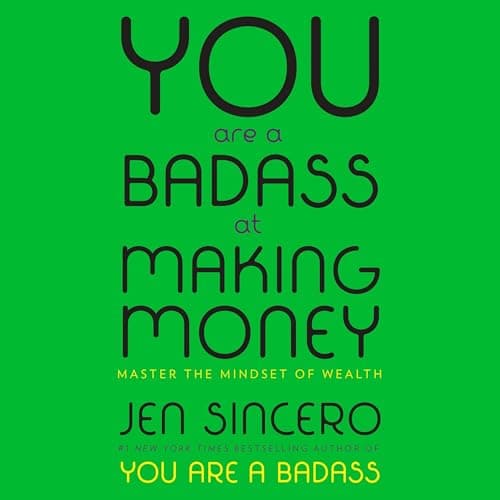
The money talk felt like a preview of her separate book You Are a Badass at Making Money, which I found leans even harder into the manifestation angle without the psychological counterbalance I wanted.Who Gets the Most Out of This
Listen if you've never really interrogated your own thought patterns and want a low-barrier, entertaining entry point. This is Psychology-101-meets-stand-up, and for someone who's never sat with the question "why do I keep doing the thing I say I don't want to do?" — it's genuinely solid.
Skip if you've already done significant therapeutic work or read books grounded in actual CBT or ACT frameworks. You'll recognize the concepts in costume and get frustrated by the mystical garnish. Also skip if constant motivational energy without tonal variation exhausts you. It exhausted me, and I study human behavior for a living.
My Clinical Note
This is a fascinating case study in how packaging determines reach. The psychology here isn't new — it's self-efficacy theory, cognitive restructuring, attentional bias — but Sincero made it accessible to five million people who would never pick up a Bandura paper. And honestly? That matters. I just wish she'd trusted the science more than the Universe.