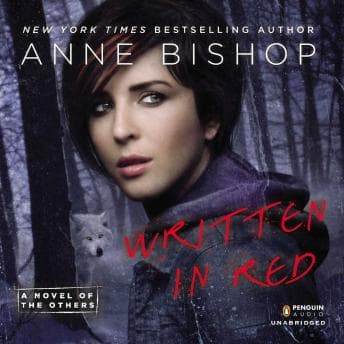
I was deep in the stacks at the library, reshelving returns during a slow Tuesday afternoon, when I first started this. Headphones in, cart half-full, and suddenly I'm standing frozen in the 800s section because Anne Bishop just described a world where humans aren't the apex predators. They're not even close. And something about that premise—that fundamental inversion of the horror hierarchy—hit me like a gut punch.
Written In Red isn't marketed as horror. It's shelved in fantasy romance. But make no mistake—this understands that horror isn't about gore. It's about dread. About the slow, creeping realization that the monsters aren't hiding under the bed. They own the bed. They own the house. They own everything, and they're letting you exist because they find you occasionally useful.
When Predators Get Protective
The Others—vampires, shapeshifters, elementals, and things far worse—have allowed humans to carve out small pockets of civilization on their continent. It's not coexistence. It's tolerance. And Bishop never lets you forget the difference. Simon Wolfgard doesn't protect Meg because he's secretly a good guy with a gruff exterior. He protects her because she's his now, the way a wolf protects its territory. The romance here isn't about two equals finding love. It's about a predator learning that prey can become something else entirely.
Alexandra Harris gets this. Her Simon has just the right amount of growl—not cartoonish werewolf snarling, but this underlying menace that suggests he's always one bad decision away from eating someone. (And not metaphorically.) When he's confused by Meg's behavior, when he's trying to parse human social cues through a wolf's understanding, Harris captures that genuine bewilderment. He's not pretending to be dangerous. He IS dangerous. He's just also... curious.
A Prophet Who Bleeds
Meg's power is body horror distilled to its essence. She sees the future when her skin is cut. Not metaphorically. Not magically. She bleeds, and the visions come. Her Controller—and god, that word choice alone deserves recognition—kept her imprisoned, cutting her for profit. Her scars are a map of exploitation.
Harris delivers Meg's vulnerability without making her pathetic. There's this innocent quality to her voice that makes sense—Meg was raised in isolation, fed information but denied experience. She knows what snow is but has never felt it. She knows what friendship means but has never had a friend. When she encounters the terra indigene's brutal honesty, she doesn't crumble. She adapts. Harris makes you hear that adaptation happening in real time.
The telepathic communication issue some listeners mention? Yeah, it's there. When the Others speak mind-to-mind versus out loud, there's no clear audio distinction. I found myself rewinding a few times in the early chapters, trying to figure out if a conversation was happening in someone's head. It's not a dealbreaker, but it's the kind of production choice that could've been handled better.
Eighteen Hours of Slow-Burn World-Building
Let's be honest—this is a commitment. Eighteen and a half hours is a lot. The first half is almost entirely setup: Meg learning the Courtyard's rules, the Others observing this strange human who doesn't smell like prey, the slow establishment of a community that operates on completely non-human logic. Some parts feel like filler. There are scenes of mail sorting and scheduling that exist purely to establish routine.
But here's the thing—that routine matters. When the violence comes in the second half (and it comes), it hits harder because you've spent hours watching Meg build something worth protecting. The climactic scenes are genuinely brutal. Bishop doesn't sanitize what the Others do to threats. She lets you see exactly what humanity is dealing with, and it's not pretty.
Compared to something like The Dresden Files, where the supernatural exists alongside human society, Written In Red inverts the power dynamic entirely. Heart Seeker plays with similar power inversions, though it leans harder into the romance side of that equation. Dresden navigates a hidden world. Meg navigates a world where humans are the ones hiding. It's a small shift that changes everything.
Who's This For (And Who Should Run)
If you want fast-paced urban fantasy with quippy protagonists, skip this. The pacing will frustrate you. But if you're a horror fan who's tired of supernatural creatures being defanged for romance—if you want your monsters to stay monstrous even as they become protective—this delivers. Readers who loved the slow community-building in cozy fantasy but wish it had actual teeth? You're the target audience.
Worth the Blood?
Harris's male voices aren't always deep enough—Simon sometimes sounds more grumbly teenager than apex predator. And yes, her naturally young-sounding voice occasionally makes scenes feel lighter than they should be. But she commits. That's rare in fantasy narration. She doesn't phone in the werebear's gruff affection or Tess's brusque menace. She finds each character's core and stays there for eighteen hours.
I finished this at 1 AM, sitting in my apartment with Shirley (my cat) staring at me like I'd lost my mind. Maybe I had. But I immediately bought the next book in the series, so take from that what you will.
Closing the Book (But Not the Series)
Horror that respects the genre—even when it's wearing fantasy romance clothing.









