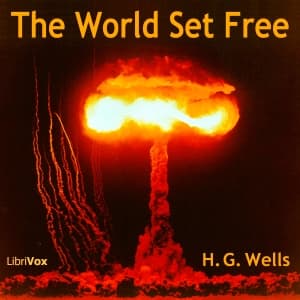

What if someone in 1914 could see the atomic bomb coming thirty years before Hiroshima? Not the vague notion of powerful weapons, but the actual mechanics—atomic chain reactions, radiation poisoning, the geopolitical nightmare of mutually assured destruction?
H.G. Wells did exactly that. And I listened to it at 2 AM when I should have been working on my thesis, which honestly felt appropriate given Wells was basically writing his own academic paper disguised as fiction.
The Prophet of Doom Had a Crystal Ball
Look, this book is wild. Wells coined the term "atomic bomb" in 1914. He described radioactive decay as a power source. He predicted that once humanity unlocked atomic energy, we'd immediately use it to blow each other up. The man was sitting in Edwardian England, probably drinking tea, and casually forecasting the Cold War.
The first half traces humanity's relationship with energy—from coal to atomic power—with this almost clinical precision that reminds me of Asimov's Foundation series. Black Star Passes does something similar with its hard sci-fi approach to space travel, though it's way more pulpy and fun. Wells isn't just telling a story; he's building an argument about technological determinism. My D&D group would eat this up because it's basically world-building as philosophy. Ready Player One has that same systematic world-building energy, though Cline's focused on virtual reality instead of atomic physics. What happens when you give monkeys nuclear fire? Exactly what you'd expect.
But here's the thing—this is 1914 speculative fiction, and it reads like it. Dense paragraphs. Long philosophical tangents. Characters who exist primarily as mouthpieces for ideas rather than people you'd want to grab a beer with. If you don't like info-dumps, this isn't for you. (You're wrong, but still.) Wells is lecturing, and the lecture happens to have a plot attached.
The Narration Problem Nobody Warned Me About
I need to be honest here: Lively Hive's performance nearly killed this for me. And that's saying something, because I'll listen to anything if the source material is good enough.
The pacing is... tedious. There's no other word for it. Wells' prose already demands attention—it's not beach reading—and when the narrator delivers it with the same flat energy throughout, those philosophical passages become endurance tests. I found myself reaching for the 1.25x speed button around hour two and never looked back.
Steven Pacey walked so other narrators could run, and this narrator is still sitting down. No vocal distinction between the various characters discussing atomic policy. No shift in energy when Wells describes cities being vaporized. Just steady, monotone delivery that treats nuclear apocalypse with the same enthusiasm as a grocery list.
Other reviews echo this exact frustration—people love the story but find the narration a slog. Yeah. That's the whole thing right there. Wells deserves better.
When the Magic System is Real Physics
Here's what kept me listening despite everything: Wells' atomic "magic system" is chef's kiss. He describes these bombs as perpetual explosions—not single detonations but continuous atomic fires that burn for years, rendering entire regions uninhabitable. It's not quite how real nuclear weapons work, but it's close enough to be genuinely unsettling.
The progression is satisfying in a grim way. Humanity discovers atomic power. Humanity immediately militarizes it. Cities burn. And then—this is where Wells gets interesting—the survivors have to figure out how to build a world government to prevent it from happening again. Utopian fiction grafted onto apocalyptic fiction. A combo I didn't know I needed.
At eight hours, this is a commitment. Worth it—but only if you're in the right headspace. This isn't background listening. This is "I'm going to think about humanity's relationship with technology" listening.
Who Should Roll These Dice (And Who Should Sit This Session Out)
If you're into classic sci-fi, alternate history, or just want to be amazed at how accurately a guy in 1914 predicted nuclear warfare, this is essential. The ideas here influenced actual nuclear physicists—Leo Szilard read this book before working on the Manhattan Project.
Skip it if you need dynamic narration to stay engaged, or if dense Edwardian prose makes your eyes glaze over. Maybe find a different recording. This version is free (public domain, available through LibriVox), and you get what you pay for.
Worth Adding to Your Campaign Notes
I read this instead of writing my thesis, and I don't entirely regret it. Wells was doing hard sci-fi before hard sci-fi existed, predicting weapons that wouldn't exist for three decades with eerie accuracy. The audiobook production drags down what should be a fascinating experience, but the source material is historically significant enough that it's worth pushing through. Just... maybe bump up that playback speed.