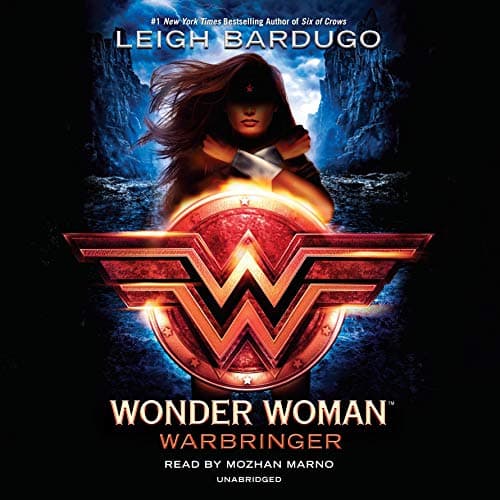

"She will become one of the world's greatest heroes. But first she is Diana, Princess of the Amazons." That tagline sets the frame, but the moment that actually hooked me comes early — Diana standing on the cliffs of Themyscira during the race that's supposed to prove her worth, watching a mortal girl's ship burn on the water below, and making a split-second choice that throws away everything she's worked for. It's a small, specific beat, and Mozhan Marnò delivers it with this quiet intensity that immediately told me: okay, this narrator gets it.
I started this one expecting competent franchise fiction. Leigh Bardugo writing Wonder Woman for DC Icons — cool concept, safe execution, move on. What I got instead was a genuine mythology nerd's love letter to Diana that also happens to work as a YA buddy adventure, and I found myself re-evaluating my assumptions about three hours in when the story shifts from Themyscira to modern New York and somehow doesn't lose a step.
Here's what Bardugo does differently with Diana compared to most Wonder Woman adaptations: she makes her alien. Not alien in a Superman-from-Krypton way, but alien in the sense that Diana's entire frame of reference is ancient Greek warfare, immortal warrior women, and divine law. When she hits Manhattan, she doesn't just do cute fish-out-of-water gags about escalators and taxis. She fundamentally doesn't understand why mortals accept the constraints they live under — why women shrink themselves, why people tolerate injustice out of convenience. Bardugo writes those clashes with real specificity, and Marnò voices Diana's confusion and frustration with a kind of regal bewilderment that never tips into comedy. Diana isn't naive. She's operating from a completely different moral framework, and the narration sells that distinction.
The Warbringer concept itself is the mythological hook that kept my world-building brain happy. Alia Keralis is a direct descendant of Helen of Troy — not Helen as a beautiful woman who launched ships, but Helen as a cosmic lightning rod for human violence. Every generation produces a Warbringer whose very existence tilts the world toward war, and Alia is it. The Greek myth isn't window dressing here. Bardugo builds actual plot mechanics around the lineage of Helen, the Oracle at Delphi, and the intervention of gods who have competing interests in whether Alia lives or dies. If you've read her Grishaverse books, you know she can construct magic systems with internal logic; she brings that same rigor to Greek mythology, and it surprised me how well it works in a DC context. Think of it like a homebrew D&D campaign where someone actually did the research on their pantheon — the rules hold up under pressure. Her author page at Leigh Bardugo is worth a browse if you're mapping out where Warbringer sits relative to her other work — I went down that rabbit hole at 2am and don't regret it.
The supporting cast is where the book really breathes. Alia's brother Jason, her best friend Nim, and the poet Theo aren't just YA sidekick slots waiting to be filled. Nim is sharp and funny without being reduced to comic relief. Theo has his own arc about courage that pays off in the final act. And Jason — I'll just say that Bardugo sets up his protectiveness in a way that had me second-guessing his motivations for hours, which is exactly the kind of slow-burn suspicion that works in audio because you can't flip ahead to check.
About that narration: Marnò doesn't do big performative character voices. She works with tonal register instead — Diana gets a slightly lower, more deliberate cadence; Alia is faster, more clipped, more modern. The shifts are subtle enough that you stop noticing the technique and just hear different people talking. Where she really earns her paycheck is the emotional peaks. There's a late-book scene where Diana and Alia's bond gets tested under genuine pressure, and Marnò's delivery cracked something open in me. Multiple listeners mention crying at this audiobook, and I get it. She finds the raw nerve in Bardugo's dialogue and leans into it without melodrama.
Now, the thing that keeps this from Bardugo's top shelf: the villain reveal. If you're paying attention — and in audio, you're always paying attention — you'll spot the betrayal coming well before it lands. Bardugo telegraphs it through character behavior that's just slightly too convenient, and when the mask drops, the climax loses some of its punch. The final act also leans into divine intervention a bit heavily. Problems get resolved by godly power rather than purely through Diana and Alia's choices, which undercuts the story's own argument about women claiming agency. It's not a dealbreaker, but it's the gap between a very good book and a great one.
For a twelve-hour listen, the pacing holds up well. I burned through most of it over two dedicated weekend sessions rather than spreading it across a week of commutes, and it rewards that kind of focused attention. The YA banter between Diana and Alia keeps things light between action sequences, but the mythology carries enough weight that you want to track the details.
Who Should Listen (And Who Should Skip)
If you want a mythology-heavy Diana-and-Alia road trip and you're fine with YA dialogue and pacing, this is an easy buy. If you're after grim adult fantasy, a villain-driven plot, or narration with big theatrical character voices, this isn't your book. Bardugo clearly cared about getting Diana right — not just as a superhero, but as a person figuring out what her power is actually for — and Marnò matches that care in the booth. It's the rare franchise novel that earns its emotional moments instead of borrowing them from the source material.