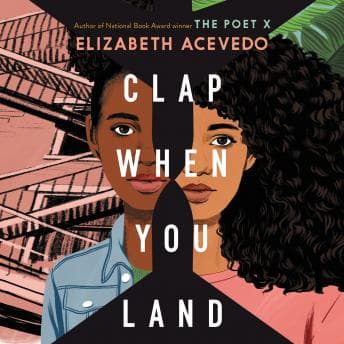

Everyone told me this was a YA book about a teen mom who cooks. And sure, technically, that's accurate the way saying Moby-Dick is about a guy who really wants to catch a fish is accurate. I came in expecting something light - maybe even a little saccharine - because I'd heard the words "feel-good" and "delicious" thrown around so much I thought I was reviewing a cookbook. I was wrong. Pleasantly, stubbornly wrong.
I started this one during a Sunday afternoon walk along the lakefront with Denise. She had her own podcast going, I had mine - or rather, I had Emoni Santiago in my ear, and by the time we hit North Avenue Beach, I'd gone quiet in that way Denise recognizes. She tapped my shoulder: "Good one?" I just nodded. Because how do you explain that a seventeen-year-old fictional girl from Philly just made you rethink the last twenty years of telling students what counts as "serious literature"?
The Author Reading Her Own Soul
Here's the thing people get wrong about author-narrated audiobooks: they assume the author will be the best narrator because they wrote it. That's like saying the architect should also be the one laying the bricks. Sometimes it works. Sometimes it's a disaster. Elizabeth Acevedo is that rare case where the author doesn't just read the words - she remembers why she chose them.
Her delivery isn't dramatic. If you're coming from, say, a full-cast fantasy production with sound effects and fifteen distinct accents, the first twenty minutes might feel understated. I've seen that complaint, and I get it. But stick with it. What Acevedo does is something closer to spoken word poetry than traditional narration - there's a rhythm underneath every sentence, a cadence that mirrors the way Emoni thinks. When she describes cooking, the pace slows just slightly, and you can hear Acevedo savoring the language the same way Emoni savors her food. The narrator understands that pause is punctuation. That slight deceleration during the kitchen scenes - where Emoni adds sazón to eggs or layers sofrito into rice - isn't an accident. It's interpretive. It's performance art disguised as simplicity.
Now, the character differentiation is minimal. 'Buela, Emoni's best friend Angelica, the love interest Malachi - they're distinguished more by emotional register than by vocal gymnastics. Acevedo shifts her tone, softens for 'Buela's wisdom, sharpens for moments of teenage frustration, but she's not doing voices. For this particular story, that works. Emoni is our lens for everything, and keeping the narration rooted in her perspective means we never leave her head. It's intimate rather than theatrical.
When Food Becomes the Metaphor Your Students Actually Understand
Let's talk about what Acevedo is really saying. Because this isn't a cooking story. The food is the language Emoni uses when words fail her - and in a book written in prose (not verse, like The Poet X), that's a fascinating structural choice. Emoni can't always articulate why she's angry, or scared, or hopeful, but she can make you a plate that communicates all of it. There's a scene where she's cooking for a class project and the food carries this almost magical quality - not literal magic, but the kind of alchemy that happens when someone pours genuine emotion into craft. This reminds me of what Hemingway said about writing one true sentence. Emoni cooks one true meal, and everything follows from that honesty.
The Spanish woven throughout the text is another thing worth addressing. Some listeners wanted translations, and I understand that impulse - especially in audio where you can't easily look something up. But I think leaving those phrases untranslated is a deliberate choice. You're meant to feel what Emoni feels, and sometimes that means understanding through context and tone rather than direct definition. My students who are bilingual tell me this all the time: code-switching isn't confusion, it's identity. Acevedo knows this in her bones.
Where the book stumbles slightly is pacing. The middle section - the culinary arts class, the trip abroad, the romance - sometimes moves so quickly between plot threads that individual moments don't get the room they deserve. Emoni's relationship with Malachi in particular develops at a clip that feels more outlined than lived-in. At seven and a half hours, there's just not quite enough space for everything Acevedo wants to explore. It's a short book trying to hold a big life.
Who This Feeds and Who Should Look Elsewhere
If you loved The House on Mango Street, this is its spiritual successor - a young woman navigating identity, family obligation, and creative ambition in a world that keeps telling her to be practical. Mad Honey sits in that same neighborhood thematically - two young people carrying more weight than anyone their age should have to, and a story that refuses to let plot mechanics substitute for emotional honesty. If you're a parent, a teacher, or anyone who's ever had to choose between what you love and what you think you're allowed to want, Emoni's story will hit you somewhere real. My students would actually love this one. I might assign it.
If you need heavy plot, constant action, or distinct character voices from your narrator - this probably isn't your meal. And that's fine. Not every book is for every listener.
Worth Pausing the Faculty Meeting For
I listened at 1.0x because the prose deserves to be savored, and because Acevedo's rhythm is half the experience. Speed this up and you lose the music. It won't change your life the way some books do - but it'll make you think about what you gave up because someone told you it wasn't realistic. And then maybe you'll go cook something with a little too much love in it, just to prove them wrong.