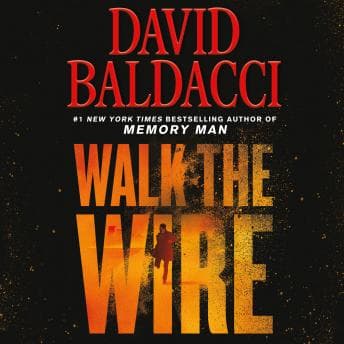

Here's the thing about Amos Decker as a character: he's basically what happens when you give someone a perfect memory and zero social skills, then drop them into situations where both of those things matter equally. It's a fascinating case study in how cognitive gifts can coexist with—and sometimes compensate for—interpersonal deficits. And honestly? Baldacci gets this right in ways that a lot of thriller writers don't even attempt.
I listened to this one during my morning jogs through Cambridge, which meant I was simultaneously trying to track a murder investigation in a North Dakota oil town while dodging tourists who don't understand how sidewalks work. Fitting, actually, because Walk the Wire is all about navigating chaos—the kind that happens when you take a small town and flood it with money, desperation, and people running from their pasts.
The premise grabbed me immediately. Irene Cramer—prostitute by night, teacher for a religious sect by day. The research actually shows that people compartmentalize their identities far more than we give them credit for, but rarely this dramatically. I found myself asking: why does someone construct such radically different versions of themselves? What psychological need is being met? Baldacci doesn't give easy answers here, which I appreciated. The character isn't just a victim with a scandalous backstory. She's a person who made choices, and those choices mattered.
Two Voices, One Investigation
Kyf Brewer and Orlagh Cassidy. Look, I've listened to enough audiobooks to know that dual narration is a gamble. Sometimes it works beautifully—different perspectives, different voices, clear delineation. Sometimes it feels like you're being passed between two people who didn't quite coordinate their approaches. This falls somewhere in the middle? Brewer handles Decker with the kind of measured intensity the character requires. There's something almost clinical in his delivery that works for a man who processes the world through pattern recognition rather than emotion. He brings that same precision to End Game, where the emotional restraint actually amplifies the tension. Cassidy brings warmth to Alex Jamison, and honestly, the contrast helps. But there were moments—transitions between narrators, mostly—where I felt a slight disconnect. Not jarring, just... noticeable. Like when you're watching a movie and you can tell they shot scenes out of order.
The Awkward Genius Problem
What makes Decker compelling is that he isn't your typical genius detective. He's not charming. He's not tortured in a glamorous way. He's awkward, blunt, and sometimes genuinely difficult to be around. The protagonist exhibits classic features of someone whose exceptional abilities have come at a social cost—and Baldacci doesn't try to sand down those edges. My therapist would have thoughts about this character, specifically about how he uses his work to avoid processing grief. (She'd probably also have thoughts about me analyzing fictional characters instead of doing my actual work, but that's between us.)
The plot itself is... ambitious. Maybe too ambitious? There's the murder, obviously. But also a mysterious government facility. A religious sect. Fracking politics. Drug trade. Property crimes. At one point I literally paused mid-run to think, wait, are we still talking about the same case? Baldacci throws a lot at you. Some of it lands—the tension between old-timers and boom-town newcomers felt real, grounded in actual sociological patterns of rapid community change. Some of it felt like it was there because thrillers need to keep escalating. The author understands human nature when it comes to individual characters, but the conspiracy elements stretched credibility in places.
Psychologically, the supporting cast mostly tracks. The ruthless business owners, the shady officials—these aren't just cardboard villains. They have motivations that make sense within their worldviews. That's harder to write than it sounds. Most thriller writers give you evil for evil's sake. Baldacci gives you people protecting interests, covering mistakes, acting out of fear. Way more realistic. He pulls off this kind of grounded character work in Edge too, where the motivations feel equally layered.
The pacing worked for me during runs but dragged slightly during cooking sessions. (I made a pretty elaborate dal makhani while listening to the middle section, and I finished the dal before the plot advanced significantly. That's a data point.) The final act picks up considerably, though. Tension builds the way it should.
Production quality is clean. No weird audio artifacts, no volume inconsistencies. Professional throughout.
Who's This For (And Who Should Run)
If you're already invested in the Memory Man series, this is a solid entry. If you like complex plots with multiple threads—and you're willing to do a little mental work to keep them straight—you'll probably enjoy it. If you want something you can half-listen to while doing other things, maybe not. This one requires attention. Skip if you need plots that move in straight lines, if dual narration pulls you out of stories, or if you're not in the mood for something that takes its time.
Case Closed (Sort Of)
Decker is the kind of character who would be exhausting to know in real life but is genuinely interesting to spend twelve hours with in audiobook form. That's a compliment. I think.