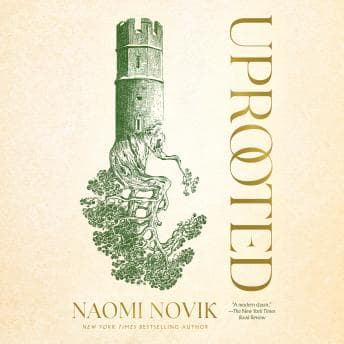

Look, I teach fairy tales. I've read every Grimm variant, analyzed Baba Yaga until my students' eyes glazed over, and written papers on the morphology of Eastern European folklore that exactly three people have read. I've assigned Grimm's Fairy Tales every semester for a decade, and most students treat it like a museum piece—interesting but dead. So when I say Naomi Novik understands the bones of these stories—the real bones, the ones that make you shiver—I'm not being hyperbolic.
Uprooted grabbed me by the collar somewhere around hour three and didn't let go until I was standing in my driveway at midnight, engine off, refusing to go inside until I heard how Agnieszka dealt with the Wood. Denise texted me twice. I ignored her. (She's forgiven me. Mostly.)
The Accent Question Everyone's Asking
Let's address Julia Emelin's narration right away, because I know it's the thing keeping some of you from hitting play. Yes, she has a strong Eastern European accent. Yes, it takes adjustment—maybe thirty minutes, maybe an hour. And yes, some listeners find it distracting enough to switch to print.
But here's my take, and I'll die on this hill: the accent is the point.
Novik didn't write a generic fantasy. She wrote a Polish fairy tale, steeped in Slavic folklore, with names like Agnieszka and Sarkan and villages that feel like they're nestled in the Carpathian foothills. Emelin's pronunciation isn't just accurate—it's correct. Every time she says "Polnya" or rolls through the magical incantations, I felt like I was hearing stories passed down through generations. Like sitting with a grandmother who remembers the old country.
That said. The narration isn't perfect. There are moments—particularly in the first few chapters—where the pacing feels choppy. Odd pauses mid-sentence that made me rewind to make sure I hadn't missed something. And the character differentiation? Honestly, it's minimal. The Dragon sounds a bit too much like the village elders, who sound a bit too much like the court nobles. If you need distinct voices to track dialogue, you might struggle.
But Emelin's emotional delivery when it counts? When Agnieszka discovers what she is, when the Wood reveals its true horror? She nailed it. Passion and intensity in all the right places.
Why This Fairy Tale Actually Has Teeth
I've been teaching literature for twenty years, and I can tell you exactly why Uprooted succeeds where so many fairy tale retellings fail: Novik respects the source material while refusing to be imprisoned by it.
Agnieszka isn't the beautiful one. She's messy, stubborn, perpetually covered in dirt, and her magic works in ways that frustrate the brilliant, controlled Dragon. Their relationship—and I mean this in the literary sense, not just the romantic one—is built on genuine conflict between two fundamentally different approaches to power. He's precision. She's intuition. Neither is wrong.
The Wood itself is genuinely terrifying. Not in a cheap horror way, but in the way the best fairy tales are terrifying—it corrupts slowly, insidiously, and the things that come out of it aren't just monsters. They're your neighbors. Your friends. Your mother. Novik understands that the scariest thing about the old stories wasn't the witch in the forest. It was losing yourself. That same unsettling transformation shows up in Alice's Adventures in Wonderland, though most readers miss how dark Carroll actually gets with identity.
My students would probably complain about the pacing in the middle section—there's a chunk where court politics takes over and the momentum dips. They'd be partially right. But they'd also be missing how Novik uses that section to expand the world, to show that the Wood's corruption extends far beyond one valley. It's not filler. It's context.
Seventeen Hours in the Carpathian Foothills
At 17 hours and 44 minutes, this is a commitment. I listened at 1.0x—yes, my students think I'm ancient—because Novik's prose deserves to breathe. The sentences have rhythm. The magic has weight. Speeding through felt wrong.
I'd recommend this for long commutes or weekend listening sessions. Not bedtime—the Wood sequences are genuinely unsettling, and I say this as someone who grades freshman essays about Poe at midnight. The production quality is clean, no audio issues to speak of.
One thing I noticed: the audiobook works better in longer stretches. The accent adjustment, the world-building, the slow burn of Agnieszka's power—it all compounds. Fifteen-minute bursts between classes didn't do it justice. But a two-hour walk along the lakefront? Perfect.
Who This Is (and Isn't) For
If you love fairy tales—real ones, not sanitized Disney versions—this is essential. If you appreciated the dark folklore of Katherine Arden's Winternight Trilogy or the stubborn heroines of Robin McKinley, you'll find a kindred spirit here. If you want magic that feels earned, relationships that develop through friction rather than instant attraction, and a villain that's genuinely original? Clear your schedule.
Skip it if you're sensitive to accents, need distinct character voices to follow dialogue, or want fast-paced action from page one. The narration is polarizing for a reason—sample first.
Class Dismissed
For me? I'm already planning my relisten. Denise says I can't do it until I finish grading midterms. She's probably right.
(She's definitely right. But I'm thinking about it anyway.)