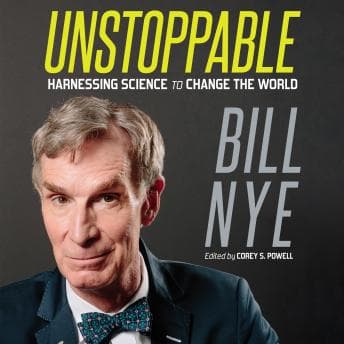

Bill Nye wrote a climate change book, and he narrates it himself, and I have feelings about both of those things.
I was walking the lakefront with Denise on a Sunday morning - one of those rare October days where Chicago decides to be beautiful instead of punishing - and I had this playing through my earbuds. She asked me why I kept muttering "yes, but" to myself. That's the experience of this audiobook in two words. Yes, but.
The Science Guy Still Has the Juice
Here's what surprised me: Bill Nye is genuinely good at explaining why two-thirds of the energy in your car's gas tank gets wasted as heat out the tailpipe. He drops that statistic early and it stuck with me for days. That's the kind of concrete, almost offensive fact that makes you rethink your commute. He does this repeatedly - takes something you thought you understood about energy consumption, transportation, or grid infrastructure, and reframes it so you feel a little dumb for not seeing it before. The man is an engineer first, and it shows. He's not hand-wringing about polar bears. He's drawing diagrams in your head about solar panel efficiency and desalination plants.
And when he's explaining these systems - how we could redesign our energy infrastructure, why nuclear deserves another look, how battery technology is the linchpin of everything - the book genuinely sings. This is Bill Nye at his best: geeky, specific, optimistic in a way that feels earned rather than naive. His little puns land better in audio than they would on the page, because you can hear him grinning through them. The dad-joke energy is real, and honestly? It's kind of charming.
When Enthusiasm Outruns the Argument
But here's where my "yes, but" kicks in. Nye has a habit of getting so excited about a solution that he barrels past the complications. He'll spend twenty minutes building a careful case for some technology, then leap to "and this will change everything!" without quite earning that jump. It's the rhetorical equivalent of a student who writes a brilliant thesis statement and then skips the body paragraphs.
The narration mirrors this problem. When Nye is calm and methodical - slowing down to walk you through how a particular system works - he's excellent. Clear, warm, the kind of voice you'd want explaining your electricity bill. But when he gets fired up (and he gets fired up a lot in eleven and a half hours), his pacing goes haywire. Words start tumbling over each other. I found myself rewinding a few times during his more passionate stretches, not because I disagreed, but because I literally couldn't parse what he was saying. At 1.0x, which is the only civilized speed, this shouldn't be happening.
The structure compounds the issue. At nearly eleven and a half hours, the book could've been tighter. Some chapters feel like they're covering ground he already covered two chapters ago, just from a slightly different angle. I kept thinking of what my old grad school advisor used to say: "Cut it by a third, and you'll find you haven't lost anything." This book needed that advice.
Who Should Plug In (And Who Should Walk On By)
If you're a science-curious listener who wants an accessible primer on energy, climate solutions, and engineering optimism - and you can tolerate some repetition - this is a solid listen. It's not a doom-and-gloom climate book. Nye is fundamentally hopeful, and that hopefulness is infectious even when it's a little too breezy. My students would probably love this, actually. It meets them where they are without talking down.
But if you're looking for deep engagement with the political, economic, and social barriers to the changes Nye proposes? You'll feel those gaps. This is a book that believes the right technology plus the right attitude equals progress, and that equation is... incomplete. It's the optimist's version of the climate conversation. Valuable, but partial. I kept thinking about how the best nonfiction earns its conclusions the hard way — the same reason I still think about Eye of the Needle, where every narrative payoff feels like it was bled for, not assumed.
Compared to his earlier book Undeniable, this one feels both more ambitious and less focused. Undeniable had a cleaner target - evolution denialism - and hit it squarely. Unstoppable is trying to cover the entire climate-energy landscape, and sometimes the seams show.
The Grade I'd Give at 11 PM
I finished this during a late-night grading session, red pen in one hand, coffee going cold. And I thought: if a student turned this in as a persuasive essay, I'd give it a B+. Strong voice, genuine expertise, real passion, needs tighter organization, could push harder on counterarguments. Bill Nye is a better science communicator than he is a writer, and this audiobook - where his voice does the heavy lifting - plays to that strength. The prose deserves to be heard in his voice. It just also deserves an editor with a sharper knife.









