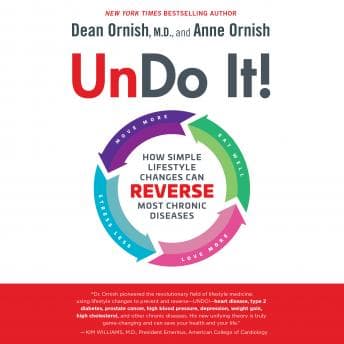

"Love more." That's one of the four pillars Dean and Anne Ornish present as literal medicine - not metaphorical, not woo-woo, but clinically documented, Medicare-reimbursable medicine. And I'll be honest, when I heard that line somewhere around the two-hour mark while chopping onions for a chana masala I was making at 9 PM on a Tuesday (yes, alone, yes, by choice), I paused the audiobook and just stood there with my knife hovering over the cutting board. Because as someone who studies why humans do what they do, the idea that loneliness is as significant a risk factor for early death as smoking - that love isn't just a nice feeling but a biological imperative - that hit differently than I expected from a health book.
But let me back up.
When Your Cardiologist Sounds Like Your Therapist
The core thesis of Undo It! is deceptively simple: eat well, move more, stress less, love more. Four lifestyle changes. That's it. Dean Ornish has spent forty-plus years building the research base showing these interventions can actually reverse - not just slow, reverse - heart disease, early-stage prostate cancer, type 2 diabetes, and now even early Alzheimer's. The research actually shows that telomeres (the caps on your chromosomes that shorten as you age) can lengthen with these changes. Your genes literally switch on and off differently. The Ornishes present this as a unified theory: chronic inflammation and oxidative stress underlie most chronic diseases, and these four lifestyle pillars address the root causes rather than just treating symptoms.
Psychologically, this tracks beautifully. I found myself asking: why does mainstream medicine keep treating the downstream effects instead of the upstream causes? The Ornishes argue it's because there's no pharmaceutical company funding lifestyle change. No patent on walking thirty minutes a day. And that cynicism - that systemic critique buried inside what looks like a cheerful wellness book - is what elevates it beyond the typical "eat your vegetables" advice.
What makes this book compelling is the "love more" pillar. This is where the psychology gets genuinely interesting. The Ornishes cite research showing that people who feel isolated have three to ten times higher rates of disease and premature death. They're not just saying "be nice to people." They're arguing that emotional connection is as pharmacologically potent as statins. The research on how giving and receiving shape our biology in measurable ways is something Adam Grant also circles in Give and Take, though he comes at it from organizational psychology rather than cardiology - and I found his evidence considerably less convincing than the Ornishes'. My therapist would have thoughts about this - specifically, she'd probably say "I've been telling you this for two years, Priya."
The Authors Behind the Microphone - A Mixed Prescription
Here's where I have to be straight with you. Dean and Anne narrate this themselves, and it's a choice that cuts both ways. On the positive side, you get Dean's genuine passion when he talks about his patients - there's a moment where he describes people who improved so dramatically in nine weeks that they avoided heart transplants, and his voice carries real weight there. He's been doing this work since the 1970s. You can hear the accumulated conviction.
Anne handles more of the practical sections - recipes, meal planning, the lifestyle implementation pieces - and she's warm without being saccharine. The husband-and-wife dynamic gives the book an intimate, almost conversational quality, like you're sitting at their dinner table.
But. Neither of them is a professional narrator, and at 8 hours and 34 minutes, you feel it. The pacing is occasionally flat, particularly through the more data-heavy sections on clinical trials. There's a certain monotone quality when Dean runs through study after study. I bumped it to 1.25x during the recipe sections and the supplemental meal-planning material, which helped considerably.
Where the Evidence Gets Complicated
I'm a researcher, so I can't not mention this: the book presents the Ornish program as having extraordinary results, and the published data does support significant benefits. But the program is intensive - it asks for a whole-foods, plant-based diet that's naturally low in fat AND sugar, plus meditation, yoga, exercise, and group support sessions. The research on adherence is strong within the program's structure, but I kept wondering about the selection bias. People who sign up for a comprehensive lifestyle overhaul are already motivated in ways that the general population might not be. The Ornishes acknowledge this somewhat, but I wanted more interrogation of the gap between clinical trial conditions and real life.
The seventy recipes and practical tips are genuinely useful - this isn't one of those health books that gives you the theory and then waves vaguely at implementation. But the relentless optimism can feel a little... uniform? Every patient story is a triumph. Psychologically, this doesn't fully track with how behavior change actually works for most people. Where are the relapses? The struggles? The people who tried and found it unsustainable?
Who This Is Actually For (And Who Should Keep Scrolling)
If you or someone you love has been diagnosed with heart disease, type 2 diabetes, or early-stage chronic disease and you want a research-backed alternative to "just take these pills forever" - this is genuinely worth your time. If you're a health professional looking for a comprehensive overview of lifestyle medicine, it's solid.
If you want a quick-hit wellness book with flashy hacks, this isn't it. It's asking for real, sustained change. And if you're skeptical of anything that sounds like it's promising too much - I get it. I was too. But the forty years of peer-reviewed research behind this is harder to dismiss than most things in the wellness space.
My Diagnosis
I came in expecting another self-help book with big claims and thin evidence. What I got was a genuinely interesting case study in how lifestyle medicine challenges the entire framework of how we treat chronic disease. The "love more" pillar alone is worth the listen for anyone interested in the psychology of health. The narration won't blow you away, but the content earns its keep. I finished it, went back to my chana masala, and thought about calling my mother. Which, if you know anything about the research on social connection, is exactly the point.