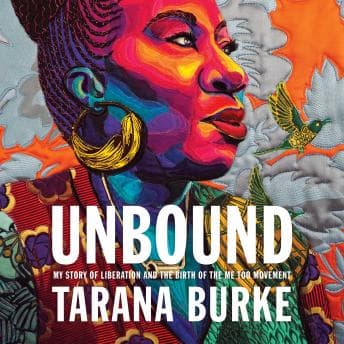

"My soul split in two."
I was standing over a pot of dal when Burke said that — this quiet, matter-of-fact description of how a child's psyche fractures under the weight of sexual trauma. Not dramatic. Not performed. Just stated, the way you'd describe weather. And I had to put the spoon down.
The protagonist exhibits classic dissociative identity patterns, except this isn't a protagonist. This is Tarana Burke, telling you what happened to her in her own voice, and the psychology of it is so precisely rendered that I kept forgetting this wasn't a clinical case study. It's a life.
The Architecture of a Fractured Self
What makes Burke's story psychologically remarkable isn't the trauma itself — though it's devastating — it's how clearly she maps the architecture of her coping mechanisms. She describes creating two selves: the bright, intellectually hungry Bronx girl raised on Black literature and power, and the "bad" girl drowning in shame who believed she was a rule breaker, not a victim. This is textbook splitting. The research actually shows that children who experience sexual assault frequently develop exactly this kind of compartmentalized identity as a survival strategy. But Burke doesn't need my jargon. She just shows you what it felt like from the inside.
And here's where it gets interesting from a narrative psychology perspective. Burke doesn't present her healing as linear. She talks about the young women she worked with — Heaven, Diamond, others whose stories she carries — and how helping them forced her to confront what she'd buried. I found myself asking: why does Burke frame her own healing as something that happened through community rather than individual therapy or self-reflection? Because that's a fundamentally different model of recovery than what most Western self-help books sell you. It's relational. It's collective. And honestly, it's more psychologically sound than "journal your way to wholeness" advice.
The section where she recounts young people trusting her with their painful stories while she hadn't yet processed her own — that's a pattern I've seen in research on helping professionals. The helper who hasn't healed. It's not sustainable, and Burke knows it. She doesn't romanticize it.
When the Author IS the Narrator (And Why It Matters Here)
Burke reads this herself, and I want to be specific about what that means for this particular book. There's a rawness to author-narrated memoirs that professional narrators can't replicate, but it's a trade-off — you sometimes lose vocal range or pacing consistency. Here, the trade-off is entirely worth it. Burke's delivery is unfiltered in a way that serves the material. When she describes shame, her voice doesn't perform shame — it carries it. There's a difference. You can hear the places where the words cost her something.
She's not a trained voice actor, and you'll notice that. The pacing is sometimes uneven, and there aren't dramatic vocal shifts between sections. But this is a memoir about a woman learning to speak her truth out loud. Having her literally speak it? That's not a production choice. That's the whole point.
At seven hours, this is a focused listen. Not bloated, not padded with filler chapters about the movement's viral moment that you already know about. Burke spends surprisingly little time on the 2017 hashtag explosion. The bulk of this book lives in the Bronx, in her childhood, in the community organizing work that preceded the cultural moment by over a decade. Which — psychologically — is the right choice. The movement was the symptom. The wound was the story. The same principle — that the visible event is never really the story — is what makes The Feather Thief so unexpectedly compelling as a psychological portrait: the heist is almost beside the point once you start asking what kind of person does this and why.
Who This Is Actually For (And a Content Warning That Matters)
I need to be direct: this book contains descriptions of sexual assault and violence. If you're a survivor, Burke's frankness might be exactly what you need to hear, or it might be too much right now. Only you know. My therapist would have thoughts about the way Burke models giving yourself permission to not be okay yet — it's genuinely one of the healthier frameworks I've encountered in memoir.
This is for anyone who studies how identity forms under pressure. For people who want to understand the Me Too movement as something that started in community rooms with Black and brown girls long before it hit Twitter. For readers who are tired of sanitized trauma narratives that skip straight to the "empowered" ending.
It is NOT for background listening. Don't put this on while you're doing dishes. It deserves — and demands — your full attention.
The Case Study I Didn't Expect to Find in Myself
I started this book as a researcher and finished it doing something I rarely do: sitting with my own stuff. Burke has this way of describing shame that bypasses your intellectual defenses. As someone who studies how stories shape identity for a living, I should've seen that coming. I didn't.
The author understands human nature — specifically, she understands that empathy isn't a personality trait. It's a practice. And sometimes you have to learn it by offering it to yourself first, which is the hardest version of the assignment.
(Maa, if you're reading this, no, I don't need to talk about it. But maybe buy the book.)









