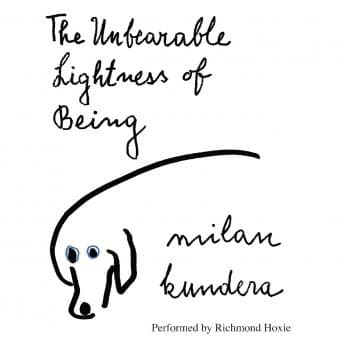

Kundera doesn't want you to escape into his novel. He wants you to think alongside it.
I finished this one during a particularly brutal stretch of late-night grading - essays on The Great Gatsby, if you can believe the irony - and kept pausing the audiobook to stare at the ceiling. Not because I was bored. Because Kundera had just said something that made me reconsider everything I thought I understood about choice, about love, about whether any of our decisions actually matter. This is why we still read the classics. This is exactly why.
The Philosopher Who Happens to Tell Stories
Here's the thing about Kundera that separates him from almost every other novelist I've taught or listened to: he refuses to hide behind his characters. He interrupts his own narrative constantly. He'll be deep in Tomas's tortured relationship with Tereza, then suddenly pull back and say - essentially - "Now let's talk about what eternal return really means and why Nietzsche got it wrong." My students would hate this. I love it.
The prose deserves to be savored, and at 9 hours and 38 minutes, you get plenty of time to do exactly that. Kundera moves between Prague and Geneva and a forgotten Bohemian village, between the farcical and the elegiac, between Tomas's compulsive womanizing and Tereza's dreams of death. It's not a plot-driven book. It's an idea-driven book that happens to contain people you'll care about despite - or maybe because of - how thoroughly Kundera dissects them.
The central question haunts you: if we only live once, does anything we do have weight? Or is existence unbearably light precisely because we can never go back and choose differently? Worth pausing the faculty meeting for. Worth pausing everything for.
Richmond Hoxie Understands the Assignment
I'll admit I was skeptical. Kundera's philosophical digressions require a narrator who can shift between intimate storytelling and almost academic meditation without making either feel false. Hoxie pulls this off through tempo and inflection rather than dramatic performance - and it works. His voice is mellow, unhurried. He doesn't try to compete with the ideas. He serves them.
The narrator understands that pause is punctuation. When Kundera shifts from Sabina's artistic betrayals to Franz's earnest, doomed fidelity, Hoxie adjusts his pacing just enough that you feel the tonal change before you consciously register it. Character differentiation is subtle - this isn't a full-cast production with distinct voices - but it doesn't need to be. The book lives in its ideas, and Hoxie lets them breathe.
I listened at 1.0x because - as I keep telling my students who speed-listen to everything - the author chose those words. Kundera's sentences have rhythm. Speeding them up would be like fast-forwarding through a jazz solo.
This Isn't Beach Reading (And That's the Point)
Let me be honest: this requires focus. Real focus. I tried listening while walking the lakefront with Denise one Saturday morning and had to restart an entire section because I'd been half-watching the runners and missed Kundera's meditation on kitsch. This isn't background listening. This is sit-down-and-pay-attention listening. Cat's Cradle demanded the same kind of focus from me - Vonnegut's philosophical games require you to track multiple layers at once.
The sexual content is frank - Tomas's affairs aren't euphemized - and the political backdrop of Soviet-era Czechoslovakia threads through everything. If you loved The Joke or Life Is Elsewhere, this is Kundera at his most ambitious. If you've never read him, be prepared for a novelist who treats you like an intellectual partner rather than a passive consumer.
Who Should Listen (And Who Should Skip)
Skip this if you're looking for plot momentum. Skip it if you want your fiction to stay inside the story. Skip it if you find philosophical tangents pretentious rather than illuminating. Fair enough. But if you've ever stayed up too late arguing about free will or whether love is choice or fate - if you've ever wondered whether your life would feel heavier if you could live it twice - this book will get under your skin and stay there.
The Kind of Book That Teaches You How to Read It
I've assigned Kundera to AP Lit students exactly once. The results were... mixed. But the three kids who got it? They really got it. That's what this novel does - it divides readers cleanly. You either find the philosophical intrusions tedious, or you realize they're the entire point.
This reminds me of what Hemingway said about writing - that the dignity of movement of an iceberg is due to only one-eighth of it being above water. Except Kundera does the opposite. He shows you the whole iceberg, explains its composition, then asks whether icebergs can truly exist if we only see them once. That kind of meta-textual playfulness - the author as visible architect - is what makes Cat's Cradle work too, though Vonnegut's version comes with more dark humor and less European melancholy.
My mom definitely fell asleep during this one. But for the 47 people who listen to my podcast about classic literature, and for anyone else who believes great novels should make you uncomfortable in the best possible way - this is essential. The 1984 critics were right. Twenty years later, forty years later, it's still a modern classic. And Hoxie's narration does it justice.