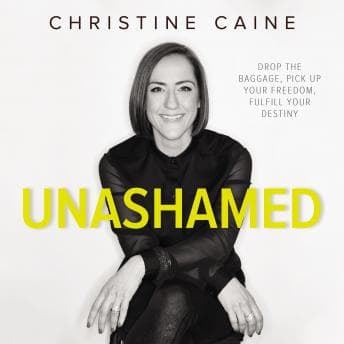

Shame is the most clinically fascinating emotion because it doesn't just sit there—it rewires how you see yourself, how you move through the world, how you interpret every sideways glance from a stranger. I know this from the research. Christine Caine knows this from living it.
I started this one on a Saturday morning while making chana masala from scratch—the kind of elaborate cooking project where you're grinding spices and pretending your life is together. And honestly, the pairing worked. There's something about the slow, meditative rhythm of cooking alone that opens you up to someone else's vulnerability. Caine's book hit differently in that space than it would have on a jog.
The Psychology of Shame, Filtered Through Scripture
Here's what I found myself asking: why does a book positioned as faith-based self-help actually land harder than most secular shame literature? And I think the answer is that Caine doesn't intellectualize shame the way, say, Brené Brown does (and I love Brown's work, don't come for me). Instead, Caine goes autobiographical in a way that's almost uncomfortably raw. She talks about being adopted, about abuse, about discovering family secrets that restructured her entire identity—and she doesn't wrap those revelations in clinical distance. She just... tells you. That particular kind of unguarded autobiographical honesty is something I also found in Educated, where Tara Westover does the same thing—reconstructing a shattered identity without the safety net of clinical framing, just the raw material of memory.
The protagonist—because yes, I'm treating Caine as the protagonist of her own narrative, this is what I do—exhibits classic avoidant coping patterns that she gradually dismantles throughout the book. She describes how shame became her "constant companion from earliest memories," and psychologically, that tracks perfectly. Shame that embeds in childhood doesn't announce itself. It becomes the operating system. You don't notice it any more than you notice breathing.
What makes this compelling is that Caine isn't writing from the mountaintop of "I've healed and now let me teach you." The book has this quality of someone mid-process, still negotiating with her own shame while pointing others toward freedom. That's more honest than most self-help authors manage.
Where the Framework Gets Thin
But—and this is a significant but—the book leans heavily on biblical frameworks as its primary intervention strategy. If you're coming from a Christian worldview, this will feel like oxygen. If you're not, you'll find yourself filtering hard. Caine doesn't really offer secular tools alongside the scriptural ones. The research actually shows that shame reduction requires multiple cognitive approaches—reframing, exposure, self-compassion practices—and Caine mostly consolidates these under the umbrella of "God's truth about you."
For her intended audience? That probably works beautifully. For someone like me, trained to look for mechanism behind the message, I kept wanting her to explain why believing you're loved by God reduces shame activation in the brain. She gets the emotional logic right but doesn't bridge to the practical "how" as often as I'd like.
Also, at just under six hours, there are stretches where the motivational energy repeats itself. The same core message—you are not your past, God has a purpose for you, shame is a liar—gets restated in slightly different packaging across multiple chapters. I found myself wishing she'd spent more time in the specific stories and less time in the inspirational reframing.
Jay O'Shea Behind the Mic
So here's the thing about narrating someone else's deeply personal memoir: it's a weird ask. Christine Caine didn't narrate this herself, which means Jay O'Shea had to channel someone else's trauma and triumph without making it feel like a performance. And she mostly succeeds. O'Shea's delivery is warm, steady, emotionally present without tipping into melodrama. She handles the heavier passages—the abuse disclosures, the identity revelations—with appropriate weight.
That said, I don't have a lot of specifics on O'Shea's vocal range here because this isn't a character-driven novel. It's one voice, one perspective, one sustained emotional register. She does it well. But "well" is about the ceiling for narrating a single-voice inspirational nonfiction book. There's no opportunity for the kind of vocal fireworks that would push a narrator rating higher.
Who This Is Actually For (Honest Version)
If you're a Christian woman processing shame—whether from abuse, family dysfunction, perceived failure, church-inflicted guilt—this book was written with your name on it. Caine gets it. She's not theorizing about your experience; she's been inside it.
If you're looking for a psychological framework for shame that's evidence-based and secular, this isn't your book. Try Brené Brown or look into Kristin Neff's self-compassion work instead.
If you're somewhere in between—curious about faith-based approaches, open to filtering the message through your own lens—you'll find genuine insight here, wrapped in more evangelical packaging than you might expect.
My Therapist Would Appreciate the Honesty, If Not the Methodology
This is a fascinating case study in how personal narrative can function as both testimony and therapeutic intervention. Caine is doing something psychologically real here, even if she wouldn't frame it in those terms. She's modeling vulnerability as a shame-reduction strategy—showing that naming the thing strips it of power. The research backs that up completely, regardless of whether you frame it as psychology or faith.
I just wish the book trusted its own stories more and its motivational refrains less. The raw moments are where the healing lives. The rest is scaffolding.