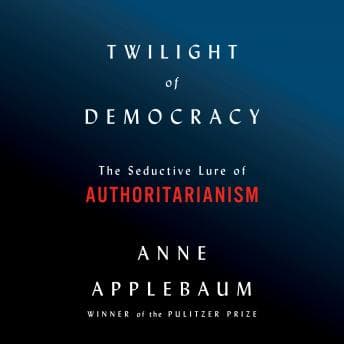

Five hours of listening to Anne Applebaum explain why her dinner party friends turned into authoritarians, and I'm still not sure if this is brilliant political analysis or the world's most intellectual grudge match.
Let me cut to the chase. This isn't the sweeping historical treatise the title suggests. It's personal. Deeply personal. Applebaum opens with a New Year's Eve party she threw in 1999 at her Polish manor house—yes, manor house—and spends much of the book tracking what happened to those guests. Some remained liberal democrats. Others became propagandists for Poland's nationalist government or Brexit cheerleaders or Trump apologists. The question driving everything: how did smart, educated people who once shared her worldview end up on the other side?
When Intel Becomes Personal
I was driving back from a client site in Houston when this really hit me. Applebaum isn't just analyzing authoritarianism from an academic distance—she lost friends to it. Real friends. People she'd known for decades. And you can hear it in her voice when she narrates certain passages. There's a controlled frustration there, maybe even grief.
The book jumps between Poland, Hungary, Britain, Spain, and the US, tracking what she calls the "clercs"—intellectuals and media figures who provide cover for authoritarian movements. Her thesis is that these people aren't stupid or evil. They're seduced by the simplicity of nationalist narratives, or they're resentful of being passed over for recognition, or they just want to belong to something that feels like winning.
Now here's where some listeners get irritated, and I understand why. Applebaum defines authoritarianism pretty loosely. If you're expecting a rigorous political science framework, you'll be disappointed. She's essentially saying "these movements I disagree with are authoritarian" without always demonstrating why they meet that specific threshold versus just being... conservative policies she finds distasteful. That's a legitimate criticism.
The Author-Narrated Gamble
Applebaum reading her own work is a mixed bag. On one hand, nobody understands the material better. When she discusses her personal relationships with Polish politicians or British journalists, there's an authenticity you wouldn't get from a professional narrator. On the other hand, she's not a voice actor. The pacing is steady but rarely dynamic. At just over five hours, it's a quick listen—I knocked it out in two days of driving—but there were stretches where I wished for more vocal variety.
What works is her clarity. This woman has spent decades explaining complex Eastern European politics to Western audiences, and it shows. When she breaks down how Hungary's Orbán consolidated power or how Poland's Law and Justice party captured the judiciary, she's genuinely illuminating. I've briefed generals who couldn't explain things this clearly.
The Hodgepodge Problem
Here's what lost me at times: the structure feels like a series of connected essays rather than a unified argument. She'll be deep into Spanish politics, then pivot to a meditation on nostalgia, then circle back to that 1999 party. Some listeners call it a "hodgepodge," and they're not wrong. But I'd argue that's partly the point—authoritarianism doesn't follow a neat narrative either. It bubbles up in different places for different reasons.
The strongest sections are the most personal. When she describes sitting across from a former friend who now works for a nationalist TV network, wondering how to navigate the conversation, that's real. When she analyzes why certain personality types are drawn to conspiracy theories and simple answers, she's drawing on decades of observation. Caste tackles similar questions about why people cling to hierarchies that hurt them, though Wilkerson's framework feels more rigorous.
The weakest sections are when she tries to universalize too quickly. Not every populist movement is the same, and lumping Brexit voters with Orbán's inner circle sometimes feels like a stretch. I had similar frustrations with oversimplification in Thank You for My Service, though Mattis at least kept his scope tighter.
Who Should Deploy This
If you've got Pulitzer Prize expectations, adjust them. This is a personal essay that uses history, not a history book. It's for listeners who want to understand the psychological appeal of authoritarianism—why smart people choose it, how friendships fracture over politics, what it feels like to watch your world realign.
Skip it if you want both-sides analysis. Applebaum has a clear point of view, and she's not pretending otherwise. If you're looking for her to steelman the nationalist position, you'll be waiting a long time.
At 1.25x speed, this is a solid afternoon. Ranger slept through most of it, which I take as neutral commentary.
Debrief
Worth your time? It's a smart, flawed, deeply personal book about how democracies rot from within. Applebaum clearly did her homework on the historical parallels, even if her definitions get slippery. The author narration adds authenticity but lacks polish. For a five-hour listen on a drive through Texas, it gave me plenty to chew on—even when I disagreed with her framing.
Not a must-listen, but a worthwhile one if you're trying to understand why your uncle's Facebook posts got so weird after 2016.







![Steve Jobs [unabridged audiobook] audiobook cover](/_next/image?url=https%3A%2F%2Fcovers.audiobooks.com%2Fimages%2Fcovers%2Ffull%2F9788499923406.jpg&w=1920&q=75)