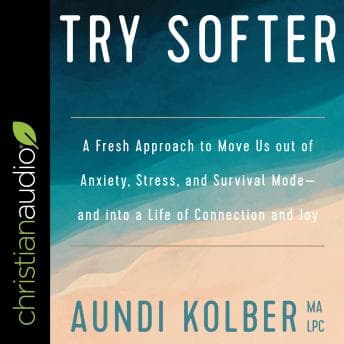

I was making chana masala at 10 PM on a Tuesday — the kind of elaborate cooking-for-one session my therapist would probably call 'self-soothing behavior' — when Aundi Kolber started talking about the window of tolerance, and I had to put down the wooden spoon. Because here was a licensed counselor narrating her own debut book, and she was essentially describing the psychological concept I've been trying to explain to undergrads for three semesters, except she was doing it in this voice so quiet and measured that my nervous system actually downshifted in real time. That's not a metaphor. I literally felt my shoulders drop.
When the Self-Help Book Actually Understands the Self
Here's my problem with most pop psychology self-help: the character motivations don't track. Authors tell you to 'just breathe' or 'practice gratitude' as if the human brain is a misbehaving golden retriever that needs a firmer command. Kolber doesn't do this. She grounds her framework in attachment theory, polyvagal theory, and somatic experiencing — the stuff I actually cite in my research papers — and she does it without turning the book into a neuroscience textbook. The 'try softer' concept is essentially about moving from a hypervigilant, white-knuckled survival mode into what she calls compassionate attention. It's the difference between forcing yourself through pain and learning to notice what your body is already telling you.
What makes this genuinely useful rather than just theoretically interesting is how Kolber weaves in her own trauma history. She's not hiding behind clinical distance. When she talks about her own attachment wounds and the way she learned to overfunction as a coping mechanism, you hear it in her delivery — this slight catch, a deliberate pause before the harder revelations. It's not performed vulnerability. It's the real thing. And as someone who analyzes how people construct identity through narrative, I found myself asking: why does this particular combination of personal disclosure and clinical knowledge work so well? I think it's because she's modeling the very thing she's teaching. She's trying softer in the telling.
The Quietest Audiobook That Might Actually Rewire Something
Now, about that narration. Kolber reads her own work, and her voice is — I'm going to be honest — almost alarmingly soft. If you're used to audiobooks with dramatic energy or vocal variety, this will feel like someone turned the volume dial way down on purpose. There's no character differentiation to speak of (it's nonfiction, so that's expected), and the pacing is gentle to the point where, at 1x speed, it felt like being slowly walked through a meditation rather than a book.
But here's the thing: for this specific content, it works. The book is asking you to slow down, to notice, to stop bulldozing through your emotional landscape. Having someone bark that at you in an energetic narrator voice would be — psychologically speaking — completely counterproductive. The softness IS the pedagogy. I did bump it to 1.25x for a few stretches in the middle where the clinical exercises got repetitive (there are several 'try softer' prompts that feel similar to each other), and that speed felt right.
Compared to something like Bessel van der Kolk's The Body Keeps the Score — which covers overlapping territory on trauma and somatic experience but with much more clinical density — Kolber's book is warmer, more accessible, and frankly more compassionate. Van der Kolk gives you the research. Kolber gives you the research AND holds your hand while you sit with what it means for your life. The trade-off is depth: if you want rigorous neuroscience, this isn't your book. If you want someone to help you understand why you've been clenching your jaw for twenty years and what to do about it, this might be exactly right.
The Faith Element (Let's Talk About It)
I should flag this: there's a Christian framework woven throughout. God designed your body this way, God wants you to heal, etc. As someone who approaches psychology from a secular research perspective, I noticed it. It didn't derail the practical content for me — the attachment theory is solid regardless of the spiritual framing — but if faith-based language actively bothers you, you'll bump against it regularly. If it resonates with your worldview, it'll probably deepen the experience significantly. Just know what you're getting. On that note, I did skim through Unshakable Hope at one point — the faith-and-healing overlap is real, though the psychological rigor isn't quite in the same league.
Who Should Listen (And Who Should Keep Scrolling)
This is for the person who's read all the productivity books, tried all the hustle frameworks, and is sitting in their car in the parking lot at work wondering why they feel nothing. It's for people who know something is off but have been too busy surviving to figure out what. If you're looking for a thriller-paced listen or hard-hitting data dumps, skip this. If you need someone to gently tell you that your nervous system deserves better — and explain the science behind why — put this on during a quiet evening. Alone. With something simmering on the stove.
My Clinical Assessment
The research actually shows that the messenger matters as much as the message in therapeutic contexts, and Kolber narrating her own work is the right call. At just under six hours, it doesn't overstay its welcome. It's not groundbreaking for anyone already deep in trauma-informed psychology, but as an entry point — as a first book for someone who's been white-knuckling everything — it's compassionate, grounded, and surprisingly well-constructed. My therapist would approve.