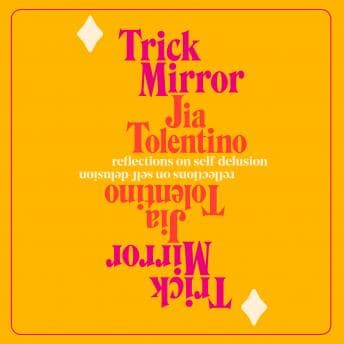

"The internet is an engine of self-expression that runs on self-delusion."
That line hit me somewhere around hour three, and I had to pause my run to just... sit with it. Look, I came into this expecting a cultural criticism book I could mine for insights about millennial workplace dynamics. What I got was a 10-hour therapy session I didn't ask for but probably needed.
The ROI on Self-Awareness
Here's the thing about Jia Tolentino - she's doing something that most business books pretend to do but don't. She's actually being honest about the incentive structures that shape behavior. The essay on optimization culture? That's basically every McKinsey deck I've ever written, except she's pointing out that the whole system is designed to extract maximum productivity from people while convincing them it's "self-improvement." I've literally sold this framework to clients. Reading this felt like being gently called out by someone who sees through the game.
The scammer essay alone is worth the credit. That same dissection of systems designed to extract value shows up in Tower Lord, though Tolentino's doing it with venture capital instead of feudal politics. She traces a line from Fyre Festival to WeWork to the entire gig economy, and suddenly you realize - oh, the con isn't the exception. The con is the business model. I've sat in boardrooms with founders who talk exactly like the people she's describing. The difference between "visionary" and "scammer" is basically just whether the money runs out before the exit.
When the Author Reads Her Own Work
Tolentino narrates this herself, and it's the right call. Her voice has this quality - smart but not smug, which is harder than it sounds for a New Yorker writer. She reads at a pace that works at 1.5x (I couldn't do my usual 2.0x - the sentences are too dense, too many ideas per paragraph). There's a warmth there that keeps the cultural criticism from feeling like a lecture.
Some people find her delivery too casual, too conversational. I get that. But honestly, after years of listening to business audiobooks narrated by guys who sound like they're reading a terms of service agreement, casual is refreshing. She sounds like she's thinking through these ideas in real time, which - given that these are essays about self-delusion - feels appropriate. We're all figuring it out as we go.
The Parts My Parents Would Recognize
The essay on the wedding industrial complex made me think about my parents' wedding in Korea. Thirty guests, a church basement, my grandmother's cooking. No Pinterest boards, no "curated aesthetic," no $40,000 average spend. Tolentino's point isn't that weddings are bad - it's that we've built systems that make it nearly impossible to opt out of the performance. The same structures that sell us "authenticity" are the ones profiting from our participation.
This is what my parents did instinctively - they just... didn't play the game. Not because they were enlightened, but because they couldn't afford the entry fee. Tolentino makes you realize that what looks like choice is often just another form of compliance.
Where It Drags
I'll be honest - the essay on heroines in literature lost me. It's well-written, but it's also clearly for people who read more fiction than I do. I found myself zoning out, checking my pace, wondering if I should skip ahead. The book is uneven in that way - some essays feel immediately applicable, others feel like they're for a different audience.
The religion essay at the end is surprisingly personal and surprisingly good. Tolentino grew up evangelical in Houston, and she writes about faith with the kind of specificity that comes from lived experience. It's not a business book chapter, but it's maybe the most honest thing in the collection.
The Exit Interview
This isn't a productivity book. There's no framework, no action items, no "5 steps to avoid self-delusion." What there is: a smart person thinking carefully about why we do what we do, and whether the stories we tell ourselves are actually serving us.
I finished this three weeks ago and I'm still thinking about the optimization essay. That's the test, right? Not whether a book gives you something to implement on Monday, but whether it changes how you see the systems you're already operating in.
Jenny asked what I was listening to and I said "a book about why everything is a scam, including self-improvement." She said, "So... your autobiography?" She's not wrong.
Who should listen: Anyone who works in consulting, marketing, or tech and has started to suspect the whole thing might be a bit of a con. Also anyone who's ever felt exhausted by the performance of being a person online.
Who should skip: If you want actionable takeaways and a clear thesis, this will frustrate you. It's essays, not arguments. The insight is in the observation, not the prescription.
All 9 hours and 46 minutes of it. My 2.0x speed couldn't handle this one - and I mean that as a compliment.