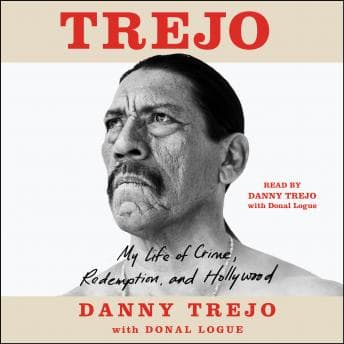

I was up at 2 AM finishing a logo revision I'd been putting off for days, both cats asleep on the back of my chair like furry gargoyles, and Danny Trejo was telling me about shooting heroin in his uncle's car as a kid. And I just — stopped designing. Sat there in the glow of my monitor with my stylus in my hand doing absolutely nothing because this man's voice was pulling me somewhere I couldn't multitask through.
Let me be real: this is not a book I would've picked up on my own. Memoir about a tough-guy action star? Not my usual vibe. But a friend sent me the Audible link with the message "trust me, you'll cry," and honestly? She was right. Three times. I kept the spreadsheet updated.
Danny Trejo Sat Down Next to Me and Just Started Talking
That's what this audiobook feels like. Not a polished celebrity memoir read by some honey-voiced narrator in a professional booth. This is Danny — gravelly, unhurried, sometimes stumbling slightly over a transition — just telling you his life. And that roughness? It's the whole point. When he describes being in solitary confinement at Soledad and finding something like peace through recovery, the slight crack in his delivery isn't an acting choice. It's a man remembering.
Donal Logue handles some of the narration too, and the shift between their voices creates this interesting rhythm — like Danny's telling you the raw version and Logue is smoothing the edges for context. It works better than it should. Danny's not a professional narrator and you can tell, but I genuinely think a polished performance would've ruined this. His voice carries the weight of every prison yard, every needle, every role he almost didn't get to play. You don't need vocal range when you have that kind of lived authority.
I listened at my usual 1.0x and I'm glad I did. There's a heaviness to certain sections — the abuse from his father, the spiral into addiction starting so impossibly young — that needs room to breathe. Speeding through Danny talking about watching men die in San Quentin feels wrong. Like fast-forwarding through someone's confession.
The Part Where Abuela Would've Clutched Her Rosary (and Then Kept Listening)
Here's where this book wrecked me: the contradiction at the center of Danny's life. He goes around the country — prisons, rehab centers, NPR studios — telling people recovery is possible. He's proof. He's the poster child. And then he comes home and watches his own kids struggle with the same addiction that almost killed him, and he can't fix it. He can inspire ten thousand strangers but he can't save his own family from the thing that runs in their blood.
That broke me open. Because it's so honest. A lesser memoir would've wrapped that up with a bow — "and then my kids got sober too and we all went to Trejo's Tacos and hugged." Danny doesn't do that. He sits in the mess of it. He admits he doesn't have the answer. That refusal to tidy up a complicated life is something I keep finding in the best memoirs — Eisenhower in War and Peace does it too, sitting unflinchingly in the gaps between the legend and the man without ever trying to reconcile them neatly. And hearing that admission in his actual voice, this tough guy who's been killed a hundred times on screen, admitting he's helpless against his children's pain?
My heart. MY HEART.
Abuela would have loved this one. She had a thing for men who'd been through hell and came out praying. She would've lit a candle for Danny Trejo and then asked me to replay the part about him meeting a serial killer in prison because — telenovela instincts never die.
Not Everything Lands Perfectly
The Hollywood chapters are the weakest stretch. Once Danny starts name-dropping — De Niro, Bronson, the Heat set — the energy shifts from confessional to anecdotal, and some of those stories feel like they've been told at too many dinner parties. You can almost hear the crowd-pleasing rhythm in his delivery during those sections versus the raw, searching quality of the prison and recovery chapters. At 13 hours, there are stretches in the middle where I did drift back to designing, which tells me the pacing gets a little loose when we're in full "and then I was in another movie" mode.
But here's the thing — even those sections have these little moments of vulnerability tucked in. Danny talking about imposter syndrome on professional film sets. Danny wondering if people see an actor or an ex-con. Those details saved it for me every time.
Who This Is For (and Who Should Skip)
If you need a narrator with crisp diction and dramatic range, this will frustrate you. If you want a tightly edited, three-act structure, look elsewhere. But if you want to sit with a real person who's done terrible things and beautiful things and is trying to make sense of both — at 2 AM or 2 PM or whenever your life gets quiet enough to really listen — this book felt like being trusted with someone's whole truth. That's rare.
I ugly-cried at the parts about his kids. Not the prison scenes, not the near-death moments. The parts where Danny Trejo, Machete himself, sounds like a dad who doesn't know how to stop the people he loves most from hurting themselves. That's the scene that'll stay with me.
Diego knocked my water glass off the desk during one of those crying jags, which felt appropriate. Even my cat wanted me to pull it together.






![Steve Jobs [unabridged audiobook] audiobook cover](/_next/image?url=https%3A%2F%2Fcovers.audiobooks.com%2Fimages%2Fcovers%2Ffull%2F9788499923406.jpg&w=1920&q=75)