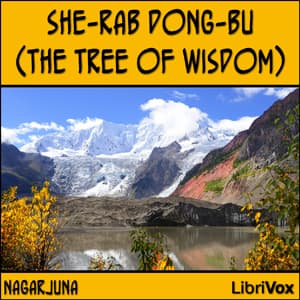

I've been teaching Buddhist philosophy in my World Literature unit for fifteen years. Nagarjuna is the real deal - the "second Buddha" according to Tibetan tradition, a founder of Madhyamaka thought, the kind of figure whose influence echoes through centuries of Asian philosophy. So when I saw this audiobook pop up during a late-night grading session, I thought: perfect. Ninety-four minutes of ancient wisdom while I mark essays on The Great Gatsby. What could go wrong?
Everything. Everything could go wrong.
When the Vessel Cracks
Let me be clear about something: the text itself is extraordinary. The She-rab Dong-bu is ethical poetry translated from Sanskrit to Tibetan around the 11th century - we're talking about wisdom that's survived a thousand years of transmission, copying, translation. The original Sanskrit is lost. What we have is precious.
But here's the problem. This is a text saturated with Tibetan and Sanskrit terminology. Names, concepts, philosophical terms that carry specific weight and meaning. I've heard similar struggles with ancient terminology in Bible (KJV) 01-03: Genesis, Exodus and Leviticus, though at least there the narrator seemed to have rehearsed the proper nouns. Chris Masterson - I'm sure he's a fine narrator for other projects - simply cannot handle them. The listener reviews aren't exaggerating when they describe him "flailing and struggling." Every time a Tibetan or Sanskrit word appears, there's this audible hesitation, this stumble that yanks you right out of contemplation.
I teach teenagers. I know what it sounds like when someone is reading aloud without having practiced first. This sounds like that.
The Tragedy of Access
Here's what frustrates me most: this is a LibriVox recording, which means it's free, which means it's accessible to anyone curious about Buddhist philosophy. Beautiful in theory. In practice? No editorial oversight, no pronunciation coaching, no second takes with a director saying "Let's try that Sanskrit term again."
The She-rab Dong-bu deserves to be savored. These are verses about wisdom, ethical conduct, the nature of mind. Nagarjuna wasn't writing entertainment - he was writing instruction. That instructional clarity is what makes Spiritual Exercises work so well—another ancient wisdom text that demands precision in delivery. And instruction requires clarity. When the narrator trips over "Prajnya Danda" or mangles Tibetan syllables, the meaning doesn't just blur. It evaporates.
I found myself stopping the audio repeatedly to look up terms, trying to figure out what he was attempting to say. That's not meditation. That's homework.
At Ninety-Four Minutes, What's the Ask?
This is barely longer than a feature film. It should be an easy, contemplative listen - something you could absorb on a long walk along the lakefront, letting ancient wisdom settle into your bones. Instead, I finished it feeling more agitated than when I started.
The brevity is actually part of the problem. With a longer audiobook, you might adjust to a narrator's quirks, find a rhythm despite the flaws. Here, by the time you've noticed the pronunciation issues, you're already a quarter through. There's no time to acclimate.
Who Should Seek This Tree (And Who Should Walk Past)
If you're already familiar with Nagarjuna's work and Buddhist terminology - if you can mentally autocorrect the mispronunciations because you already know what he's trying to say - this might serve as a free refresher. The text itself remains valuable.
But if you're new to Buddhist philosophy? If you're curious about this "second Buddha" and want an introduction? Skip this version. Find a print translation. Read W.L. Campbell's notes yourself. The prose deserves to be savored, and you deserve a narrator who can actually deliver it.
My students would probably appreciate the brevity. I can't appreciate much else.
Mr. Williams's Office Hours Verdict
Not worth pausing the faculty meeting for. And that pains me to say. Nagarjuna's wisdom has survived the loss of its original language, survived a millennium of transmission across cultures and continents. It deserves better than to stumble at the last mile - in the mouth of a narrator who wasn't prepared for what he was reading.
The tree of wisdom is still standing. This audiobook just isn't the right path to reach it.