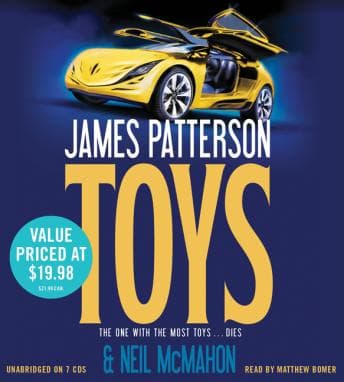

What happens when a character's entire identity collapses in a single revelation—and you can see it coming from chapter two?
I was making dal makhani at 10 PM, the kind of elaborate cooking that requires just enough attention that you need something engaging in your earbuds but not so complex you'll miss a step and burn the garlic. Toys seemed perfect for this. Fast-paced thriller, Matthew Bomer's voice (which, let's be honest, I'd listen to reading a phone book), and a premise that promised identity crisis on a grand scale. The protagonist exhibits classic narcissistic wounding when his perfect Elite life crumbles—or at least, he should.
Here's the thing: I study why people do terrible things to each other. I've spent years analyzing how fictional characters process trauma, reconstruct identity, and rationalize the unthinkable. So when a book promises me a man whose entire sense of self gets obliterated by a shocking truth, I'm expecting psychological meat. What I got was... well, a very pretty skeleton.
The Bomer Effect (Or: Why I Kept Listening)
Let me be clear—Matthew Bomer is doing Olympic-level heavy lifting here. His sultry lilt shifts into a drawled presidential voice so naturally that I actually stopped stirring my dal to pay attention. The French resistance fighter character? He gives her this seductive edge that made me briefly forget I was annoyed by the predictability of her eventual betrayal. (That's not a spoiler. You'll see it coming too. My therapist would have thoughts about this character's trust issues, but the writing doesn't give us enough depth to analyze.)
Bomer excels at creating distinct voices for the many people and androids Hays meets—and yes, there are androids, because this is a future where humans are basically toys for the genetically enhanced Elite. The class divide is instantly audible. His colleagues get these gruff, utilitarian grunts while the Elites speak with the kind of polished cadence that screams "I've never worried about money." It's a fascinating case study in how vocal performance can do world-building work that the text itself neglects.
Psychologically, This Doesn't Track
Hays Baker discovers he's not what he thinks he is. This should be devastating. The research actually shows that identity disruption of this magnitude typically triggers dissociation, denial, rage—a whole cascade of psychological defense mechanisms. Instead, Hays pivots to action hero mode with the emotional processing time of a microwave dinner.
I found myself asking: why does Hays really care about saving humanity? The book tells us he should, but it never shows us the internal work. He goes from hunting humans to championing them with barely a philosophical hiccup. Patterson and McMahon want us to accept that the switch flips because... plot requires it? The human mind has patterns. This isn't one of them.
At seven hours, Toys doesn't overstay its welcome. But it also doesn't earn its emotional beats. The wife, Lizbeth, exists primarily as motivation and betrayal device. The children are props. I kept waiting for someone—anyone—to have a genuine moment of psychological complexity, and Bomer kept delivering the lines like they contained depths the writing simply hadn't bothered to include.
Who Gets Something Out of This (And Who Won't)
If you want a mindless action romp with excellent voice acting, this works. For a long drive where you need something engaging but not demanding, Toys delivers. The pacing never drags. Bomer's warm voice makes even the clunkiest dialogue go down smooth. Cutting Season: A Novel delivers that kind of character work—messy motivations that actually track psychologically.
But if you're like me—if you need character motivations that make sense, if you want to understand why someone would betray everything they believed—skip this one. Or at least go in with adjusted expectations. This is popcorn, not a meal.
The comparison to James Bond and Jason Bourne in the description is... ambitious. Bond has decades of cultural mythology backing his flatness. Bourne's identity crisis is the entire point, explored with genuine tension. Patterson's NYPD Red 7: The Murder Sorority has the same issue—competent thriller mechanics without the psychological depth I crave. Hays Baker has Matthew Bomer, and honestly? That's almost enough.
The Case Study I Wanted vs. The One I Got
My dal turned out perfectly. The audiobook did not ruin it. This is perhaps the highest compliment I can pay Toys—it's competent background entertainment elevated by a narrator who deserved better material.
I finished it. I won't remember it in six months. But those seven hours passed pleasantly enough, and Bomer's performance made me curious about what else he's narrated. Sometimes that's the real takeaway: the book is forgettable, but the voice stays with you.