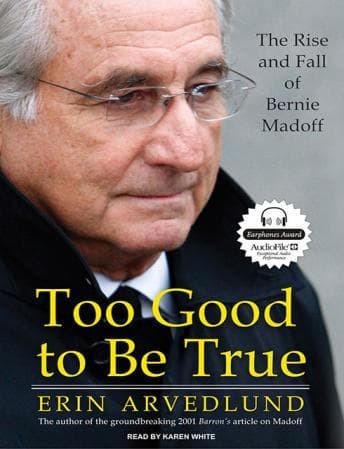

How do you steal sixty-five billion dollars and nobody notices?
That's the question I kept turning over during my Saturday morning grocery run - yes, I was listening to a book about financial fraud while squeezing avocados, because night shift brain doesn't turn off just because you're in a Fry's at 9 AM. And honestly? The parallels between Madoff's operation and what I see in healthcare bureaucracy kept hitting me in uncomfortable ways. Systems designed to catch problems. People whose literal job is oversight. And everyone just... not looking. Because looking would mean admitting something was very, very wrong.
The Journalist Who Called It Eight Years Early
Here's what makes Erin Arvedlund the right person to write this book: she wrote a Barron's article in 2001 - 2001! - based on over a hundred interviews, basically saying "Hey, nobody can explain how this guy's returns work, and that should scare you." The SEC did nothing. Nobody wanted to hear it. And that detail alone tells you everything about how Madoff operated for decades.
Arvedlund traces the whole arc from Madoff's unremarkable youth in Queens - indifferent student, no grand ambitions - to working for his father-in-law, to eventually chairing NASDAQ. She maps the network of feeders like Walter Noel at Fairfield Greenwich and Ezra Merkin at Gabriel Capital, people who collected fat commissions and conveniently never asked hard questions about where the returns came from. The book doesn't let them off the hook, which I appreciated. The "I had no idea" defense gets the scrutiny it deserves.
What stuck with me is how Madoff weaponized exclusivity. He played hard to get. Made people feel lucky to give him their money. And then he kept them at arm's length so they couldn't peek behind the curtain. As someone who works in a system where we question every order, every dosage, every deviation from protocol - the idea that these supposedly sophisticated investors just... trusted blindly? It made my blood pressure rise in the produce aisle.
When the Spreadsheets Hit Different
Look, I'm a nurse, not a finance person. My investment strategy is basically "contribute to my 401k and pray." But Arvedlund does something smart here - she breaks down the financial mechanics without making you feel stupid. The Ponzi structure, the fake trade confirmations, the split-strike conversion strategy that nobody could replicate because it didn't actually exist. At 13 hours, this is a substantial listen, and there are stretches in the middle where the web of feeder funds and offshore entities gets dense. Really dense. I won't lie - around hour seven, somewhere between the Fairfield Greenwich chapter and the European connections, my eyes glazed a little and I had to rewind.
But then she'll drop something like the detail about SEC investigations that repeatedly failed to catch the fraud even when people literally walked in and said "this is a Ponzi scheme" - and you're right back in it, furious all over again. The institutional failure here is staggering. It's like if a nurse told a doctor "this patient is coding" and the doctor said "nah, his chart looks fine" and walked away. Multiple times. For years.
Karen White narrates with this steady, broadcast-reporter cadence that works perfectly for material this infuriating. She doesn't dramatize. She doesn't need to. The facts are dramatic enough. Her tone stays level even when describing the charities that lost everything, the retirees who had nothing left, and that restraint actually made those sections hit harder. No vocal theatrics - just clean, clear delivery that lets the horror of what happened speak for itself. I never once got confused about who was being quoted or which entity she was discussing, which in a book with this many players and institutions is no small thing.
Who This Is Really For
If you want a true crime audiobook that's about money instead of murder - this is it. If the phrase "regulatory capture" makes you want to throw things, you'll find plenty of fuel here. If you need every chapter to move at thriller speed, the middle third might test your patience. The financial detail is necessary but it's work. Speed it up to 1.25x during those stretches and you'll be fine.
My mom would love this. She still tells the story of her coworker who lost retirement savings in the Madoff collapse - a nurse, actually, who'd invested through one of the feeder funds. So this one's personal even though it's about Wall Street. Money crimes aren't victimless. Arvedlund never lets you forget that.
Charting My Final Note
Carlos asked why I was aggressively loading groceries into the car. I told him the SEC had one job. ONE JOB. My review of Acid for the Children has a similar energy - me processing something intense while the people around me slowly back away. He nodded and didn't ask follow-up questions. Smart man.
This is solid investigative journalism in audio form. Not flashy, not sensationalized, just a reporter who saw through the con before anyone else and then spent years documenting exactly how it worked and why nobody stopped it. Night shift approved - but save it for when you can actually pay attention. This one rewards focus.