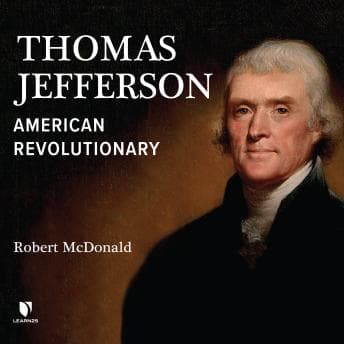

"He made more attempts than any other officeholder of his generation to end slavery. Yet he remained a slaveholder throughout his life."
That line hit me around hour two, and I had to pause my design work. Just sat there staring at Frida (the judgier of my two cats) while my brain tried to hold both truths at once. This is what Professor McDonald does throughout these seven hours—he refuses to let you simplify Thomas Jefferson into hero or villain. And honestly? It wrecked me in ways I wasn't expecting from a history lecture.
The Professor Who Talks Like Your Brilliant Friend at 2 AM
Here's the thing about Rob McDonald narrating his own work: you can hear the decades of obsession. This isn't some actor reading words someone else wrote. When he explains Jefferson's complicated relationship with religious freedom, there's this energy in his voice—like he's genuinely excited to share this puzzle he's been turning over for years.
The format is weird, I'll admit. It's somewhere between audiobook and podcast, structured as 15 lectures. At first I was like, wait, am I back in college? But it works. It really works.
McDonald doesn't do dramatic voices or theatrical pauses. He's just... teaching. And somehow that's more engaging than most narrators trying to "perform" for me. His expertise comes through in the confidence of his delivery—he'll make a claim about Jefferson's motivations and you believe him because you can tell this man has read every letter, every journal entry, every scrap of paper Jefferson ever touched.
Abuela Would Have Had OPINIONS
I kept thinking about my grandmother while listening to this. She had zero patience for hypocrisy—would call it out in telenovelas, in politicians, in family members who thought they were slick. Jefferson would have driven her absolutely crazy. This man wrote "all men are created equal" while owning over 600 enslaved people throughout his lifetime. McDonald doesn't shy away from this. He doesn't try to excuse it or erase it. He contextualizes it—explains how Jefferson was "a man of his times"—but never in a way that feels like a get-out-of-jail-free card.
Around hour five, there's this section about Sally Hemings that I had to listen to twice. McDonald handles it with the gravity it deserves while also acknowledging how much we still don't know, how much was deliberately obscured. My heart. MY HEART. The way he talks about the historical record—what's there, what's missing, what we have to read between the lines—felt like grief work somehow.
This Is a Rainy Sunday Book (But Make It Homework)
I'm gonna be honest: you can't half-listen to this. I tried to keep designing while it played and kept missing crucial connections. This needs your focus. The 15-lecture structure actually helps—each one is about 25-30 minutes, so you can treat them like episodes. I'd finish a lecture, do some design work, then come back for the next one.
The hybrid format means there's no music, no sound effects, no production tricks. Just him talking. For some people that might feel dry. For me, it felt intimate. Like sitting in on a really good office hours session with a professor who actually wants you to understand.
Who Gets to Be Complicated?
Here's what kept hitting me: we extend so much grace to certain historical figures. We allow them contradictions, growth, context. McDonald is clearly wrestling with this throughout—you can hear him trying to be fair while also being honest. He's not here to tear down Jefferson or build him up. He's here to show you the whole messy human. That same commitment to complexity—showing historical figures as fully human rather than cardboard cutouts—is what made Great Train Robbery so satisfying.
I didn't cry during this one—it's not that kind of book. But I felt something shift in how I think about American history, about founding myths, about who gets remembered as "complicated" versus who just gets erased. That's worth something.
Skip If You Want Easy Answers, Stay If You Want the Mess
If you need Jefferson to be either hero or monster, this will frustrate you. If you hate lecture formats or need dramatic narration to stay engaged, look elsewhere. But if you're the type who listens to history podcasts while making dinner? If you want to feel smarter without doing the actual reading (me, always)? This is your jam.
McDonald's expertise is obvious, his delivery engaging without being performative, and seven hours is the perfect length—substantial enough to feel like you learned something, short enough that you'll actually finish. Just know it's designed as an educational product (part of the Learn25 collection), so adjust your expectations if you're coming from traditional audiobook storytelling.
Closing the Sketchbook on This One
Abuela would have listened to the whole thing just to argue with Jefferson across two centuries. Miss you, Abuela.