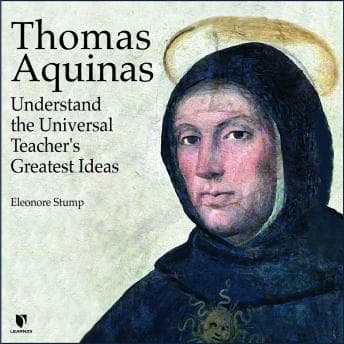

Okay, so here's my confession: I bought a philosophy course about a 13th-century theologian because I needed something that would keep me awake during charting at 3 AM but wouldn't spike my cortisol like another thriller. The irony of a night shift nurse turning to Thomas Aquinas for relaxation is not lost on me.
But honestly? This worked. Like, really worked.
When a Professor Actually Knows How to Teach
Eleonore Stump is the author AND the narrator here, and that combination is rare gold. Most academic audiobooks suffer from one of two problems: either the author reads like they're being held hostage by their own manuscript, or they hire a narrator who doesn't understand the material and mangles every technical term. Stump does neither.
Her voice has this warmth to it - and I don't throw that word around lightly. After 15 years of hearing every tone of voice humans can produce (panic, grief, relief, the specific pitch of someone lying about their pain level), I notice these things. She sounds like someone who genuinely loves this material and wants you to get it too. Not condescending, not rushed. Just... clear. The way a really good charge nurse explains a complex case to a new grad.
The pacing is deliberate but not boring. She'll walk you through something like Aquinas's view on human flourishing, break it down, then circle back to connect it to something she explained earlier. It's actual teaching, not just reading.
Philosophy for People Who Don't Have Time for Philosophy
Look, I'm not going to pretend I understood everything. Some of the metaphysics sections had me rewinding while my coffee got cold. But here's what surprised me - a lot of Aquinas's ethics stuff actually connects to what I see every night. His ideas about what makes a human life go well, about morality and free will and suffering? These aren't abstract questions when you're watching a family make impossible decisions at 4 AM.
Stump doesn't dumb things down, but she doesn't make you feel stupid either. She has this way of taking something that sounds impossibly complex - God's eternity, epistemology, whatever - and explaining it in steps that build on each other. My mom would absolutely love this, by the way. She's been on a spiritual reading kick since she retired, and this is the kind of thing she'd listen to during her morning walks and then call me to discuss. (She still thinks I should've been a doctor, but at least she's proud now.)
The course is under five hours, which is perfect. Long enough to actually learn something, short enough that you don't lose the thread between listening sessions.
The Religious Angle - Fair Warning
I should mention: this is explicitly about Christian philosophy. If you're looking for a secular philosophy course, this isn't it. Aquinas was a Dominican friar. His whole project was integrating faith and reason. Stump doesn't hide that or apologize for it - she just teaches it.
For me, that worked. I grew up Catholic (Filipina family, so - yeah), drifted away in my twenties, and now I'm somewhere in the middle. This course didn't feel like it was trying to convert me. It felt like it was trying to help me understand how one of history's smartest people thought about God, morality, and what it means to be human. Whether you agree with him is up to you.
Who This Is (and Isn't) For
If you're curious about Aquinas but intimidated by actually reading him - and honestly, medieval Latin translations are not beach reading - this is your entry point. Perfect for lapsed Catholics wondering what they actually believe, philosophy-curious folks who want substance without academic gatekeeping, or anyone who needs something mentally engaging but not anxiety-inducing for commutes or night shifts. Skip it if you want purely secular philosophy or if you're already deep into Thomistic studies - this is an introduction, not a deep dive.
Night Shift Approved
I listened to this mostly during my drives home - that 45-minute decompression window where I'm trying to shift from "trauma nurse" back to "mom who makes pancakes." It's perfect for that. Engaging enough to hold attention, calm enough not to wind you up.
Carlos asked why I was suddenly talking about "the nature of ultimate reality" over breakfast. I told him I'm expanding my horizons. He said that's what I said about the sourdough phase. He's not wrong. At least this phase involves less mess than Sorry Not Sorry, which I picked up during my last "personal growth" kick and found surprisingly relatable despite the age gap.
The PDF study guide is a nice bonus if you want to go deeper, though I haven't used it yet. Maybe on my next vacation. (Ha. Vacation.)
Clocking Out
Stump is one of the world's leading experts on this stuff, and she makes it accessible without making it shallow. That's a rare skill. Would I listen again? Parts of it, yeah. The ethics sections especially. Some of the metaphysics I'd need to be better rested to tackle again. But for under five hours, this gave me more to think about than most books twice its length.