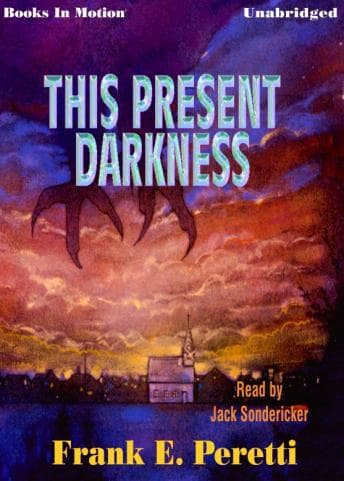

What happens when you take the invisible spiritual battle that Christians talk about and make it... visible? Like, literally visible, with named demons and angels duking it out over a small town in the Pacific Northwest?
That's the central conceit of Frank Peretti's This Present Darkness, and I'll be honest—I approached this one with my literary snob hat firmly in place. Christian fiction has a reputation, and not always a flattering one. But here's the thing: seventeen hours later, I'm still thinking about it. And not in the way I expected.
The Genre That Shouldn't Work (But Does)
Peretti essentially invented the Christian thriller with this book back in 1986, and you can feel him figuring out the formula in real time. The premise is bonkers on paper: a small-town pastor and a newspaper editor stumble onto a New Age conspiracy that's actually a front for demonic infiltration. Meanwhile, in a parallel narrative, angels and demons are literally fighting sword battles in the spiritual realm over the same territory.
It sounds like it could be unintentionally hilarious. And sometimes it is. The demons have names like "Rafar" and "Lucius" and they hiss a lot. The angels are noble warriors named Tal and Guilo who talk about prayer like it's spiritual ammunition. (Which, theologically speaking, is the point.)
But Peretti commits so fully to the concept that it works. He's not winking at you. He believes every word, and that conviction carries the narrative through moments that might otherwise feel campy. The human characters—Pastor Hank Busche and reporter Marshall Hogan—are drawn with enough depth that you actually care what happens to them. Hank's marriage struggles feel real. Marshall's skepticism-turned-belief arc has genuine weight.
My students would absolutely hate this. Too earnest, too long, too explicitly religious. But there's something refreshing about a book that knows exactly what it is and doesn't apologize for it.
Jack Sondericker's Voice in My Head
Okay, let's talk about the narration, because this is where things get complicated.
Jack Sondericker brings a theatrical, almost old-radio-drama quality to the performance. His demon voices are genuinely unsettling—gravelly, menacing, the kind of thing that made me glance over my shoulder while walking the lakefront at dusk. (Denise thought I was being paranoid. I was. But in a fun way.)
The angel voices work too—authoritative without being preachy, which is harder than it sounds when you're delivering lines about spiritual warfare.
But—and this is a significant but—his female character voices are rough. Not just "male narrator doing women" rough, but actively distracting. There are several important female characters in this book, and every time one of them spoke, I got pulled out of the story. I had a similar issue with the narration in Wife Between Us: A Novel, though there the problem was less about voice work and more about pacing choices. It's not that he doesn't try; he just doesn't succeed.
There's also a scratchy quality to the audio that suggests this wasn't exactly a big-budget production. Some listeners find Sondericker's voice irritating in general, and I can see why—it's distinctive in a way that you either adapt to or you don't. I adapted. Not everyone will.
One listener called his reading "superbly fiendish" with "an incredible range of voices, reaching greater heights of horror than the prose." That's... actually pretty accurate. He elevates the thriller elements while sometimes undercutting the emotional ones.
Two Chess Games at Once
The book's structure is interesting from a craft perspective. Peretti alternates between the human storyline and the angelic/demonic battles, and the two narratives inform each other in ways that are genuinely clever. When the humans pray, we see the angels get stronger. When the demons scheme, we see the effects ripple into the physical world.
It's a literalization of theology that could feel heavy-handed—and sometimes it does—but mostly it creates a kind of dramatic irony that keeps you engaged. You know things the characters don't. You're watching two chess games at once.
The pacing, though. Seventeen and a half hours is a lot, and there are stretches in the middle where the conspiracy plot gets convoluted enough that I had to rewind a few times. (This was during a faculty meeting. Principal Martinez, if you're reading this, I was definitely paying attention to the budget presentation. I wasn't.)
The climax delivers, though. When the threads finally come together, there's a satisfaction to it that rewards the investment.
Who This Is For (And Who Should Skip It)
If you're interested in Christian fiction, spiritual warfare themes, or just want to understand where a lot of contemporary religious thrillers come from, this is the source material. For believers, this book will feel like a dramatization of something you already sense is true. For skeptics, it's a window into a worldview that takes the supernatural seriously.
Skip it if: you can't handle earnest religiosity, you need tight pacing, or—critically—if Sondericker's voice grates on you. Sample it first. Seriously. If his theatrical style works for you, you're in for a genuinely engaging listen. If it doesn't, try the print version instead.
Class Dismissed
Here's my honest assessment: this is a foundational text for a genre, and it's worth experiencing for that reason alone. Peretti's conviction makes it hard to dismiss entirely, even when the prose gets clunky or the conspiracy threads tangle.
I listened at 1.0x because the prose deserves to be savored—even when it's imperfect. The author chose those words. The narrator interprets them. And somewhere in that combination, something unexpectedly powerful emerges.