
Look, I know what you're thinking. "Tom, why are you listening to a YA contemporary novel about high school drama? Where are the dragons? Where is the hard magic system?"
Fair question. But here's the thing: I needed a break. I've been drowning in 40-hour epic fantasies and my thesis advisor, Dr. Patel, is breathing down my neck about my "lack of tangible output" on the procedural generation code. I needed something different. Something grounded. And honestly? I heard the format of this audiobook was basically the only way to experience the story.
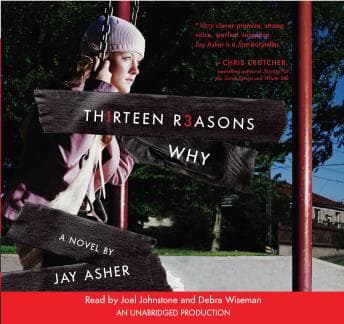
So, I put down the Stormlight Archive for a minute (sacrilege, I know) and picked up Thirteen Reasons Why.
And let's be real—high school is its own kind of dystopian hellscape anyway. You don't need Orcs when you have jocks.
The Inception-Level Immersion
Okay, the concept here is actually genius for audio. The whole plot revolves around Clay Jensen finding a box of cassette tapes recorded by Hannah Baker, a girl who killed herself. As he listens to the tapes, we listen to him listening to the tapes.
It's meta. It's chef's kiss for the medium.
Usually, when a fantasy book has a "found footage" element or an epistolary format, narrators struggle to make the transition clear. Here? It's baked into the DNA. You have Joel Johnstone playing Clay, and he's got this nervous, desperate energy that feels painfully real. Then you have Debra Wiseman as Hannah on the tapes.
The duality is the strongest part of the production. When Clay pauses the tape, or reacts to something Hannah says, it feels like you're right there in the garage with him, sweating over a boombox. (Do kids even know what boomboxes are anymore? I feel old, and I'm still in grad school.)
It creates this weird, voyeuristic intimacy. You feel like you shouldn't be listening. It's effective. Way more effective than reading the text on a page would be.
When the NPC Voice Glitches
Here's where I have to drop the nerd enthusiasm for a second and get critical.
Debra Wiseman's performance as Hannah is... divisive.
Look, on one hand, she's playing a character who has given up. There's a detachment there that makes sense for someone recording their suicide note. It's eerie. It's cold. It's a blend of disgust and defeat that hits hard in certain moments.
But—and it's a big but—sometimes she sounds a little too detached. Like, robotic. There were moments where it felt less like a heartbroken teenager and more like a GPS trying to route me to the nearest emotional trauma.
Some people online say she sounds too old for the role. I can see that. It didn't ruin the experience for me, but it did pull me out of the immersion a few times. It's like when you're playing a high-budget RPG and one of the main quest givers has clearly been voiced by the developer's accountant. It works, but it's jarring.
Joel Johnstone, on the other hand? Nailed it. He captures that specific brand of teenage boy confusion and anxiety perfectly. He's the anchor here.
Not Exactly a Fun Dungeon Crawl
I need to be super clear about this: This is not a "listen while you grind levels in WoW" kind of book.
It's heavy. We're talking suicide, bullying, sexual assault—the works. Darker than Joe Abercrombie on a bad day, because it's real-world dark. Undone tackles similarly heavy real-world trauma, though with a suspense angle that at least gives you some forward momentum through the darkness. There's no magic to fix this. No resurrection spells.
(I actually had to pause it a few times and just stare at my wall of unplayed board games. It gets intense.)
The pacing is a slow burn. Clay takes his sweet time going through these tapes, crisscrossing town to visit the locations Hannah mentions. It can feel a bit dragged out, but I think that's the point? You're stuck in the waiting game with him. You can't speed run grief.
Is it melodramatic? Yeah, a bit. It romanticizes the "revenge from the grave" trope in a way that sits a little weirdly with me. My D&D group would probably pick apart the logic of Hannah's plan for hours. But as an emotional narrative? It lands.
Who Should Queue This Up (And Who Should Pass)
If you want to see how the audiobook format can genuinely elevate a story about listening—about being forced to hear someone out—give it a shot. But skip this one if you need polished prose, happy endings, or something light for background listening. This demands your full attention and a strong stomach for real-world darkness.
Rolling for Emotional Damage
So, did I enjoy it? "Enjoy" isn't the right word. It's an experience.
It's a solid 6.5 hours—short enough to binge in one coding session (if you're ignoring your thesis like I am).
Just... maybe have a palate cleanser ready. I'm going straight back to Roshar after this. I need some Knights Radiant to balance out the real-world gloom.