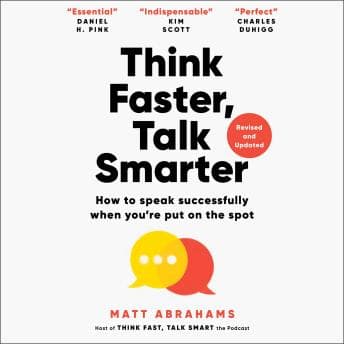

So here's the thing everyone keeps telling me about this book: it's life-changing, it'll fix your communication, Stanford lecturer, blah blah blah. And look - it's fine. It's a solid B+. But I went in expecting something that would rewire how I handle those terrifying moments when my skip-level VP corners me after a meeting and asks what I think about our team's roadmap, and what I got was... a pretty good blog post series stretched to 7 hours.
The First Three Chapters Hit Different Than the Rest
Here's where Abrahams actually earns your time. His framework around reframing anxiety - treating spontaneous speaking situations as opportunities rather than threats - is genuinely useful. The "Dare" approach (don't try to be perfect, just try to be present) clicked for me in a way that most communication advice doesn't. He's got this bit about how we catastrophize our speaking mistakes while nobody else even remembers them, backed by actual research, and it landed hard at 6:47 AM on a Tuesday when I was rehearsing how to push back on a design review. The anxiety reframing angle reminded me of Anxious for Nothing, which covers similar ground on catastrophizing with more depth if that specific thread is the one you're actually there for.
But after chapter three? I get why some listeners check out. The book shifts into what I'd call "framework collection mode" - structure after structure after structure. The "What? So What? Now What?" framework. The PREP method. Problem-Solution-Benefit. They're all reasonable. They're all useful in isolation. But stacked back to back in audio form, they start blurring together like commits in a git log you're scrolling too fast through. By hour five I genuinely couldn't remember which acronym went with which situation.
Matt Narrating Matt: The Author-Read Double-Edged Sword
Abrahams reads his own book, and credit where it's due - the guy practices what he preaches. His delivery has this relaxed, podcast-host energy that feels like he's talking TO you rather than reading AT you. Natural pacing, genuine enthusiasm, no wooden textbook-narrator vibes. You can tell he's been teaching this material for years because certain anecdotes land with the timing of someone who's workshopped them in front of hundreds of Stanford students.
The downside of author-narrated business books is always the same: there's no one to save you from the author's blind spots. A professional narrator might've injected some vocal variety into the framework-heavy middle section to keep you locked in. Abrahams stays pretty consistent throughout - energetic, clear, warm - which works great for the first few hours but doesn't shift gears when the content gets repetitive. When you're explaining your seventh communication framework, you need to bring something different vocally. He doesn't quite.
(Kevin actually asked me what I was listening to because I kept zoning out and missing my stop at Mountain View. That's... not a great sign for a book about holding attention.)
The ROI Calculation
Okay let me be the engineer about this. 7 hours and 12 minutes. At 1.75x - because yes, this is absolutely a 1.75x book - that's about 4 hours of actual listening. Three commutes, give or take. The actionable content could probably fit in 2 hours. Maybe 90 minutes if you're aggressive about it.
What you'll actually use: the anxiety reframing techniques (genuinely good), the "What? So What? Now What?" structure for impromptu responses (I've used this in three meetings already), and his advice about listening as a communication skill rather than just a waiting-to-talk skill. That last one sounds obvious but the way he frames it - as active information gathering that makes your spontaneous responses better - stuck with me.
What you'll forget: most of the client stories (they're fine but interchangeable), the distinction between his six or seven different response frameworks, and probably half the acronyms.
Who Gets Value Here (and Who Should Just Listen to His Podcast)
If you're someone who genuinely freezes up in meetings, interviews, or networking situations - like full-on deer-in-headlights - this book has enough practical tools to justify the credit. The early chapters on managing anxiety and the core structural frameworks are worth the price of admission.
But if you're already a decent communicator who just wants to get sharper? Honestly, go listen to his Think Fast, Talk Smart podcast instead. It's free, the episodes are 20-30 minutes, and you get the same core ideas in interview format which is way more engaging than the monologue format of the book. The book feels like a podcast host who got a book deal and had to pad 3 hours of great content into 7.
Ship It, But Maybe Not at Full Price
Abrahams knows his stuff. The science holds up where he cites it, the frameworks are practical, and his narration is pleasant enough to not be a chore. But this is the definition of a business book that could've been a blog post - or in this case, a really good 3-episode podcast series. Listen at 1.75x, take notes on the first half, and don't feel guilty if you zone out after hour four. Your commute has better options waiting.