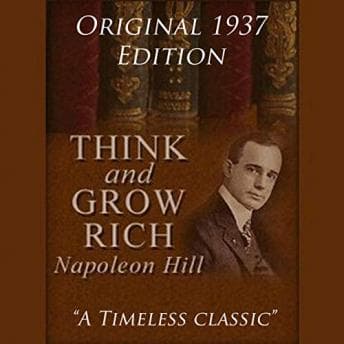

I was making aloo gobi at 11 PM on a Tuesday—the kind of elaborate cooking I do when my brain won't stop analyzing a particularly frustrating research paper—when Napoleon Hill started telling me about his "Definite Chief Aim." And I found myself asking: why does this 1937 self-help book still have such a chokehold on the business world?
The answer, I think, is that Hill understood something fundamental about human motivation that most modern self-help authors miss entirely. He wasn't just selling optimism. He was selling a psychological framework dressed up as wealth advice.
The Psychology Underneath the Prosperity Gospel
Let me be clear about what this book actually is: a case study in how belief systems shape behavior. Hill interviewed Carnegie, Ford, Edison—the titans of early American capitalism—and extracted what he called their "secret." The protagonist here (and yes, Hill positions himself as a protagonist on a quest) exhibits classic confirmation bias throughout. He found exactly what Carnegie told him he'd find.
But here's what's fascinating from a research perspective: the thirteen principles Hill outlines—desire, faith, autosuggestion, specialized knowledge, imagination, organized planning, decision, persistence, the "Master Mind," sex transmutation (yes, really), the subconscious mind, the brain, and the sixth sense—these aren't entirely nonsense. Some map surprisingly well onto what we now understand about goal-setting theory and self-efficacy.
The "autosuggestion" chapter is basically cognitive behavioral therapy before CBT existed. Write down your goal. Read it aloud. Visualize success. Hill was doing affirmations in 1937, and the research actually shows that implementation intentions do improve goal achievement. He stumbled onto something real, even if his explanations are wrapped in mystical language about "Infinite Intelligence."
Pulpit Energy: The Narration Problem
The Core Media Productions narrator delivers Hill's words with what I can only describe as pulpit energy. Clear, authoritative, the kind of voice that makes you sit up straighter. For the first few chapters, this works. Hill's material is declarative—he's not hedging, he's proclaiming—and the narrator matches that intensity.
But by hour four, I was exhausted. The narration runs too hot for sustained listening. It's like being lectured by someone who believes every single sentence is the most important thing you've ever heard. My therapist would have thoughts about this character—specifically, about why he can't modulate.
And then there's the technical problem: audio skips. Chapter 3, around the 8:32 mark, has a noticeable jump. There are apparently more throughout. For an 8-hour commitment, that's unacceptable. The publisher genuinely needs to re-rip this and review the copy before calling it finished.
An Unreliable Narrator With Thirty Million Readers
Hill is an unreliable narrator in the literary sense. He claims Andrew Carnegie commissioned this work, but historical verification is... thin. He positions himself as a humble reporter, but the ego radiating off every page suggests otherwise. Psychologically, this doesn't track as pure humility.
Yet the book persists. Thirty million copies. Why?
Because Hill understood that people don't want information—they want permission. Permission to believe they can be wealthy. Permission to think their circumstances aren't fixed. The "Master Mind" concept (surrounding yourself with like-minded achievers) is basically social psychology 101. The persistence chapter reads like a proto-grit manifesto.
Compared to modern self-help—your Atomic Habits, your 7 Habits—Hill feels simultaneously dated and more honest. He's not pretending this is science. He's openly selling a belief system. There's something almost refreshing about that transparency, even when the content veers into pseudoscience (the sex transmutation chapter is... a lot).
Emerson was doing the same thing a century earlier in Self-Reliance—also openly ideological, also weirdly compelling, also absolutely uninterested in citing his sources.Who This Is For (And Who Should Run)
If you're interested in the history of American success mythology, this is essential primary source material. If you're a psychology nerd like me who wants to see where modern self-help stole its ideas, genuinely useful. But if you want actionable, evidence-based advice? Skip this version. The narration intensity will wear you down, the audio quality issues are real, and Hill's framework—while historically important—has been refined significantly in the 87 years since publication. Also, if motivational speaking energy makes you twitchy, you will not survive eight hours of this narrator. I barely did, and I have a professional tolerance for analyzing things that irritate me.
The Dissertation Committee's Take
This is a fascinating case study in how self-help books function as psychological permission slips. Hill's "secret" isn't really a secret—it's the placebo effect applied to ambition. Believe hard enough, act consistently enough, and you might achieve your goals. Or you might not, but you'll feel like you tried.
The audiobook version? Worth streaming if you're curious. Not worth paying full price given the technical issues and relentless narration style. Borrow it from your library app, listen while doing something that requires your hands but not your full brain, and treat it as a historical artifact rather than a how-to guide.
My mother would ask why I needed to listen to a book about getting rich when I already have a perfectly good job. Maa, that's not how this works. But also—she might have a point.