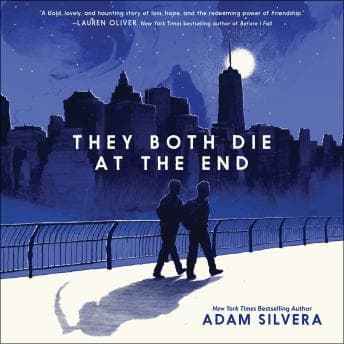

Look, the title tells you exactly what's coming. No twist. No fake-out. These two boys are going to die at the end. And somehow, knowing that from page one makes the whole thing hit harder.
I picked this up because a founder I'm advising mentioned it during a strategy session. We were talking about urgency—how startups need to operate like they're running out of time. She said, "You should listen to They Both Die at the End. It's basically a masterclass in prioritization under constraint." I thought she was joking. She wasn't.
The Business Case for Mortality
Here's the thing about this book that my MBA brain couldn't stop analyzing: it's essentially a thought experiment about resource allocation. Mateo and Rufus have exactly one day. No extensions. No pivots. No "we'll figure it out in Q2." The Death-Cast call comes, and suddenly every decision matters.
And what do they choose to do? Not bucket list nonsense. Not skydiving or whatever Instagram would have you believe matters. They choose connection. They choose each other. They choose to be present.
My parents worked 14-hour days for 30 years. Never took a vacation. Church on Sundays was their only break. Watching Mateo struggle with the same immigrant-family guilt—the fear of disappointing everyone, the weight of expectations, the paralysis of "what if I mess this up"—that hit different. Silvera gets it. The kid's been so busy being responsible he forgot to actually live.
Rufus is the opposite. Foster kid, nothing to lose, already lost everything that mattered. He's the disruptor to Mateo's established enterprise. And watching them figure out how to merge their approaches in real-time? Better than most case studies I've read. Arnold Bennett covered similar ground a century ago in How to Live on Twenty-Four Hours a Day—same obsession with time as our scarcest resource, though his version involves a lot less crying.
Three Voices, One Gut Punch
The narration setup is smart. Michael Crouch handles Mateo—all that anxiety and vulnerability and careful, careful hope. Robbie Daymond takes Rufus—sarcastic, fatalistic, but with this undercurrent of desperate wanting. And Bahni Turpin (who AudioFile literally named a Golden Voice, and yeah, she earned it) handles the third-person interludes.
Crouch nails the overthinking. You know that voice in your head that runs through every worst-case scenario before you can order coffee? That's his Mateo. Daymond's Rufus is the opposite energy—the guy who's already accepted the worst, so what's left to fear?
The production is clean. No weird audio issues. The transitions between narrators are smooth. At 2.0x speed, it clocked in around 4 hours, and honestly? I didn't want it to end. (Yes, I see the irony.)
One thing—the book occasionally shifts to minor characters for these little vignettes. Some people find this distracting. I actually liked it. It's like seeing the ripple effects of a business decision across an org. Every choice Mateo and Rufus make touches someone else's story.
Where the ROI Gets Real
Silvera isn't subtle about the LGBTQ+ themes. Mateo and Rufus fall for each other over the course of their last day alive. Some listeners apparently found this "abrupt" or "forced." I don't know what to tell those people except: have you met teenagers? Everything is abrupt and intense when you're seventeen. Add in the whole "definitely dying by midnight" thing and yeah, feelings move fast.
The book doesn't preach. It just shows two kids trying to figure out who they are in the time they have left. Which, if you think about it, is what we're all doing. Most of us just pretend we have unlimited runway.
Jenny made me listen to this, actually. She'd heard about it from her book club. I complained for the first twenty minutes—"this is YA, I have real books to get through"—and then I didn't say another word until it was over. She didn't gloat. Much.
Final Assessment
Is this a business book? No. But it's the most effective meditation on urgency and prioritization I've encountered this year. Better than the productivity books that pad 45 minutes of insight into 8 hours.
The key takeaway is worth the listen: we all have limited time. The question is whether we're spending it on what actually matters or just on what feels safe.
Content warning: death (obviously), emotional devastation, and the strong possibility you'll call someone you love immediately after finishing. I texted my mom. We don't talk about that either.
Who's this for: Anyone who needs a gut-check on their priorities. Skip if you need fast-paced action or hate feeling things. Otherwise? This one earns its spot.