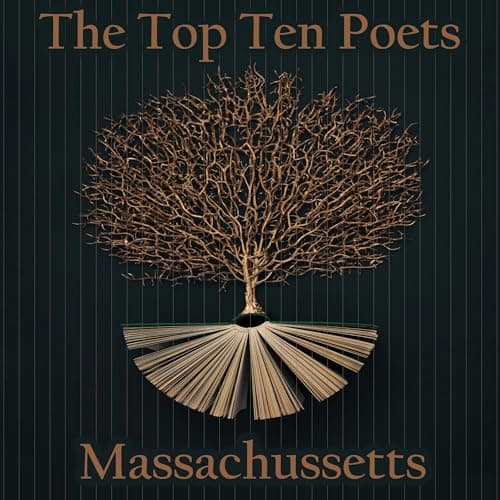

Everyone tells you poetry anthologies are gateway drugs - little sampler platters meant to ease you into the hard stuff. And sure, that's the pitch here: a tidy 82-minute tour through Massachusetts' greatest poetic voices. But here's what nobody warns you about: when you line up Dickinson next to Emerson next to Poe, you don't get a smooth introduction. You get whiplash. Beautiful, clarifying whiplash.
I was grading a stack of junior essays on The Crucible last Tuesday night - eyes glazing, red pen running dry - when I put this on as background company. Within ten minutes I'd stopped grading entirely. Not because the collection is so electrifying it demands your full attention (it's poetry; it demands your full attention by default), but because hearing Dickinson's spare, dagger-precise lines followed by Lowell's lush imagery forced me to actually think about what makes each voice distinct. Which is exactly the exercise I try to get my students to do. And here I was, accidentally doing homework.
Ten Poets Walk Into a State
The conceit is geographical - all Massachusetts poets - but what you actually get is a crash course in American literary evolution. Hawthorne's here, and yes, he wrote poetry (my students are always shocked; they think he only existed to torment them with The Scarlet Letter). Angelina Weld Grimké is here too, which is a genuine surprise and a welcome one - her work is underrepresented in most anthologies, and hearing her alongside the usual Transcendentalist suspects creates a tension the collection is better for. Thoreau sounds different when you've just heard Grimké. Context changes everything.
At 82 minutes, this is compact. You're not getting deep cuts or obscure selections. What you're getting is the Greatest Hits, which is fine - honestly, it's what this format needs. The selections lean toward the recognizable, the classroom-ready. If you've taken a single American Lit survey course, you'll know most of these poems. But knowing them on the page and hearing them performed are genuinely different experiences, and that's where this collection earns its keep or doesn't.
Three Voices, Uneven Weight
Here's where I have to be honest about the limits of what I can tell you. Three narrators split the duties - John McCrae (yes, the "In Flanders Fields" poet, which is a curious choice for reader), Trei House, and Richard Mitchley. The collection doesn't give you a full-cast dramatic reading; it's straightforward recitation, rotating between voices. And I wish I could tell you that one narrator absolutely nails Dickinson's dashes - that they pause exactly where the breath should catch - but the truth is, the performances here are competent rather than revelatory. Nobody embarrasses themselves. Nobody makes you forget you're listening to a recording and believe you're hearing the poet think.
This is the thing about poetry narration that I bore my 47 podcast listeners with constantly: the narrator understands that pause is punctuation. Or they don't. And when you're reading Dickinson especially - where the dash IS the meaning half the time - that understanding is everything. The readings here respect the texts. They don't transform them. For an introductory anthology, that might be exactly right. For someone who wants performance art, you'll want to look elsewhere.
The Classroom Question
I keep coming back to whether I'd assign this to my students. And the answer is: maybe, as a starting point. The 82-minute runtime means you could genuinely listen to the whole thing in a single sitting - a single long walk along the lakefront, if Denise doesn't mind me muttering about iambic pentameter. It's curated, it's accessible, and it puts Grimké and Bates alongside Emerson and Poe, which is a canon-expanding move I respect.
But - and this matters - there's no commentary, no context, no biographical framing between selections. You get the poems. Just the poems. If you already know why Dickinson's reclusion shaped her compression, or why Grimké's racial identity electrified her love poetry, you'll bring that to the listening. If you don't, these poems might wash over you as pleasant sounds without the voltage they carry. Poetry without context is like sheet music without dynamics markings - technically complete, emotionally incomplete.
My students would probably find 82 minutes of straight poetry recitation about as appealing as a budget presentation. (Principal Martinez, I'm projecting.) But for the curious adult listener who wants a quick survey? This does what it promises. No more, no less.
Worth the Walk, Not the Credit
This is a sampler. It knows it's a sampler. The prose deserves to be savored, and 82 minutes is the right length for savoring without exhaustion. But at audiobook-credit prices, you're paying full fare for what amounts to a playlist. The poetry itself is immortal - Dickinson alone is worth your time until the sun burns out - but this particular packaging is serviceable rather than essential. Stream it, borrow it, let it be the thing that sends you hunting for a full Dickinson collection or a deep Grimké anthology. That's the best thing a sampler can do. Funny enough, the last time a book sent me hunting for more was Los siete maridos de Evelyn Hugo — not poetry, not even close, but it had that same quality of making me feel like I'd only scratched the surface of something much larger.