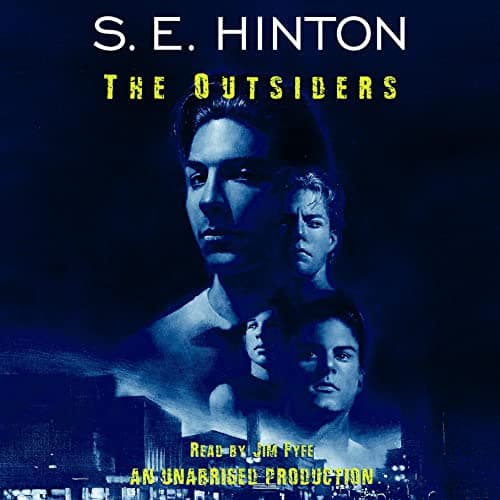

I started this one on a late-night drive home from work — windows cracked, highway mostly empty — and something about hearing Ponyboy's voice in that context felt exactly right. A kid talking about sunsets and switchblades while the world sleeps. I almost pulled over during the last chapter because I didn't want to walk into my house mid-sentence.
Here's what surprised me: I expected The Outsiders to feel like homework. The kind of book you respect because someone told you to respect it. But Hinton wrote this as a teenager, and that restless, unpolished urgency hasn't faded. Ponyboy Curtis is fourteen, navigating a class war between Greasers and Socs that plays out through fists and blades in a small town where your haircut determines which side of the street you walk on. The stakes are local and personal, but they carry genuine weight — loyalty tested past its breaking point, grief that arrives before any of these kids have the tools to process it, the way violence reshapes everyone it touches whether they threw the punch or not.
Jim Fyfe's narration is what made me rethink this audiobook entirely. He voices Ponyboy with an earnest vulnerability that never tips into parody. This is a grown man reading as a fourteen-year-old boy, and that's a tightrope act that goes sideways fast in lesser hands. Fyfe doesn't try to sound like a kid — he captures the emotional register of one. When Ponyboy is scared, there's a slight tightness in the delivery. When he's trying to act tough, there's just enough wobble underneath to remind you this is a boy playing at being hard because softness gets you hurt.
The character differentiation works without ever feeling like a one-man show. Darry sounds like a young man carrying too much responsibility too early — you can hear the exhaustion in his authority. Sodapop has that reckless warmth that makes you understand why everyone gravitates toward him. Johnny comes through with a fragility that makes every scene he's in feel precarious, like something is about to break that can't be fixed. Two-Bit gets the sardonic edge he deserves. Fyfe isn't doing carnival voices; he's making subtle shifts in tempo and tone that let you track who's speaking without ever pulling you out of the story.
Compared to something like Lord of the Flies, which covers similar thematic territory around youth, violence, and the line between civilization and chaos, The Outsiders feels more grounded and empathetic. Golding's novel is an allegory; Hinton's is a diary. You're not watching boys descend into savagery from a philosophical remove — you're inside Ponyboy's head while he watches his world crack open. That intimacy is what gives the book its staying power, and Fyfe's performance amplifies it rather than getting in the way.
If you've only encountered The Outsiders through the 1983 Coppola film, the audiobook offers something the movie couldn't. The film gave you Matt Dillon and Patrick Swayze and a particular visual vocabulary. Fyfe's narration gives you Ponyboy's interior life — his observations about sunsets, his love of reading, the way he processes grief by trying to intellectualize it before the emotions catch up and flatten him. That interiority is what makes this more than a gang story.
The themes of class division, chosen family, and the cost of growing up too fast haven't lost their edge. Listening as an adult hit harder than reading it as a kid. When you're twelve, you identify with Ponyboy because you feel like an outsider too. When you're older, you recognize how much of his bravado is armor, and how the adults in this world have failed every single one of these kids. That gap between how a story lands at twelve versus forty-something is something I kept turning over while reading Apples Never Fall — another book where family loyalty and the stories we tell ourselves about the people we love do a lot of quiet, devastating work.
At just over five hours, this is a tight listen. No padding, no meandering subplots. Every chapter moves the story forward or deepens your understanding of these characters. That brevity is both the audiobook's strength and the one thing that might give you pause — you'll burn through it in a single afternoon, and at full credit price, that's a real consideration. If you measure value strictly by runtime, borrowing through your library app might be the smarter play.
Who should listen: anyone who wants a short, focused listen with real teen interiority and class tension delivered by a narrator who trusts the material enough to stay out of its way — buy it. Who should skip: if you need fifteen-plus hours of sprawling narrative to justify a credit, or you're looking for flashy vocal pyrotechnics, borrow it or stream it. The experience itself is worth your time either way — the question is just whether five hours justifies your particular currency.









