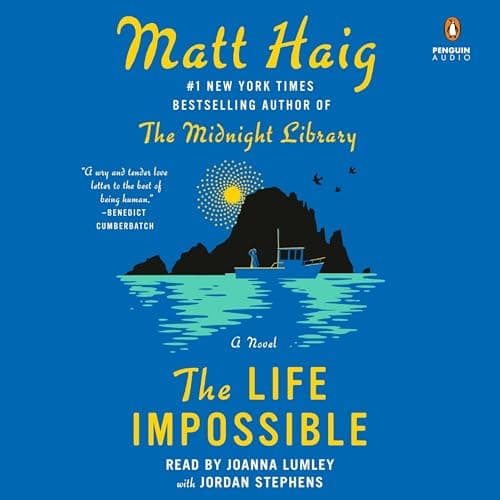

Everyone raves about Joanna Lumley's narration being perfect for this book, and honestly, they're not wrong — but they're also not telling you the whole story.
Matt Haig's The Life Impossible follows Grace Winters, a retired math teacher and recent widow who inherits a crumbling house on Ibiza from a friend she'd lost touch with decades ago. She flies out with nothing but questions and a one-way ticket, and what starts as a quiet mystery about her friend's death gradually shifts into something far stranger — veering into supernatural territory that will either captivate you or have you reaching for the stop button.
Let me start with what works beautifully here. Lumley's voice is genuinely lovely. She captures Grace's particular brand of British crustiness — the dry wit, the stiff upper lip hiding oceans of grief — with a warmth that makes you want to keep listening even when you're not entirely sure where the story is heading. There's a lived-in quality to her performance that feels less like acting and more like a proper storyteller recounting something that actually happened to her. When the story asks you to suspend disbelief during its more fantastical turns, Lumley's steady, grounded delivery is the rope you hold onto.
Jordan Stephens handles the secondary narration — a series of emails from a male character — and brings a raw, aching quality to those sections. They're brief but effective, adding emotional texture that contrasts nicely with Lumley's measured warmth. The dual narrator setup works well structurally, even if Stephens gets limited material.
Now, the parts that don't quite land. Lumley's accent work when voicing Spanish and Ibizan characters is, to put it charitably, a tour of Europe's greatest hits. One moment it's vaguely Russian, the next it sounds Dutch, and occasionally it wanders into what one listener memorably described as a spaghetti western villain. It's not a dealbreaker, but it pulls you out of scenes that are meant to ground you in the local culture of the island.
The bigger issue is pacing. This audiobook runs just under eleven hours, and for significant stretches it ambles along with the urgency of a Sunday afternoon nap. Haig's writing is contemplative and philosophical by nature — he's exploring grief, second chances, the intersection of science and wonder — but the audiobook format magnifies the slower passages. I found myself bumping the speed to 1.25x during the middle third, and the story actually benefited from it. Lumley's delivery is so measured and soothing that at normal speed, some sections feel almost sedative. Multiple listeners have confessed to nodding off, and I understand the impulse.
The real dividing line with this book is the supernatural element. Without spoiling specifics, what begins as a realistic story about a grieving woman finding purpose abroad takes a sharp turn into the preternatural. If you've read Haig's other work — The Humans, How to Stop Time — you know he likes to use the fantastical as a lens for examining what makes us human. Here, though, the shift feels more abrupt and less earned. Some listeners found it magical and elevating. Others felt the story simply lost the plot. I land somewhere in the middle: the ideas Haig is playing with are genuinely interesting, but the execution occasionally tips from mystical into muddled.
What keeps the whole thing afloat is Grace herself. She's a wonderful character — prickly, intelligent, deeply wounded but not defined by her wounds. Lumley makes her so convincing that even when the story asks you to swallow some fairly outlandish developments, you stay because you care about this woman and want to see where she ends up. That particular alchemy — a flawed, grieving woman carrying a story on her back — is something All of Grace also leans on hard, though with far quieter stakes.
The book's core message about new beginnings and the possibility of transformation at any age is genuinely moving without being saccharine. Haig writes about hope the way he always does — with an awareness of pain that makes the hope feel real rather than naive. If you connected with The Midnight Library's exploration of unlived lives, there's a similar emotional frequency here, though the wavelength is different.
As a listening experience, this is best suited for quiet, focused time. The philosophical texture rewards attention, and the pacing demands patience — or a finger on the speed control. It's not an audiobook that thrives as background listening during chores or commutes with heavy traffic. Give it space, and it gives something back. Rush it or half-listen, and you'll likely end up in the camp that found it plodding and nonsensical.
Who Should Listen (And Who Should Skip)
If you loved The Midnight Library and want Haig in a more expansive, ruminative mode — and you're open to supernatural turns — this is worth your eleven hours, especially with Lumley narrating. Skip it if you need tight pacing, if magical realism isn't your thing, or if inconsistent accent work is a hard stop for you.
Lumley's narration elevates material that might feel thinner on the page, and that alone makes the audio format worth choosing over print. But temper your expectations: this isn't The Midnight Library's tight emotional punch. It's a wider, woolier, more uneven book that reaches for something extraordinary and doesn't always close its fingers around it.