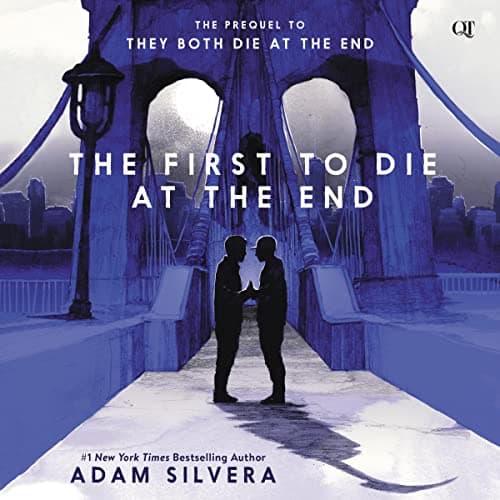

Look, I need to talk about the unattributed dialogue situation in this audiobook because it genuinely made me lose my mind. I'm sitting at my desk at 2 AM, finessing a logo rebrand with Frida curled on my keyboard, and suddenly I can't tell who's talking. In a book where knowing who said what is literally life-and-death stakes? That's a problem. But I'm getting ahead of myself.
The First to Die at the End is Adam Silvera's prequel to They Both Die at the End, and it does exactly what the title promises — it takes us back to the night before Death-Cast goes live, when nobody knows if this whole "we call you on the day you die" thing is real or just the world's most morbid startup. And into this chaos walk Orion Pagan, who has a heart condition and basically signed up hoping for answers, and Valentino Prince, who just moved to New York with his whole future spread out in front of him like a buffet.
They meet in Times Square. Of course they do.
The Boy With the Broken Heart (Literally)
Orion is the emotional anchor of this entire book, and Jason Genao knows it. His performance has this raw, aching quality — like someone who's been bracing for bad news so long that hope actually scares him more than death does. There's a yearning in his voice that never lets up, never breaks character, and it wrecked me. I was coloring gradient swatches and had to just... stop. Put my stylus down. Stare at the wall while Frida judged me.
Genao gives Orion this specific vulnerability that makes every line feel like he's holding his breath. You feel the weight of a boy who registered for Death-Cast not because he's afraid of dying but because he's afraid of dying without being ready. That distinction matters, and Genao gets it.
Anthony Keyvan as Valentino, though? This is where I got frustrated. Valentino is supposed to be this bright, optimistic counterbalance — the boy with the long future — and Keyvan's delivery just... flattens him. He sounds pleasant enough, sure, but pleasant isn't a personality. Where Genao gives you every crack and tremor in Orion's emotional state, Keyvan gives you a smooth surface with nothing underneath. It made the romance feel lopsided, like I was falling for one boy and tolerating the other.
Kyla Garcia picks up the side plots — the interconnected storylines happening around the edges of Orion and Valentino's day — and she's genuinely good at shifting between characters. She's the glue holding the peripheral chaos together.
When You Already Know the Ending but Your Heart Hasn't Accepted It
Here's the thing about Silvera's whole deal: he tells you someone's going to die. It's in the title. It's the entire premise. And somehow your stupid heart still thinks maybe this time it'll be different. I ugly-cried at work — and by "work" I mean my apartment, and by "at work" I mean while trying to export a file that kept crashing, so I was already emotionally compromised.
The romance between Orion and Valentino has this desperate tenderness that only works because the clock is ticking. They meet, they connect, one of them gets the call, and then every moment together becomes both a beginning and an ending. Silvera is so good at that bittersweet knife twist — making you feel the fullness of a single day, the way time stretches when you know it's running out.
But — and this is the big but — if you read They Both Die at the End first, some of the magic is gone. The world-building isn't new anymore. The Death-Cast concept doesn't hit with that same gut-punch of discovery. You're watching Silvera set up dominoes you've already seen fall, and while there's a sad beauty in that, it doesn't carry the same electricity.
The Dialogue Problem Nobody Warned Me About
With three narrators, you'd think it'd be easy to track who's speaking. But there are stretches — especially in scenes with rapid back-and-forth — where the unattributed dialogue just blurs together. I rewound at least four times during one sequence because I genuinely couldn't tell if Orion or Valentino was talking. In an audiobook about two boys spending their last day together, I need to know whose last words I'm hearing. That confusion pulled me out of moments that should've been devastating.
At 10 and a half hours, the pacing mostly works, but there are sections in the middle where the side characters' storylines slow things down when all I wanted was to stay with Orion and Valentino. The interconnected structure is ambitious — very Silvera — but it dilutes the emotional intensity sometimes.
Who Should Listen (And Who Should Skip)
If you love queer YA love stories that make you cry in public (or in your apartment at 2 AM while your cat watches), this is your book. Silvera fans who haven't read They Both Die at the End yet? Start here — the emotional punch lands harder coming in fresh. But if flat narration pulls you out of a story, or if you already read the original and want the same level of surprise, temper your expectations.
Abuela Would've Needed Extra Tissues
She would've loved this one. The way Silvera writes about family, about holding onto people while knowing you'll lose them — that's telenovela energy with a literary spine. The queer love story at the center is tender and urgent and real, and it doesn't apologize for making you feel everything at once. My abuela would've gasped, clutched her rosary, and then immediately asked me to play it again from the beginning.
This book felt like pressing a bruise you know is there — it hurts, but you can't stop touching it. Genao's performance alone makes it worth the listen, even when Keyvan's flatness and the dialogue confusion test your patience. It's not as good as They Both Die at the End. But it's still Silvera doing what Silvera does best: making you fall in love with people you're about to lose. Infinity Kings scratched a similar itch for me — that same gut-level attachment to characters whose survival the story refuses to guarantee.









