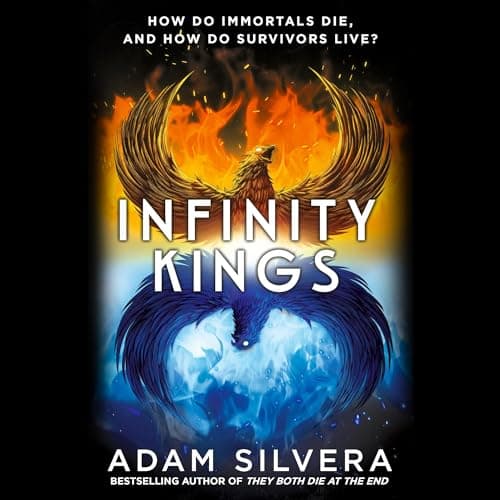

Twenty-two hours and forty-eight minutes. That's how long I spent with the Rey brothers while finishing a massive rebrand project for a local mezcalería — Frida curled on my lap, Diego swatting at my stylus every time I paused to press my hand against my chest because Adam Silvera decided to rip my heart out. Again.
This book felt like watching two people you love destroy each other in slow motion while you're trapped behind glass.
The Brother War That Wrecked Me
Let me be real: I came into Infinity Kings already emotionally compromised. I've been with Emil and Brighton since Infinity Son, and the betrayal at the end of Infinity Reaper left me genuinely angry — not at the book, at Brighton. The kind of angry where you pause the audiobook and say out loud to your cats, "Can you BELIEVE him?" So this finale had a lot riding on it.
And Silvera goes hard. The brother-versus-brother war isn't just plot mechanics — it's the specific, awful ache of watching someone you grew up with become someone you don't recognize. Emil doesn't want to fight. He never wanted any of this. He just wanted to be the quiet kid, and now he's supposed to lead a war against his own twin? That tension — between duty and love, between what you have to do and what's going to break you — Silvera writes it like he's lived it.
The love triangle with Ness and Wyatt competing for Emil's heart? Normally I'm ALL in for romantic tension, but here it almost felt secondary to the brother stuff, which says something about how devastating that central conflict is. I wanted more time in those tender moments with Ness — those quiet scenes where Emil lets his guard down — but the plot keeps barreling forward. Silvera writes action like a sprint, and sometimes I wished he'd let us catch our breath in the softer places.
Maribelle's arc — aligning with her worst enemy to bring back someone she loves? Abuela would have loved this one. That desperate, impossible love that makes you do reckless things? Pure telenovela energy, and I mean that as the highest compliment. The God of Small Things lives in that same space — love as a force that bends people toward destruction, and it wrecked me in a completely different but equally devastating way.
Four Voices, Four Heartbeats
Okay, so the full cast narration. Robbie Daymond as Emil? His voice is velvet and honey. He plays Emil's reluctance so well — there's this quietness in his delivery that makes you lean in, like Emil is telling you a secret he's not sure he should share. When Emil is forced into leadership moments, you can hear the strain, the "I don't want this" underneath the brave face. It's subtle work and it destroyed me.
Kirby Heyborne as Brighton is a fascinating contrast. He captures this earnest, almost desperate optimism that Brighton carries — the kind that curdles into something darker as the book progresses. Brighton genuinely believes he's the hero of his own story, and Heyborne plays that conviction without making him a cartoon villain. You understand Brighton even when you want to shake him.
Maria Liatis handles the female POVs and Elliot Knight rounds out the cast. Having four narrators for a book this long and this complex actually helps untangle the multiple storylines — you always know whose head you're in, which matters when Silvera is juggling like six plot threads at once.
I listened at my usual 1.0x. No regrets. At 22+ hours, some people might be tempted to speed up, but the emotional beats need room. There's a moment — I won't spoil exactly when — where a character makes a sacrifice that I saw coming from three chapters away and it STILL made me pause my work, set down my stylus, and just sit with it. That only hits if you're not rushing.
Where the Magic Frays at the Edges
Here's where I get honest: this is a dense book. Sometimes too dense. Silvera packs SO much into this finale — the brother war, the political subplot with Ness infiltrating Iron's campaign, Maribelle's resurrection mission, an ancient scythe that can kill the unkillable, plus all the romantic threads — that some storylines get less breathing room than they deserve. The pacing is relentless in a way that occasionally works against the emotional moments I was craving.
And look, as a trilogy closer, some of the worldbuilding shortcuts that worked in book one feel a little thin by book three. The magic system (specters, celestials, phoenixes) is cool but the rules can feel inconsistent when the plot needs them to be. If you're someone who needs airtight fantasy logic, you might get frustrated. I'm not that person — I'm here for the feelings — but I noticed.
Who Should Listen (And Who Should Skip)
If you loved They Both Die at the End and want that same gut-punch energy stretched across a fantasy war, this delivers. If you've been with this trilogy from the start, the payoff is worth the 22-hour commitment. I ugly-cried at two separate points and had to aggressively pet Diego to calm down.
But if you haven't read the first two books? Do not start here. You will be completely lost. And if you need tight, streamlined plotting over emotional messiness? This might test your patience.
My heart. MY HEART. This book did exactly what Silvera always does — made me care about imperfect people making impossible choices, then made me watch the consequences. The vibes are immaculate if you're in the right headspace. I finished it at 2 AM, stared at my ceiling, and texted my brother just to say I love him.
That's the highest compliment I can give a book about brothers.









