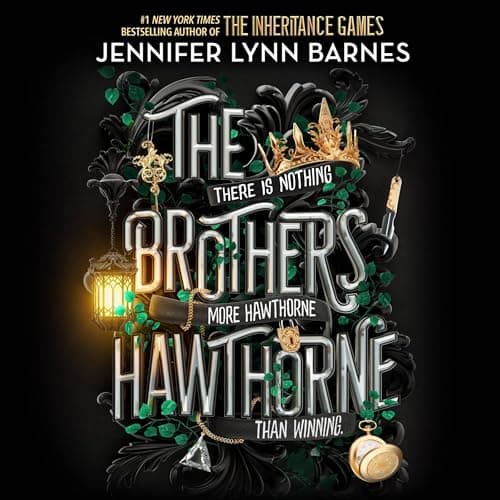

So here's the thing nobody tells you about being an English teacher: you develop this quiet, protective snobbery about certain kinds of fiction. YA puzzle thrillers? Not my lane. I'm the guy who podcasts about Faulkner to 47 people. But Denise grabbed this for our Saturday lakefront walks because she'd blown through the Inheritance Games trilogy and wanted me to "stop being such a literary snob for once." Her words. She's usually right.
And look — I went in expecting to roll my eyes. Instead I found myself genuinely invested in how Jennifer Lynn Barnes structures parallel narratives, which is something I spend actual class time teaching with A Tale of Two Cities. So credit where it's due.
Two Brothers, Two Continents, One Structural Gamble
Barnes splits this book down the middle — Grayson dealing with a custody-adjacent legal crisis involving his half-sisters stateside, Jameson infiltrating an underground London gambling club at his estranged father's request. It's a bold structural choice because you're essentially listening to two separate novellas braided together, and the tonal whiplash is real. Grayson's chapters run cold and procedural, all chess moves and suppressed emotion. Jameson's run hot — con artist energy, aristocratic power plays, the kind of heist-adjacent tension that made me actually speed up my walking pace without realizing it.
The gambling club sequences are where Barnes is having the most fun. The games-within-games logic, the way each round escalates the personal stakes alongside the literal ones — this is where the book earns its 13 hours. Grayson's half, honestly, drags in the middle third. There's a stretch where legal maneuvering and family revelations stack up without enough forward momentum, and I caught myself drifting during a particularly tedious faculty meeting. (Though to be fair, I was already not listening to Principal Martinez discuss parking lot traffic flow.)
What surprised me — genuinely — is how Barnes handles the emotional architecture beneath all the puzzle-box plotting. Grayson's inability to process grief without converting it into action? That's real characterization. Jameson's compulsive risk-taking as a response to abandonment? Barnes doesn't spell it out in neon, but it's there if you're paying attention. This reminds me of what Hemingway said about the iceberg theory — the dignity of movement is due to the seven-eighths underwater. Barnes isn't Hemingway (my students would revolt if I said she was), but she understands subtext better than a lot of authors writing for this audience. The subtext conversation is one I keep returning to on the podcast — I went down a similar rabbit hole when I reviewed Selected Poems of Robert Frost, where everything that matters is buried beneath what's actually on the page.
Jay Ben Markson's Tightrope Walk
Here's where I have to be honest, because the listener reviews on this one are genuinely split and I land right in the messy middle. Markson does something smart with Grayson and Jameson — Grayson gets this clipped, controlled delivery, almost aristocratic in its restraint, while Jameson gets more breath, more impulsiveness in the phrasing. You can feel the difference in their thinking speeds, which is a narrator choice I respect enormously. He understands that pause is punctuation, and he uses silence well in Grayson's chapters especially.
But — and this is the problem — once you move past the two leads, the supporting cast blurs. Avery, Xander, Nash, the various antagonists and side players: they live in this narrow vocal band where I sometimes had to rewind to figure out who was speaking. In a book with this many characters operating across two storylines, that's not a minor issue. It's like watching a play where the two leads are perfectly cast but the ensemble is all wearing the same costume.
I wouldn't call it flat, which some listeners have. Markson's emotional register is genuine — there's real urgency in the gambling sequences, real tension in Grayson's confrontation scenes. But "immersive" is doing a lot of heavy lifting when you're pausing every twenty minutes to recalibrate who's talking.
Who Gets the Hall Pass (And Who Gets Detention)
If you loved the Inheritance Games trilogy, this is its expansion pack. Barnes trusts you to remember the world and its players, which means newcomers will be completely lost. Don't start here. But for the initiated, there's a confidence in the writing that the original trilogy was still building toward. Skip this if you haven't read the first three books — you'll spend more time confused than entertained, and Barnes offers zero hand-holding.
My students would hate that I'm analyzing the narrative structure of a YA thriller. I love that it rewards analysis anyway. The prose doesn't demand to be savored the way a Donna Tartt novel does, but at 1.0x speed, you catch the symmetries Barnes plants between the brothers' storylines — moments where Grayson's control mirrors Jameson's chaos, where both arrive at the same emotional crossroads from opposite directions.
Is it great literature? No. Is it smart, propulsive entertainment that uses its dual-narrative structure with more skill than half the "literary" fiction I've assigned this semester? Yeah. It pretty much is.
The Grade on This One
Worth your time if you're already in this world. The Jameson London chapters alone carry the listen, Markson nails the two leads even if the ensemble work needs polish, and Barnes has figured out how to write puzzle plots that actually mean something emotionally. I finished it three walks before Denise finished the print version, and for once, I got to be the one spoiling things. Small victories.