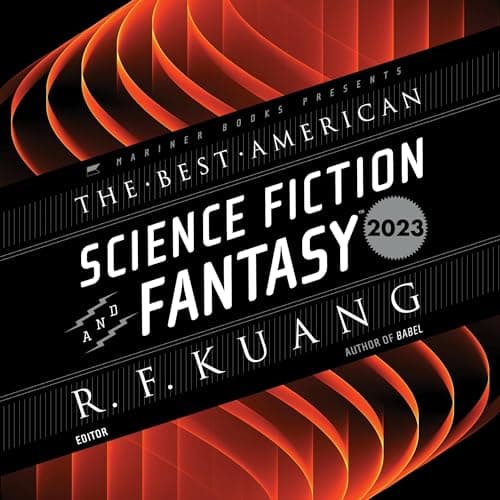

Short story anthologies are the hardest thing to review in audiobook form, and I'm just going to say that upfront.
I was sitting at the kitchen table at 11:30 on a Tuesday night, red pen in one hand, cold coffee in the other, a stack of sophomore essays on The Great Gatsby that all seemed to think Nick Carraway was "just some guy who moved to New York." And I had this playing through my earbuds like a lifeline. R. F. Kuang's introduction hit me first — her line about short stories needing to accomplish "a nearly impossible magic trick" — and I thought, yeah, that's what I tell my students about opening paragraphs. Except Kuang actually means it, and my students are still starting essays with "Since the dawn of time."
Twenty Stories, Ten Narrators, and the Math Problem Nobody Mentions
Here's the thing about a multi-narrator anthology: ten voices for twenty stories means some narrators carry two or three pieces, and the matchups matter enormously. Yelena Shmulenson — who's won an Earphones Award, and you can hear why — brings this particular gravitas that made me stop grading entirely during her sections. There's a theatrical weight to her delivery that turns sentences into small performances. André Santana has this realistic, almost documentary-style approach that works beautifully for the stories grounded in political reality, the ones about border enforcement and reproductive legislation. When the collection pivots from fathers feeding their children ghost preserves to the grinding cruelty of immigration policy, you need a narrator who can handle that tonal whiplash without blinking. Santana doesn't blink.
But — and this is the math problem — ten narrators means ten different interpretive philosophies colliding inside one audiobook. Some of these transitions feel like channel surfing. You settle into one narrator's rhythm, their particular relationship with silence and emphasis, and then you're handed off to someone new. In print, you just turn the page and recalibrate. In audio, it's more jarring. It kept pulling me out of the flow, especially when consecutive stories occupied similar emotional territory but got wildly different vocal treatments.
The Kuang Curation Problem
Let's talk about what the editor is really saying with her selections. Kuang is interested in weirdness as a vehicle for urgency — stories that use speculative premises to smuggle in political fury. Women who can't lie or fall in love. Souls chasing each other through animal incarnations. These are fun, strange, disorienting setups, and the best of them earn their strangeness by landing somewhere emotionally precise.
The problem is that when you stack twenty stories that all share this philosophy — get weird to get real — the cumulative effect starts to flatten. By hour eight, I was walking the lakefront with Denise, and she asked me what I was listening to, and I found myself saying "it's another one where the fantasy metaphor is actually about systemic oppression" with less enthusiasm than that sentence deserves. Individually, several of these stories are remarkable. Collectively, the collection starts to feel curated for a thesis rather than for range.
This is the tension in any "Best Of" anthology, and it's worth naming: "best" according to whom, and best at doing what? Gloria Naylor wrestles with the same curatorial problem in Mama Day, where the question of whose story counts as worth telling shapes every page. Kuang is transparent about her criteria — she wants the weird and the urgent — but that transparency doesn't prevent the listening experience from feeling a little one-note after the halfway mark.
The 2.67 in the Room
I notice the aggregate rating sitting around 2.67, and honestly? I get it. Not because the writing is bad — some of these stories are genuinely excellent — but because the audiobook as an audiobook has structural issues. The narrator transitions create friction. The tonal sameness across selections compounds over nearly thirteen hours. And thirteen hours is a LOT for short fiction in audio. My students would hate this. They'd say it "doesn't go anywhere," which is a complaint I usually push back on, but with an anthology this long, pacing becomes a real concern.
The prose deserves to be savored, story by story. And that might be the key recommendation here: don't marathon this. Treat it like a literary tasting menu. One story per commute. One story per grading session. Let each piece breathe before the next narrator takes over.
Who Gets the Syllabus Spot (And Who Gets Dropped)
If you're the kind of listener who treats short fiction as a palette cleanser between novels — pick this up. You'll find three or four stories that genuinely rearrange something in your head, and the rest are competent at worst. If you want a curated window into where contemporary SFF is politically and aesthetically, Kuang's introduction alone is worth the price of admission.
But if you need narrative momentum, if you listen primarily during workouts or while doing something with your hands, this will frustrate you. Short stories in audio demand a different kind of attention — you can't zone out for ten minutes and catch up. Each story is its own world with its own rules, and the narrator rotation means you can't even rely on vocal familiarity to anchor you. Skip it if you're not willing to hit pause between stories and let each one settle.
(Principal Martinez, I did listen to three of these stories during your faculty meeting last Thursday. The one about ghost preserves was better than the budget projections. I'm sorry. I'm not sorry.)
Worth Borrowing, Not Buying
This is a library audiobook. Stream it on Libby. Cherry-pick the stories that grab you, skip the ones that don't, and don't feel guilty about it. The writing talent represented here is real, and several narrators — Shmulenson especially — deliver genuine performances. But the anthology format at this length, with this many vocal handoffs, makes it a better browsing experience than a listening experience. If you loved Exhalation by Ted Chiang, understand that Chiang's collection works because of its internal coherence and singular voice. This collection has breadth where Chiang had depth, and in audio, depth wins.









