
Ever wonder why the most accurate depiction of police leadership involves trolls, dwarfs, and a dragon?
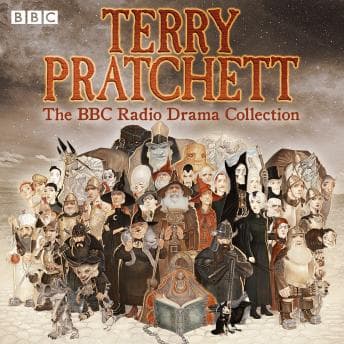
I picked this collection up because I needed a break from the "ex-SEAL saves the President" genre. Sometimes you need to clear the chamber. And honestly? I didn't expect a BBC radio play to hit this hard. I usually prefer my intel raw—unabridged, every detail included. But this collection? Different beast entirely.
When the Theater Comes to the Cockpit
Let's get one thing straight—this isn't an audiobook. It's a full-spectrum production. Sound effects, background chatter, music cues. The works.
Usually, I hate sound effects. They distract from the intel. But here? It works. Feels like those old radio serials my dad used to talk about, but with crisp, modern production. You're not being told a story; you're dropped right into the middle of the Ankh-Morpork market.
The cast is stacked. You've got Sheila Hancock and Martin Jarvis, people who actually know how to use their voices as instruments. When Death speaks (yes, the Grim Reaper is a main character), the vocal processing gives it this hollow, echoing quality that's genuinely unsettling—and hilarious. Ranger actually barked at the speakers during Guards! Guards! when the dragon roared. That's a seal of approval in my house.
Vimes Gets It
I have to talk about Sam Vimes.
In Guards! Guards! and Night Watch, you follow Captain Vimes of the City Watch. Look, I've commanded men in some bad neighborhoods—Fallujah, Ramadi. I know what it looks like when a commander is running on caffeine, rage, and a desperate desire to keep his people alive. Vimes is that guy.
The way these actors portray the weariness of the City Watch? It hit home. Vimes deals with incompetent superiors, a public that hates him, and a squad that includes a werewolf and a troll. It's satire, sure. But it captures the absurdity of chain-of-command politics better than most serious war memoirs I've read. (Don't tell the Pentagon I said that.)
The humor is British—dry as a bone. Not slapstick. It's that grim chuckle you let out when everything is going FUBAR.
The Intel We Lost
Here's the downside. For purists, it might be a dealbreaker.
These are dramatizations. Which means they're abridged. Heavily.
Pratchett's writing is famous for his footnotes and internal narration. You lose pretty much all of that here. You get the dialogue and the action, but you miss the philosophical tangents that make Pratchett a genius. Dragon Orb had a similar problem—great world-building, but the execution felt like it was missing chapters. It's like getting the executive summary instead of the full dossier. Efficient? Yes. Complete? No.
If you've never read the books, you might feel like you're missing context. The plots move fast—sometimes too fast. I had to rewind a couple of times during Small Gods because the scene transition was so abrupt I thought my Bluetooth cut out.
Who's This For?
Perfect for commuters who want episodic chunks—get in, get a laugh, get out. Skip it if you're a Pratchett purist who needs every footnote and tangent intact.
Mission Debrief
Is it perfect? No. The pacing can be frantic. But entertaining? Hell yes.
Great for short hops. Since these were originally radio broadcasts, they're broken into episodic chunks. Perfect for my commute to the consulting office.
If you want the deep dive, read the actual books. But if you want to hear a world come alive while you're stuck in traffic on I-35? This is the ticket.
Mission accomplished, BBC.