
I was sitting in the back row of a professional development seminar on "Differentiated Assessment Strategies" — the kind of PD that makes you question every life choice that led you to this folding chair — when George Saunders opened "Victory Lap" in my earbuds and I almost laughed out loud. Not a polite chuckle. A genuine, involuntary bark of recognition. Because Saunders writes the interior monologue of a teenage girl with such pitch-perfect absurdity, such manic overthinking energy, that I thought: this man has been reading my students' journals.
I had to pretend I was coughing. I don't think anyone bought it.
The Author Who Reads His Own Silences
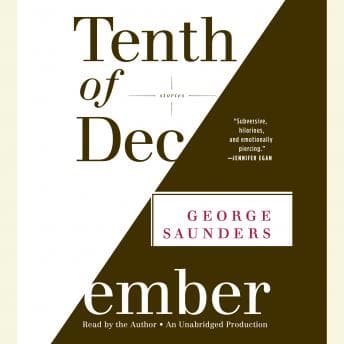
Let's talk about what happens when a writer narrates his own short stories. Usually it's a disaster. Novelists mumble, poets whisper, and everyone reads too fast because they wrote the thing and they know what's coming. Saunders is the exception that proves the rule.
He reads these stories like he's still discovering them. There's a quality to his voice in "Escape from Spiderhead" — when the narrator is being chemically manipulated into feeling love, then lust, then violence — where Saunders sounds genuinely unsettled by his own sentences. The narrator understands that pause is punctuation. He'll hit a line about pharmaceutical-induced desire and just... let it sit there. Let you feel the wrongness of it. A hired narrator would have played it for drama. Saunders plays it for truth.
The character differentiation isn't what you'd get from a seasoned voice actor — he's not doing full theatrical voices. But the tonal shifts are real. The smothered, anxious kid in "Victory Lap" sounds different from the weary combat veteran in "Home," and both sound different from the desperate, self-deluding father in "The Semplica Girl Diaries." It's subtle work. He's shifting the register of his thinking voice, not performing characters so much as inhabiting their particular brands of confusion.
Chekhov's Gun, But It's Loaded with Empathy
This reminds me of what Hemingway said about writing — that the dignity of an iceberg is that only one-eighth shows above water. Saunders does something similar, but stranger. His surfaces are manic, funny, deliberately weird — corporate jargon, pharmaceutical brand names, medieval theme parks — and underneath every single story is someone trying desperately to be good and failing in heartbreaking ways.
"The Semplica Girl Diaries" wrecked me. A middle-class father keeping a diary, trying to give his daughters a normal suburban life, and the central conceit — I won't spoil it, but it involves a lawn decoration that is also a human rights violation — is so casually horrifying that you keep waiting for the story to acknowledge how insane it is. It never does. Because the narrator doesn't see it. And that's the point. Saunders is asking: what are WE not seeing?
My students would hate this. I love it.
And then there's the title story. "Tenth of December." A man with a brain tumor walks into frozen woods to die on his own terms, and a lonely kid playing imaginary games stumbles into his path, and what happens over the next thirty minutes is — look, I was grading sophomore essays on The Great Gatsby at 11 PM when I got to this story and I had to put my red pen down. The prose deserves to be savored. Saunders writes the man's deteriorating thoughts as his body temperature drops, the syntax literally falling apart, coherence dissolving into fragments and half-memories, and because he's reading it himself, you hear the exact rhythm he intended. The stumbles aren't stumbles. They're architecture.
The One Flaw That's Actually a Feature (And the One That Isn't)
Here's my honest complaint: the transitions between stories are too abrupt. At five hours and forty-one minutes, this collection moves fast, and there were at least two moments where I didn't realize a new story had started until I was three minutes in wondering why the characters had changed personalities. A beat of silence, a tone — something to signal the shift. It's a production choice, not a Saunders choice, but it matters.
The bleakness, though — some listeners flag this as a negative, and I get it. These stories are dark. Violence, despair, a sexual assault scene in "My Chivalric Fiasco" that earns a genuine content warning. But I've taught Flannery O'Connor to sixteen-year-olds. I know the difference between darkness that serves a purpose and darkness for its own sake. Saunders earns every uncomfortable moment because he's not interested in cruelty. He's interested in what people do when cruelty finds them.
If you loved Flannery O'Connor or Denis Johnson's Jesus' Son, this is their spiritual successor — same moral seriousness, but filtered through corporate America and pharmacological nightmares instead of Southern gothic or heroin haze. That same quality — where you recognize the world being described even when it's nothing like your own — showed up for me in Hillbilly Elegy too, though I'll admit Vance earns far less of his darkness than Saunders does.
Who Gets to Skip Faculty Meetings for This
This is for readers who believe short stories are literature's most demanding form. Who want to laugh and then feel terrible about laughing. Who trust a writer enough to follow him into invented worlds that feel more real than the news. Worth pausing the faculty meeting for — and I say that having paused an actual faculty meeting for it.
Not for you if sustained bleakness makes you anxious, or if you need clear narrative transitions in your audio, or if you prefer your fiction without pharmaceutical torture experiments. Fair.
But if you teach, if you've ever watched someone try to be decent in a system designed to make decency impossible — this is why we still read the classics. Even the ones written in 2013.