
What's the ROI on living longer if you spend those extra years listening to a book that could've been half as long?
I was on the treadmill at 5:45 AM - one of those mornings where Jenny's alarm goes off and you just accept that sleep is over - when I started The Telomere Effect. Seemed fitting. A book about cellular aging while I'm trying to outrun my own mortality on a machine that's literally tracking my declining heart rate recovery. Poetic.
A Nobel Prize Winner Walks Into a Self-Help Book
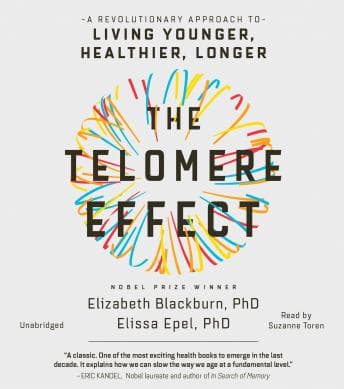
Here's what makes this different from your average longevity book written by some wellness influencer with a supplement line: Elizabeth Blackburn won the Nobel Prize in Physiology or Medicine in 2009 for discovering telomerase. That's not a blurb-worthy credential - that's the actual scientist who found the thing. Pairing her with Elissa Epel, a health psychologist who studies stress and aging, should be the dream team. And for the first few hours, it is.
The core science is genuinely interesting. Telomeres are the protective caps on your chromosomes - think of them like the plastic tips on shoelaces. They shorten as you age. When they get too short, cells stop dividing properly, and that's when things go sideways. Blackburn's discovery of telomerase, the enzyme that can actually replenish these caps, is legitimately groundbreaking. The book walks you through how chronic stress, poor sleep, processed food, and toxic relationships literally eat away at your telomeres at a cellular level. The mind-body connection isn't woo-woo here - it's measured in base pairs.
The section on how childhood adversity and prenatal stress can shorten telomeres in kids hit different. My parents worked 14-hour days at the dry cleaner, came home exhausted, and somehow still made sure we ate dinner together. This book would tell them their stress was shortening their telomeres while their community bonds and sense of purpose were lengthening them. This is what my parents did instinctively. Now it has a TED talk.
The 11-Hour Problem
But here's where my consulting brain kicks in: this book is 11 hours long. The actual science - the telomere biology, the key studies, the actionable findings - that's maybe 4 hours of material. The rest? Lists of foods. Exercise recommendations that sound like every other health book published since 2010. The same editorial bloat buries a genuinely sharp idea in In the Flo—you get a brilliant hormonal framework, then seven chapters that could've been a pamphlet. Meditation suggestions. Neighborhood design principles. A chapter that basically says "don't live in a bad neighborhood" as if that's a lifestyle choice and not an economic reality.
I've seen this pattern in a hundred business books - and it's worse in health books. You get the insight early, and then the authors feel obligated to give you a complete life manual. Compare this to something like Why We Sleep by Matthew Walker, which is roughly the same length but sustains genuine revelation throughout. The Telomere Effect front-loads its best material and then becomes a wellness checklist.
Skip to chapter 5. Thank me later. Actually, better yet - listen to the first four chapters carefully, then skim the rest for anything that applies to your specific situation.
Suzanne Toren Does What She Can
Suzanne Toren narrates with clear, professional delivery - exactly what you want for dense scientific material. She doesn't try to make it exciting. She doesn't need to. When the content is strong (the studies on caregivers whose telomeres shortened measurably during periods of high stress), her steady tone lets the data land. When the content is a grocery list of anti-inflammatory foods, well - no narrator can make that riveting. She's competent and invisible, which is the right call for this kind of book. Not a performance you remember, but not one that gets in the way either.
I've heard Toren bring a lot more dramatic flair to a murder trial than to cellular biology—Raspberry Danish Murder proves she can sell a pastry-related crime with the same steady pace, which makes me respect her restraint here even more.At 2.0x speed, I finished this in about five and a half hours. That felt closer to right. Toren's pacing is deliberate enough that acceleration doesn't turn it into gibberish, which is more than I can say for some narrators.
Who Gets the Best Return on This Listen
If you're someone who needs the scientific credibility behind advice you've already heard (sleep more, stress less, eat vegetables, exercise) - this is your book. The telomere framework gives you a biological mechanism for why those things matter, and Blackburn's Nobel credentials mean you can't dismiss it as pop psychology.
If you're already bought into the lifestyle medicine approach and you've read Greger or Walker or Huberman's work - you're going to be bored by hour 6. The science is solid but the prescriptions aren't new.
My wife would tell me I should be more grateful for a book that made me think about stress management while actively stressing about how long the book is. Jenny would say I'm being harsh. Jenny is right. But also - this needed an editor with a machete.
Bottom Line: Good Science, Bad Time Management
The key takeaway is worth the listen. The other 7 hours? Not so much. Blackburn's telomere research is the real deal, and the framework for understanding how stress literally ages your cells is powerful enough to change behavior. But at 11 hours, this book violates its own thesis - it's adding unnecessary stress to your life when it could've respected your time and delivered the same impact in half the runtime.








![Steve Jobs [unabridged audiobook] audiobook cover](/_next/image?url=https%3A%2F%2Fcovers.audiobooks.com%2Fimages%2Fcovers%2Ffull%2F9788499923406.jpg&w=1920&q=75)