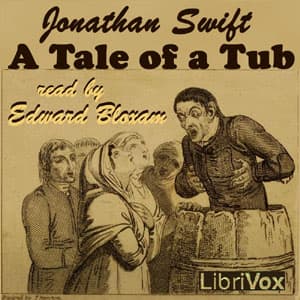

This is not a mom book. Let me just say that upfront. This is a 300-year-old satire about religious infighting written by the guy who gave us Gulliver's Travels, and I listened to it during Sophie's nap time like some kind of unhinged person who thinks she's going to become an intellectual between diaper changes.
So how did I end up here? Blame my husband, who casually mentioned Jonathan Swift at dinner like we're people who discuss 18th-century literature over reheated chicken nuggets. I saw it was only 4 and a half hours and thought, "Sure, I can handle that in a week." Reader, it took me almost two weeks, and I had to rewind more times than I've replayed the Bluey theme song.
Three Brothers Walk Into a Will
The core story is actually kind of brilliant once you get your bearings. Three brothers - Peter, Martin, and Jack - inherit coats from their father with strict instructions not to alter them. Naturally, they immediately start altering them. Peter's the Catholic Church, going full maximalist with gold lace and embroidery. Martin's the Church of England, trying to carefully remove the extras without ripping the fabric. And Jack's the Puritans, literally tearing his coat to shreds trying to get back to the original.
It's... a surprisingly good metaphor? Like, I genuinely laughed at the absurdity of Peter convincing his brothers that bread is literally mutton because he says so (hello, transubstantiation debate). Swift had this razor-sharp way of making serious theological arguments sound completely ridiculous just by describing them plainly. That part survived my pauses and interruptions just fine.
But here's the thing - the brothers' story is maybe 40% of the actual book. The rest is these wild "digressions" where Swift parodies bad writing, literary critics, and basically everyone who annoyed him in the 1690s. And some of those digressions are genuinely funny (the bit about critics being descendants of the goddess Criticism, born from ignorance and pride, is pretty timeless). But others require context I simply do not have. There's a whole section about the Battle of the Books that assumes you know about a specific academic feud between ancients and moderns that was apparently a huge deal in 1704.
Edmund Bloxam Doing God's Work (Literally)
Okay, here's where credit is due. Edmund Bloxam reads this thing clearly and steadily, which is no small feat given that Swift writes sentences that go on for actual paragraphs. His pacing is even, his tone has just enough dry wit to signal when Swift is being ironic (which is... always?), and he handles the archaic language without making it sound like a museum tour. For a free LibriVox recording of a notoriously difficult text, this is solid work.
BUT. The Latin. There are Latin phrases scattered throughout this book like Lucas scatters Legos across my kitchen floor - everywhere, unavoidable, and painful when you step on them unprepared. Bloxam reads them, as he should, but there's no translation. No pause. No context. Just sudden Latin in your earbuds while you're folding tiny socks, and you're supposed to just... know what it means? I don't know what it means. I took Spanish in college and barely retained that.
This is the kind of book that really needs footnotes, and audiobooks don't have footnotes. That's a fundamental problem no narrator can solve.
Who This Is (And Isn't) For
Let me be honest: this did not survive 47 pauses and still make sense. This required actual focus. I ended up listening to chunks during car time after the kids were in bed - sitting in the dark garage, trying to parse 18th-century satire at 1.25x speed like some kind of academic fugitive.
If you studied Swift in school, if you're into the history of religious satire, or if you genuinely enjoy untangling dense allegory - this is a sharp, funny, surprisingly modern-feeling work. Swift was essentially doing what the best satirists do now, just with powdered wigs. The man got himself blacklisted from church promotion because this book was too spicy. That's kind of amazing.
But if you're looking for something you can half-listen to while wiping counters? This ain't it. Not even close. This is a "dedicated listening, maybe with a Wikipedia tab open" kind of experience.
Back to My Regularly Scheduled Programming
I'm genuinely glad I listened to this. It made me feel like my brain still works for things beyond snack logistics and school permission slips. But am I going to recommend it to the other moms at pickup? Absolutely not. They'd think I'd lost it. I'm going straight back to a romance novel where the biggest conflict is whether the brooding contractor will kiss the bakery owner by chapter twelve. Modern Romance is already loaded and waiting — my brain has earned something that doesn't require a Wikipedia tab. My brain needs the vacation.
Swift was brilliant. This book is important. And it is emphatically not a multitasking listen.