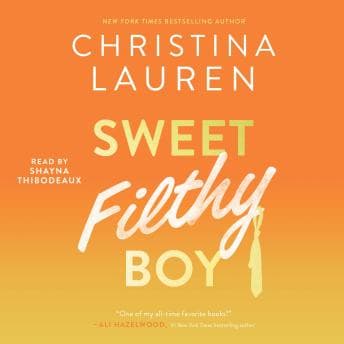

I was not supposed to be listening to this book. Let me explain. Denise and I were walking the lakefront last Saturday — one of those perfect Chicago evenings where the light hits the water just right and you feel temporarily absolved of all your responsibilities — and she had queued up Sweet Filthy Boy on our shared Audible account. Her pick, not mine. I teach Faulkner and Fitzgerald. I have opinions about the semicolon. But somewhere around hour two, while pretending I was merely tolerating it for marital harmony, I caught myself genuinely invested in whether Mia Holland was going to get her act together in Paris. And I thought: okay, Marcus. Time to check your literary snobbery at the door.
Here's the thing about Christina Lauren — which, if you didn't know, is actually two people, Christina Hobbs and Lauren Billings writing together. That collaborative energy shows up in the pacing. The book moves like a conversation between friends who keep interrupting each other with the good parts. The premise is bonkers on paper: recent college grad drunkenly marries a French stranger in Vegas, then follows him to Paris for the summer instead of starting the safe, parent-approved career she doesn't want. It could be pure fantasy escapism. And it is, partly. But what surprised me is that the book is actually doing something real underneath the Paris apartments and the steamy scenes — it's about a young woman who's terrified of her own agency. Mia's not just running toward Ansel Guillaume; she's running away from a life that was never hers to begin with. Her father's expectations, her pre-mapped career. That tension between obligation and desire is as old as literature itself. This reminds me of what Hemingway said about Paris — that it's a moveable feast — except here it's less about artistic freedom and more about figuring out who you are when nobody's watching.
The French Accent Question (And Why It Matters More Than You Think)
Shayna Thibodeaux narrates, and her performance is a split decision. When she voices Ansel, her French accent is legitimately good — not the cartoonish "hon hon hon" thing you get in bad audiobooks, but something warm and slightly rough around the edges. During the French dialogue scenes, you can hear her leaning into it with real confidence. One listener I read described Ansel sounding "yummy," and honestly? That tracks. Thibodeaux gets the romantic and intimate scenes right too — the "sweet filthy" moments (the title earns itself, trust me) land with the right mix of heat and tenderness.
But here's where it gets complicated. The narrator has a cadence problem. And once you hear it, you can't unhear it. There's a rhythmic pattern — almost a sing-song rise and fall — that repeats across chapters, across scenes, across moods. By hour five, I found myself grading papers and suddenly realizing I'd drifted because the vocal rhythm had lulled me into autopilot. Same-gender characters blur together too. Mia's best friends should feel distinct, but through Thibodeaux's voice they sort of... don't. The sassy, flirty register she gives Mia works beautifully, but when her girlfriends show up, you're mostly relying on context clues to figure out who's talking.
The narrator understands that pause is punctuation — she proves it in the quieter romantic moments — but she doesn't always vary her toolkit enough to sustain ten hours without some fatigue.
What My Students Would Call "The Vibes" (And What I'd Call the Actual Craft)
Let's talk about what the author is really saying. Christina Lauren is smart about structure here. The Vegas opening is deliberately chaotic and blurry — mirroring Mia's headspace — and then the move to Paris slows everything down. The book becomes almost a domestic drama: two strangers who are technically married trying to build something real inside a situation that started as pure impulse. Ansel works long hours, Mia wanders Paris alone, and the loneliness that creeps in feels earned rather than manufactured. There's a stretch in the middle where Mia starts exploring the city by herself, finding her own rhythm apart from this man she barely knows, and that's when the book clicked for me. Not the romance — the self-discovery.
Is it high literature? No. My students would probably love this, actually, which means I should be suspicious. But the prose is clean, the emotional beats are honest, and the pacing rarely drags across those ten hours. If you loved the Beautiful Bastard series and want something with a little more emotional depth and a European setting, this is its spiritual successor — or maybe its more grown-up cousin.
Who Should Hit Play (And Who Should Keep Walking)
Romance readers who want a vicarious summer in Paris with genuine character growth underneath the steam — this is your book. If you're an audiobook listener who needs sharp vocal differentiation between characters, the narration might frustrate you. I'd recommend focused listening over background mode; the cadence issue means you will drift if you're multitasking. (I lost a solid twenty minutes during a stack of sophomore essays before I realized I'd absorbed nothing.)
If you're a literary snob like me who thinks romance can't do real emotional work — give it three hours. You might not convert, but you'll at least respect the craft.
Worth Pausing the Faculty Meeting For?
Not quite. But worth a lakefront walk with someone you love? Absolutely. The narration holds it back from greatness, but the story itself is smarter than its title suggests. And sometimes that's enough — a book that surprises you by being more than what you expected. Denise finished it before I did and just smiled when I asked how it ended. She knew I'd keep listening. She was right. Though if you want a reminder of what happens when narration actively undermines a story rather than just occasionally losing its rhythm, my notes on Into the Water are a pretty stark contrast — that one had the opposite problem, where the vocal chaos buried what could have been genuinely affecting material.