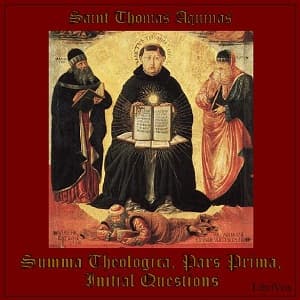

Can you teach someone to think about God? Not to believe—that's a different question entirely—but to actually think systematically about the divine, about existence itself, about why there's something rather than nothing?
Thomas Aquinas thought you could. And 750 years later, I found myself testing that theory during a particularly brutal stretch of late-night paper grading, letting Jim Ruddy's steady voice walk me through arguments that shaped Western thought for centuries.
A Manual for Beginners (Who Are Apparently Smarter Than Me)
Aquinas called the Summa a "manual for beginners." My students would hate this. I love it. Because here's the thing—this is what intellectual rigor looked like in the 13th century. Each question follows the same structure: objections first (here's why you might disagree), then Aquinas's response (here's why you're wrong), then replies to each objection. It's debate club meets graduate seminar meets monastery.
This first volume covers what Aquinas considered the foundational questions—the existence and nature of God, divine knowledge, divine will, providence. The famous Five Ways (those proofs for God's existence your philosophy professor mentioned once) show up early. But what struck me wasn't the conclusions. It was watching a mind work through problems with almost mathematical precision. "Whether God exists" gets treated with the same methodical care as "Whether there is only one God" or "Whether God knows future contingent things."
At nearly thirteen hours, this is not casual listening. I won't pretend otherwise. There were moments—somewhere around hour seven, I think, deep into questions about divine simplicity—where I had to pause, rewind, and genuinely ask myself what century I was in.
Jim Ruddy as Translator Across Time
Ruddy reads this like what it is: a philosophical text that demands clarity above drama. His pacing is measured. Deliberate. The kind of reading that lets the arguments breathe rather than rushing toward some climax that isn't coming.
Is it electrifying performance art? No. But it shouldn't be. What Ruddy provides is consistency and comprehension—you can actually follow the logical threads, which is no small feat when Aquinas is distinguishing between "simple apprehension" and "composition and division" for the fourteenth time. One listener called it "eloquent," and that's fair. It's the eloquence of a good lecturer, not a stage actor.
The LibriVox production is clean, which matters more than you'd think for material this dense. No distracting audio artifacts pulling you out of a syllogism.
Who Should Listen (And Who Should Run)
Let me be direct. If you're looking for spiritual comfort or devotional listening, this isn't it. If you want to understand why Catholic theology developed the way it did, why natural law theory exists, why certain philosophical questions about God got framed in particular ways for centuries—this is primary source material. The real thing. For a much gentler exploration of faith and moral reasoning, Love and Respect approaches divine principles from a completely different angle—though Aquinas would probably have some objections to file.
Philosophy students, theology nerds, anyone who's ever wanted to actually read Aquinas instead of just reading about him. Also: people who find dense argumentation oddly soothing. (I'm not judging. I'm one of you.)
Skip this if you need background listening. I tried it while grading essays on The Great Gatsby and found myself writing margin notes about efficient causation. Don't do this to yourself.
Class Dismissed (But the Reading Continues)
Here's what I kept thinking: we don't read like this anymore. We don't think like this anymore—taking a single question ("Whether God can be seen in His essence?") and spending pages examining it from every angle, anticipating objections, building responses brick by brick. It's exhausting. It's also kind of beautiful.
The Summa was never finished. Aquinas stopped writing in 1273, reportedly after a mystical experience that made everything he'd written seem "like straw." There's something almost unbearably human about that—a man who spent his life building the most systematic theology in Christian history, and then just... stopped.
This audiobook is the beginning of that unfinished cathedral. Whether you find the architecture compelling or oppressive probably depends on your tolerance for medieval scholasticism. But if you've ever wanted to understand how we got from Aristotle to the modern university, from Athens to Rome to the arguments your philosophy-major nephew makes at Thanksgiving—this is where a lot of those threads come together.
I listened at 1.0x because the author chose those words. Aquinas chose them very, very carefully. And 750 years later, they're still worth hearing properly.