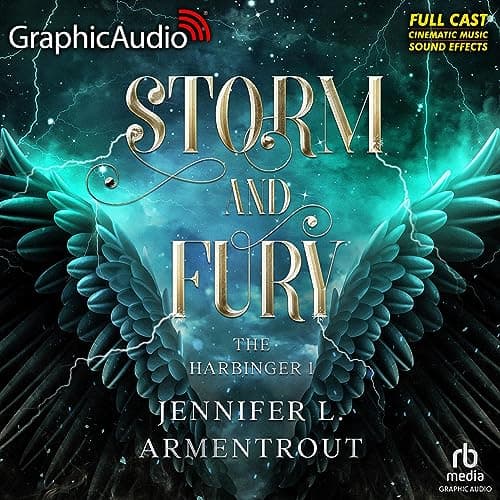
So here's the thing — I went into this expecting to be a snob about it. Armentrout writes paranormal romance with fantasy trappings, and I'm over here with my Shirley Jackson shrine and my annotated copy of The Haunting of Hill House. But I was shelving our YA paranormal section at the library last Tuesday, and one of my teen patrons told me the dramatized version of Storm and Fury was "like watching a movie but in your ears," and honestly? That's a pitch I can't ignore. So I queued it up during a late shift reorganizing our horror stacks (the irony of sorting Dean Koontz while listening to gargoyle romance was not lost on me).
And look — I didn't hate it. I kind of loved parts of it. Which genuinely surprised me.
When the Demons Breach the Compound, You Hear the Stone Crack
This isn't a standard audiobook. It's a full dramatized adaptation with — and I'm counting — over twenty-five cast members, plus sound effects and a cinematic score. The production team committed to making this feel like an audio drama, not a narrated novel, and that distinction matters enormously. When Wardens shift into their gargoyle forms, there's this grinding, geological sound design underneath the dialogue that sells the physicality of it. The demon encounters don't just get described — you hear the low-frequency rumble before the attack lands, the way the music drops out right before something terrible happens.
Tanja Milojevic carries Trinity with a voice that manages to be both vulnerable and sharp-edged, which is harder than it sounds when your character is going blind but can also see ghosts. She doesn't play Trinity as fragile. There's this bristling quality to her line readings, especially in the early exchanges with Zayne, where you can hear her actively resisting being charmed by him. Robb Moreira's Zayne has this careful steadiness to him — the kind of voice that sounds like it's always holding something back, which works because the character literally is.
The full cast approach means you're not relying on one narrator to differentiate fifteen characters through vocal tics. Each Warden, each outsider from the arriving clan, each demon gets their own actual human voice. This eliminates the usual audiobook problem of "wait, who's talking now?" entirely.
Trinity's Secret Isn't the Hook — Her Stubbornness Is
I expected the central tension to be about Trinity hiding her abilities from demons who would consume her. And technically, yes, that's the plot engine. But what actually kept me listening past hour three was Trinity's refusal to be protected. She's been kept in a guarded compound her whole life, surrounded by shape-shifting Wardens who treat her like a porcelain bomb, and she's furious about it in a way that feels earned rather than bratty. Her deteriorating vision isn't played for pity — it's played as the thing that makes her more dangerous, more reckless, more willing to throw herself into a fight she probably can't win.
The romance between Trinity and Zayne follows beats that'll be familiar if you've read Armentrout before — irritation to attraction to reluctant trust — but the dramatized format actually makes the banter land differently than it would on a page. The Near Witch pulls off that same slow-burn tension on the page — the kind where restraint does more work than confession. You hear the pauses. The almost-laughs. The moments where one of them starts to say something honest and then pulls back. The actors are doing actual scene work here, not just reading dialogue.
Now, is this horror? No. Let me be clear about that. My podcast listeners would eat the demon mythology alive (pun intended), but this is paranormal fantasy romance with horror-adjacent set dressing. The demons are threats, not terrors. The violence is action-movie, not dread-inducing. If you're coming to this expecting the kind of slow atmospheric crawl that makes you check your locks at night — that's not what this is doing, and it's not trying to.
What the Dramatization Gets Right (and What It Trades Away)
One listener noted they picked up more details in this version than in the original audiobook, and I believe it. When you have sound design doing the work of description, the script can cut exposition and let you absorb worldbuilding through ambient information — the echo of the compound halls, the way outdoor scenes have wind and insect sounds layered under dialogue. Your brain fills in the visual without being told what to picture.
The trade-off is interiority. Trinity's internal monologue gets trimmed significantly in a dramatized format, and some of the character depth lives in her unspoken thoughts. You lose her private observations, her sardonic internal commentary. The actors compensate with vocal performance, but it's a different kind of intimacy — external rather than internal.
At ten hours and change, the pacing stays tight. The Armentrout tendency toward slow-burn romantic tension gets punctuated by genuine action sequences that the sound design elevates from "described fight" to "experienced fight." The compound breach in particular hits different when you're hearing it rather than imagining it.
Shelve This Under "Guilty Pleasure I Don't Feel Guilty About"
I'm not going to pretend this changed my understanding of the genre or challenged me intellectually. But the production quality is legitimately impressive, the cast commits — and that's rare in dramatized adaptations that often feel like they're splitting the difference between audiobook and radio play without fully committing to either. This one commits. It knows what it is, it does it well, and it respects its audience enough to invest in real production value.
Shirley (my cat) was unimpressed. But she's unimpressed by everything that doesn't involve gargoyles made of actual stone, so her opinion is noted and dismissed.
Skip this if you're after genuine horror — the demons here are action-set-piece threats, not the kind that follow you to bed. But if you want a paranormal fantasy romance that sounds like it costs way more than a single credit, and you don't mind trading internal monologue for full-cast scene work, this is the one.