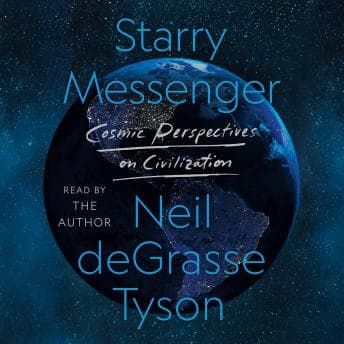

Look, I have a confession. I started this audiobook fully prepared to be annoyed.
Not at Neil deGrasse Tyson specifically—I've consumed enough of his content to know what I'm getting into. But the subtitle "Cosmic Perspectives on Civilization" had me bracing for seven hours of "have you considered that we're all just stardust, man?" energy. The kind of thing that sounds profound at 2AM but falls apart under daylight scrutiny.
I was wrong. Mostly.
The Tyson Algorithm
Here's the thing about NDT narrating his own work: the man has a voice that could sell you a timeshare on Mars. That smooth, warm delivery with just a hint of a burr—it's basically ASMR for science nerds. And unlike some author-narrated audiobooks where you can tell they're reading off a page (looking at you, every tech founder memoir ever), Tyson sounds like he's just... talking to you. Like you're sitting across from him at a bar and he's explaining why your political arguments are cosmically irrelevant.
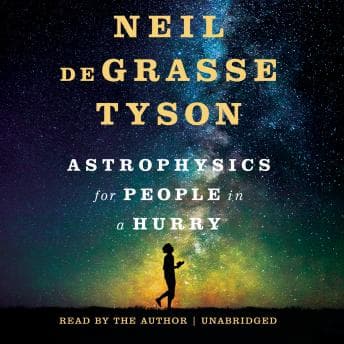
Which brings me to the actual content. This isn't "Astrophysics for People in a Hurry"—that book was about space. This one is about us. Tyson takes his cosmic perspective and points it at war, politics, religion, race, gender—basically every topic your family tells you not to bring up at Thanksgiving. His thesis is pretty simple: if we could zoom out and see ourselves as one species on one pale blue dot, maybe we'd stop being such idiots to each other.
It's not a new idea. But Tyson's execution is surprisingly effective.
Where the Science Brain Meets Society
The best parts of this audiobook are when Tyson applies actual scientific reasoning to cultural debates. Not in a "well, actually" way (okay, sometimes in a "well, actually" way), but in a way that genuinely reframes problems. He's not trying to tell you what to believe—he's trying to show you how a scientist approaches questions. David and Goliath does something similar, using data to challenge our assumptions about power dynamics. The difference between correlation and causation. The importance of sample size. Why anecdotes aren't data.
At 7 hours and 17 minutes, this is basically three commute days for me. I finished it in two because I kept listening during my lunch breaks. That's the ROI metric that matters.
Now, I should mention—some listeners apparently take issue with his chapters on race and social issues. I read a few reviews where people called it a "rant." Having listened to the whole thing, I think that's... a stretch. Tyson's approach is analytical, not preachy. But if you're someone who gets defensive when anyone applies logic to topics you'd rather keep emotional, maybe this isn't your book. That's not a criticism of the book—that's a feature-not-a-bug situation.
When to Queue This Up (And When to Skip)
Perfect for: train, gym, walking the dog. The chapters are self-contained enough that if you zone out during a crowded BART situation, you can pick back up without losing the thread.
Skip for: deep work sessions. Tyson's arguments are engaging enough that you'll want to actually process them, which is hard to do while debugging a production incident. (Ask me how I know.)
The narration itself is flawless—clean production, great pacing, and Tyson's natural charisma carries even the sections that could've felt lecture-y. He won an AudioFile Earphones Award for this, which tracks. When the author IS the narrator AND the narrator is basically a professional science communicator, you get something that feels less like an audiobook and more like a really good podcast series.
My one minor gripe: some of the arguments feel a bit surface-level. Tyson's covering a LOT of ground here—war, beauty, truth, gender, race, vegetarianism (yes, really)—and you can't go deep on everything in seven hours. It's more of a "here's a new way to think about this" sampler platter than a deep dive into any single topic. For some listeners, that'll feel unsatisfying. For me, on my 6:17 AM Caltrain surrounded by other zombies, it was exactly the right level of engagement.
The Zoom-Out Factor
Would I listen again? Probably not—but I'd recommend it to anyone who needs a mental reset on how to approach disagreements. In a world where everyone's screaming past each other, having someone calmly suggest "hey, what if we looked at this from 250,000 miles away" is weirdly refreshing.
Tyson's not trying to solve everything. He's just asking you to zoom out. And honestly? That's worth seven hours of commute time.