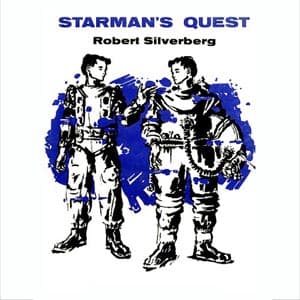

Look, I have a bone to pick with 1958. Specifically, with 1958's idea of what teenagers sound like. Because Alan and Steve - twin brothers separated by relativistic time dilation - talk like they're auditioning for a Leave It to Beaver episode written by someone who'd never actually met a teenager. "Gosh" and "golly" and earnest declarations about doing the right thing. It took me half my Tuesday commute to stop rolling my eyes.
But here's the thing. Once I got past the dated dialogue, Silverberg's actual science held up way better than I expected for a novel older than my parents.
The Twin Paradox Before It Was Cool
Bottom Line: Worth your commute if you're a sucker for classic space opera concepts.
This is basically the twin paradox thought experiment but for pulp adventure. Alan lives on the Dorado, a starship that hops between planets at near-light speed. His twin Steve got off the ship years ago - but because of time dilation, Steve's now decades older while Alan barely aged. When Alan finally leaves to find his brother, he's walking into a world where his twin is middle-aged and he's still seventeen.
The science actually holds up. Silverberg doesn't handwave the relativistic effects - he builds the entire social structure of spacemen around them. Jurassic Park does something similar with chaos theory - taking real science and building an entire thriller around its implications. These crews are essentially a separate society, aging slower than everyone else, unable to maintain normal relationships with groundsiders. It's the kind of worldbuilding that makes you go "oh, right, that's why this guy won all those Hugos."
At just over 5 hours, the pacing moves. No bloat. I finished this in 3 commutes, which is my sweet spot for older sci-fi that might otherwise feel like homework.
Dawn Larsen Does What She Can
Here's where I have to be honest - I couldn't find much specific intel on Larsen's narration for this particular recording. What I can tell you: this is a LibriVox production, which means volunteer narration, which means your mileage may vary on production quality. The recording I got was clean enough that I wasn't distracted, and Larsen reads with steady pacing that doesn't fight the material.
She's not doing character voices that'll blow your mind, but she's also not doing that thing where you can't tell who's talking. For a 1950s juvenile novel with fairly straightforward prose, competent and clear is actually what you want. I bumped it to 1.5x without losing anything.
Who Gets Value Here (And Who Doesn't)
Perfect for: train, gym. Skip for: deep work.
If you want a short, punchy piece of classic SF from a Grand Master before he became a Grand Master - time dilation, gambling dens on future Earth, a protagonist caught between two worlds - this delivers. Skip it if dated gender politics bother you (women are basically scenery) or if "golly gee" dialogue makes you want to throw your phone.
The content warnings for drug use and violence are pretty mild by modern standards - we're talking 1950s juvenile fiction, so think "implied" rather than "graphic."
Is it dated? Absolutely. But as a time capsule of what hard SF looked like before the New Wave? As a 5-hour palate cleanser between heavier series? It works.
The fact that it's free through LibriVox doesn't hurt either. Could've been a blog post? No - this one earns its runtime. It's lean, it moves, and the central concept of spacemen as a separate aging class of humanity is genuinely clever.
My Caltrain Verdict
I started this at 6AM surrounded by other Caltrain zombies, mildly annoyed by the golly-gee dialogue. By the time I got to Mountain View, I was genuinely curious how Alan would handle finding his brother. That's the Silverberg hook - even his early stuff knows how to keep you listening.
Just... maybe don't expect anyone to talk like a real human. It was 1958. They hadn't invented teenagers yet.