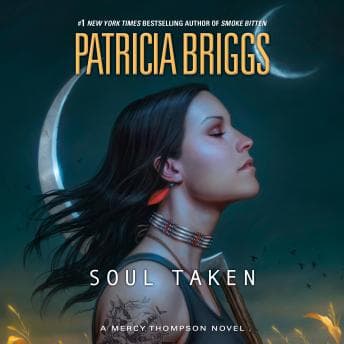

Okay, I need to rant about something before we get into this. Book thirteen. THIRTEEN. In a series. And Patricia Briggs is still introducing new supernatural lore and faction politics like she's got an infinite content well. Meanwhile, I can't even keep my thesis outline consistent across three chapters. The audacity.
I was supposed to be debugging my procedural generation code — the one that's been broken since, honestly, late September — and I had this queued up as "background listening." That lasted about twenty minutes before I closed my laptop lid and just... sat there in my desk chair in the dark, headphones on, completely absorbed in Wulfe's mess.
The Vampire Who Won't Stay in His Lane
So here's the deal with Soul Taken: the premise is deceptively simple. Wulfe — ancient vampire, semi-unhinged, has been stalking Mercy in that creepy "I find you fascinating" way — goes missing. And normally you'd think, good riddance, right? But the power structure in the Tri-Cities is a Jenga tower, and Wulfe is one of those load-bearing blocks you don't want to pull. So Mercy and Adam have to go find him.
But then bodies start showing up, and there's this whole thread about the Harvester — a figure with a cursed sickle that reaps souls, which sounds like it walked straight out of a B-movie plot and Briggs knows it. She leans into that campiness just enough to make you think it's going to be a simpler mystery, then pulls the rug. The actual antagonist situation is darker and more tangled than the Harvester legend suggests, and by the back half of the book, the stakes feel genuinely personal for Mercy in a way that goes beyond "I might die." It's more like "I might lose the parts of myself that make surviving worth it."
The magic system stuff here — look, it's urban fantasy, so it's not going to be Sanderson-level hard magic with detailed rules. But Briggs does something I really respect: she keeps layering in new supernatural mechanics (the soul-taking sickle, fae artifact lore, vampire metaphysics) without contradicting thirteen books of established continuity. That's world-building discipline. My D&D group would love this kind of artifact design — the sickle isn't just a macguffin, it has rules about how it works and what it costs.
The way the sickle feels like a cursed D&D item with actual mechanics reminded me of the dark, cost-heavy powers in Young Elites—though that series leans way harder into tragedy than campy sickle lore.Lorelei King IS Mercy Thompson at This Point
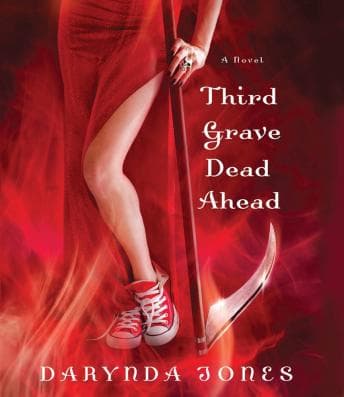
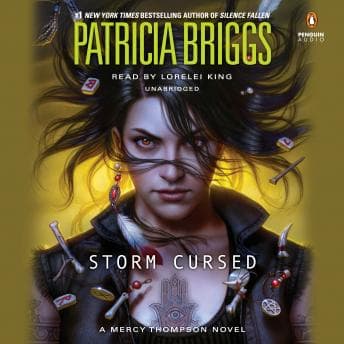
Thirteen books. Lorelei King has been voicing these characters for thirteen books, and it shows in the best possible way. Her Mercy is so lived-in — that dry, slightly exhausted first-person narration where Mercy is simultaneously terrified and cracking jokes — King nails the tone without ever making it feel like she's performing "sarcastic heroine." It just sounds like a real person thinking out loud while terrible things happen around her. That same dry, I-cope-by-making-jokes energy is a huge reason I tore through the Charley Davidson audiobooks—Fourth Grave Beneath My Feet has Lorelei King nailing that exact blend of gallows humor and genuine heart.
Her male voices are genuinely impressive. Adam sounds like Adam. Wulfe sounds distinctly unsettling — there's this slightly too-smooth quality she gives him that makes your skin crawl in the right way. She maintains consistent character voices across what is now a massive cast, and for longtime listeners, that consistency is worth its weight in gold. You don't have to re-learn who anyone is. You hear the voice and you know.
Now. I have to be honest about the production side, because some copies of this audiobook apparently have issues — scratchy audio in spots and what sounds like repeated sentences that didn't get caught in editing. I hit what I think was one repeated line and it yanked me right out of a tense scene. It's not King's fault, it's a production QA problem, and it's frustrating because her performance deserves better. If you're the kind of listener who can roll past a minor audio hiccup, you'll be fine. If that stuff makes you want to throw your phone, maybe check reviews on your specific platform first.
Who's Going to Love This (And Who Should Back Away Slowly)
If you've been riding with Mercy Thompson since Moon Called, this is an easy yes. The character relationships have this accumulated weight that only comes from a long series — the Mercy/Adam dynamic, the pack politics, the way Mercy's relationships with the fae and vampires have evolved. Briggs rewards long-term readers here.
If you're already obsessed with this world and haven't picked up the companion Alpha & Omega series, Dead Heat brings the same tense pack drama and Lorelei King narration that makes these books impossible to pause.If you haven't read the series? Do not start here. Book thirteen is not your on-ramp. You'll be drowning in faction politics and character history within the first hour. Go back to the beginning. Yes, it's a commitment. Yes, it's worth it.
For the LitRPG and hard fantasy crowd — this is softer magic, character-driven urban fantasy. If you need stat blocks and power scaling, this isn't your thing. But if you appreciate a well-maintained supernatural world where the rules are consistent even if they're not spelled out in appendices, give the series a shot.
Roll for Initiative, Mercy
At 10 and a half hours, this is a tight, focused entry in a long-running series. Not the best Mercy Thompson book — I'd probably give that crown to River Marked or Silence Fallen — but it's a strong installment that handles a genuinely creepy central mystery and pushes Mercy into uncomfortable emotional territory. Lorelei King's performance carries it even through the production hiccups. I read this instead of writing my thesis, and I regret nothing. (Dr. Patel, if you're reading this, no you're not.)