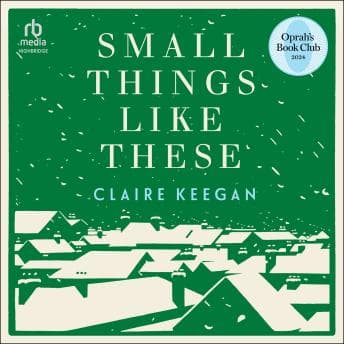

Two hours. That's it. That's the whole audiobook. And I'm genuinely annoyed about it — not because Claire Keegan shortchanged anyone, but because those two hours hit harder than novels five times their length, and now I have to sit with this feeling in my chest with no more pages left to process it.
I finished this on the lakefront last Saturday morning, Denise walking beside me, and when the audiobook ended I actually stopped walking. Just stood there. Denise asked if I was okay. I wasn't sure.
The Silence Between the Coal Dust
Here's what Keegan does that I wish I could teach my sophomores: she writes a story about enormous, institutional evil through the smallest possible lens. Bill Furlong is a coal merchant. He delivers fuel. He has five daughters and a wife and a routine that fills his days with honest, physical labor. And the story never leaves his scale. It never zooms out to give you the historian's view of the Magdalene laundries or Ireland's relationship with the Church. It stays in Bill's truck, in the frost of a December morning, in the weight of a coal bag on his back.
The discovery at the convent — I won't spoil the specifics, but you'll know the moment — lands like a stone dropped into still water. And then the rest of the book is just the ripples. Bill knows what he saw. The town knows what the convent is. Nobody talks about it. This is why we still read the classics, because this kind of moral pressure — the weight of a community's silence pressing down on one ordinary man — that's Ibsen. That's "An Enemy of the People" in an Irish wool coat.
My students would hate this. They'd say nothing happens. I love it.
Aidan Kelly Knows That Pause Is Punctuation
The narrator understands something critical about Keegan's prose: the white space matters as much as the words. Kelly reads with a gruff warmth — authentic Irish accent, nothing performed or tourist-brochure about it — and he lets sentences breathe the way they need to. Bill Furlong's voice is steady, working-class, the kind of man who measures his words because he knows they cost something.
But the real performance? The Mother Superior. Kelly shifts into something caustic and controlled for her, a voice that's polite the way a closed fist is polite — technically not threatening, but you know what's underneath. That contrast between Bill's quiet decency and the Superior's institutional authority is where the whole drama lives, and Kelly nails it through emphasis and tone alone. No theatrical tricks. Just a man reading with intelligence and restraint.
I listened at 1.0x, obviously, because the prose deserves to be savored. This isn't a book you speed through. Keegan chose every single word — and at under two hours, she clearly cut ten for every one she kept. Speeding this up would be like fast-forwarding through a Chopin nocturne.
The Ending People Keep Complaining About
Let's talk about it. Some listeners hit that final moment and apparently said "What?!" out loud. I get it. The book ends abruptly — or at least it feels abrupt if you're expecting resolution in the conventional sense. But here's what I think Keegan is really saying: the heroic act isn't the grand gesture at the end. It's the small, terrifying decision to not look away. Bill Furlong doesn't transform into a crusader. He just — and this is everything — refuses to pretend he didn't see what he saw.
This reminds me of what Hemingway said about writing — that you can leave things out if you know them well enough, and the reader will feel them. Keegan knows the full weight of Irish history with the Magdalene laundries, knows it in her bones, and she trusts us to carry that knowledge into the gaps. The ending isn't unfinished. It's a door left open. What matters is that Bill walked through it.
Who Needs to Hear This
If you loved "Foster" (also Keegan, also devastating, also short), this is its spiritual successor in both form and moral seriousness. If you're the kind of listener who thinks great literature has to be 600 pages — give this a chance. It'll rearrange something in you before you finish your morning coffee.
Skip it if you need plot-heavy stories with clear beginnings, middles, and ends tied up with ribbon. This isn't that. I gave Secretly Yours a shot a few months back precisely because I was craving that ribbon-tied ending, and honestly — sometimes you need that palate cleanser between books that crack you open like this one does. This is a character study of one man's conscience, and it assumes you're willing to do some of the emotional work yourself.
Worth Pausing the Faculty Meeting For
Two hours. Shorter than most faculty meetings I've survived. But there's more genuine moral courage in Bill Furlong's quiet decision than in a thousand epic fantasy battles. The prose is spare and perfect. Aidan Kelly's voice is the exact right instrument for it. And I'm going to be thinking about that convent doorway for a long time.
I'm adding this to my podcast queue. All 47 of you — especially you, Mom — stay awake for this one. It's short enough. I promise.