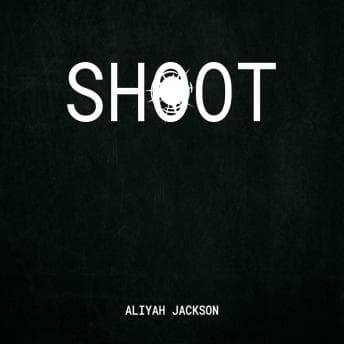

"Written to heal myself, published to heal others."
That's how Aliyah Jackson describes SHOOT, and honestly? That line hit me before I even pressed play. I've been teaching poetry to teenagers for two decades, and every year I tell them the same thing: poetry isn't meant to be silent. It lives in the breath, the pause, the catch in someone's throat.
So when I found this collection—13 poems about police brutality and systemic racism from 2020—I knew I needed to hear it, not just read it.
When the Poet Becomes the Voice
Here's what my students don't always understand about author-narrated work: it's a gamble. You're betting that the person who wrote the words can also perform them. Gambler: Secrets from a Life at Risk takes that same bet with Billy Walters narrating his own story, and mostly wins. Sometimes you get Maya Angelou reciting "Still I Rise" and the universe makes sense. Sometimes you get... well, something else.
Jackson reads her pieces with genuine emotional weight. You can hear it—that thing I try to teach my kids about, how certain lines need to land differently than others. She gets it. The poems themselves emerged from 2020, from watching Black bodies become hashtags, from that particular exhaustion of grief mixed with rage mixed with the demand to keep explaining your humanity to people who should already know.
I listened while grading papers at 11 PM, which is maybe not the right context for this. Or maybe exactly the right context. There's something about being tired, about having your defenses down, that lets poetry actually reach you.
The Dual Narration Question
Here's where I need to be upfront about what the research shows. Larry Fleming is listed as a co-narrator alongside Jackson, and listener feedback on Jackson's work more broadly suggests her voice acting for other characters—particularly male ones—can be inconsistent. Some listeners found those moments distracting, even describing them as "silly" when the material demands gravity.
I couldn't find specific breakdowns of who narrates which poems in this particular collection. But if you're someone who gets pulled out of serious content by uneven voice work, that's worth knowing. Poetry collections like this live or die on tonal consistency.
(My students would roast me for hedging like this. But I'm trying to be fair here.)
The production itself is clean—no audio issues, no background noise. That part's solid.
Rawness as Method
Jackson wrote this to heal herself. She published it to heal others. There's a rawness to work that comes from that place—it's not polished in the way a carefully workshopped MFA piece might be. It's more like a wound that's still closing.
The themes are exactly what you'd expect from 2020: violence, systemic racism, the particular terror of being Black in America when every news cycle brings another name to remember. Content warnings apply here—this isn't escapism. This is witness.
I think about what I'd say if a student brought me this work. I'd tell them the emotional truth is there. I'd tell them the perspective matters. I'd probably also mention that sometimes the most personal work needs the most careful presentation, because the rawness can either hit harder or feel unfinished depending on how it's delivered.
Jackson's other work—Life in Solitude, Planting Gardens on the Moon—deals with similar themes of social justice and personal experience. This feels like part of a larger artistic project, one poem collection among many in an ongoing conversation about what it means to be Black in America.
Who This Is For (And Who Should Read Instead)
If you're looking for contemporary poetry that grapples with social justice—really grapples with it, not just gestures toward it—this is worth your time. If you appreciate hearing poets read their own work, understanding that author-narration comes with its own particular intimacy and its own particular risks, give it a shot.
But if inconsistent voice acting genuinely bothers you, if you need polished performance across every element, you might want to read the text instead. Several listeners wished they'd done exactly that.
Me? I'm glad I heard it. There's something about Jackson's voice on those central pieces that a print version couldn't give me. The pauses are punctuation. The breath is part of the line. That's what I tell my students, and that's what I heard here. Tao Te Ching works the same way in audio—those ancient verses need the silence between them to breathe.
The Teacher's Take
Thirteen poems. A whole year's worth of grief compressed into something you can experience in one sitting. That's either a feature or a limitation, depending on what you're looking for.
My mom would probably fall asleep during my podcast episode about this. But she'd understand why it mattered.