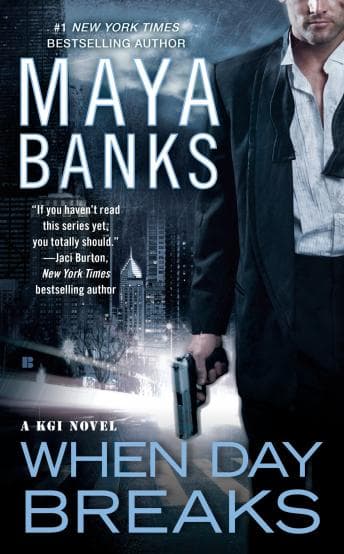
This is not a book I'd normally reach for. Let me be honest about that upfront.
I picked up Shades of Gray because Denise left it in our shared Audible library after binging the KGI series, and I was stuck in a dentist's waiting room with a dead phone battery and nothing but my earbuds and whatever was already downloaded. Sometimes literature finds you in the chair, mouth open, vulnerable. Appropriate, given what this book puts you through.
The Only Woman on the Team Gets the Worst Story
Here's what I kept turning over in my head during my lakefront walk the next morning, replaying sections I'd blasted through in the waiting room: P.J. Rutherford is the sole female operative on this KGI team, and Maya Banks chose to make her story hinge on a violent sexual assault. The aftermath scenes — P.J. scrubbing herself raw, the team discovering what happened to her, the slow fracturing of her composure — hit with genuine emotional force. I won't pretend otherwise. Banks writes trauma with a specificity that made my stomach drop.
But I teach The Handmaid's Tale and Beloved to juniors who roll their eyes until they don't. I know the difference between trauma that illuminates something about power, survival, and identity — and trauma deployed as a plot accelerant. This book walks that line uncomfortably. P.J.'s assault propels a revenge arc involving a child trafficker named Carter Brumley, and Banks keeps ratcheting the darkness until you're either fully invested or deeply skeptical about why this particular character needed to suffer this particular way. I landed somewhere in between, which is an uncomfortable place to sit for eight hours.
The romance with Cole works better than I expected. Their dynamic before everything goes sideways — that sharpshooting rivalry, the "uncomplicated camaraderie" that was never actually uncomplicated — has real texture. Cole's refusal to let P.J. disappear into her own vengeance reads less like possessive alpha-male posturing (though there's some of that) and more like genuine panic from someone who knows his teammate is spiraling. When their team follows her into the dark anyway, sacrificing their standing with KGI, it feels earned.
Adam Paul Carries What the Page Can't
This reminds me of what Hemingway said about the dignity of an iceberg — most of the emotional weight should be below the surface. Adam Paul gets that. His narration doesn't oversell the trauma scenes, which could've tipped into melodrama so easily. He plays P.J.'s post-assault scenes with a flattened affect that's more devastating than any vocal fireworks would've been. The narrator understands that pause is punctuation. There's a controlled restraint in how he handles her voice — slightly hollow, slightly detached — that tells you everything about dissociation without the text having to spell it out.
He's apparently a step up from earlier narrators in the series, and I believe it. The action sequences — and there are plenty, this is romantic suspense after all — move cleanly. I noticed the same thing reviewing Demon Crown: A Sigma Force Novel — a narrator who can keep tactical chaos audibly organized is doing more work than most listeners ever credit. He doesn't trip over the tactical jargon or the overlapping team dialogue. Cole and P.J. sound like two distinct people who happen to speak the same operational language, which is harder to pull off in single-narrator audio than people realize.
Where he's less distinctive is in the supporting cast. The Kelly brothers and their various team members blur together a bit. Not fatally, but if you're deep in this series and care about distinguishing Sam from Garrett from Ethan, you might find yourself rewinding.
Who This Is For (And Who Should Think Twice)
If you've been reading the KGI series and felt the last couple entries were coasting, listeners say this one's a return to form. I can see that — Banks commits fully to P.J.'s arc in a way that feels like she had something to prove. The pacing is tight for eight hours, the action scenes are specific and tactile, and Cole's pursuit of P.J. drives the plot without suffocating her agency entirely.
But — and this is a significant but — the sexual assault content is graphic and central, not incidental. If you're looking for a military romance that's adrenaline and banter, this isn't that book. My students would hate this. Not because of the quality, but because they'd argue about it for three class periods and nobody would change their mind. (Honestly, that might mean Banks did something right.)
Content warnings are real here: sexual assault, violence against women, child trafficking as a plot element. Know what you're walking into.
Worth Pausing the Faculty Meeting For?
Almost. It's a well-executed romantic suspense that takes genuine risks with its protagonist, even if I'm not fully convinced those risks were necessary rather than exploitative. Adam Paul's narration elevates the material — particularly in the quieter, uglier moments where a lesser performance would've sunk everything. The prose deserves to be savored in those scenes, even when what it's describing makes you wish you could look away.
I finished it. I thought about it the next day. That counts for something. But I also can't shake the feeling that P.J. deserved a story that didn't require breaking her first.