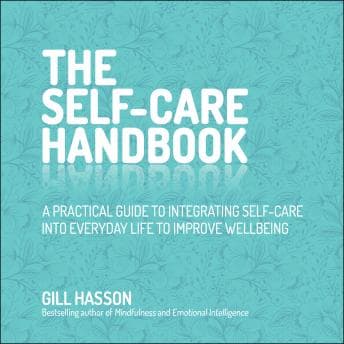

Six hours on self-care feels like a lot until you realize you've spent longer debugging a memory leak that turned out to be your own code from three months ago.
I listened to this during a particularly brutal on-call week—the kind where Slack notifications haunt your dreams and you start questioning every life choice that led you to distributed systems. Gill Hasson's book hit different at 5:47 AM on the Caltrain, surrounded by other tech zombies who clearly also needed someone to tell them to drink water and go outside occasionally.
The Blog Post That Earned Its Runtime
Look, I'm usually the first to complain that self-help books could've been a Medium article. This one... actually earns its nearly six hours. Hasson structures it like a well-documented codebase—there's a clear architecture to how she builds from basic self-care principles (sleep, boundaries, stress management) to more complex implementations (handling crisis, maintaining habits long-term). It's not revolutionary advice, but it's organized revolutionary advice, which matters when you're trying to actually apply it. Practical Guide to Self-Hypnosis has that same no-nonsense structure—concrete techniques you can actually use instead of vague aspirational thinking.
The practical bits are genuinely practical. Not "meditate for an hour every morning" practical (who has that kind of time?), but "here's how to build a five-minute routine that doesn't require you to become a different person" practical. As someone who optimizes everything, I appreciated that she treats self-care like a system you iterate on, not a one-time deployment.
Christine Rendel's British Efficiency
Rendel has this British accent that somehow makes advice about taking breaks sound like reasonable engineering requirements rather than fluffy wellness speak. Her pacing is steady without being boring, which is harder than it sounds for this genre.
Some sections landed with unexpected humor. Not laugh-out-loud funny, but that dry British wit that makes you smirk when she's describing the absurdity of how we neglect ourselves. It breaks up what could otherwise be a lecture.
No character voices to evaluate here (it's not that kind of book), but the single-narrator approach works. This isn't a story—it's a manual, and Rendel reads it like someone who's actually internalized the content rather than just performing it.
The ROI Calculation
Bottom Line: Worth your commute if you're the type who needs permission to take care of yourself.
Here's the thing—if you're already good at work-life balance, this book will feel obvious. But if you're the person who skips lunch because "I'm in the zone" and then wonders why you're exhausted and irritable by 3 PM (hi, it's me), Hasson provides a framework for thinking about self-care as maintenance, not indulgence. I tried Metahuman hoping for similar practical frameworks, but it leaned too heavily into abstract consciousness talk when I really just needed someone to tell me to eat lunch.
I finished this in about 4 commutes at 1.5x speed. The content holds up at that pace—it's not dense enough to require slower listening, but it's also not so fluffy that you can zone out completely. Perfect for that half-awake morning train state where you need something engaging but not demanding.
Who Should Queue This Up
Perfect for: Type-A personalities who intellectualize everything (including why they're burned out), anyone recovering from a rough work period, people who need structure to justify rest.
Skip if: You already have solid self-care routines, you're looking for deep psychological insights rather than practical frameworks, or advice books in general make you twitchy.
The book won't change your life overnight—that's not how systems work anyway. But it's a solid reference architecture for treating yourself like a human being instead of a machine that runs on caffeine and anxiety. Sometimes that's exactly what you need to hear at 6 AM on a packed train, heading toward another day of production incidents and Jira tickets.
The Commit Message
I'm keeping this one in my library for the next time I catch myself eating lunch at my desk for the fifth day in a row. It's not groundbreaking, but it's useful—and in self-help, useful beats profound every time. Kevin would probably say I should actually apply the advice instead of just appreciating its organizational structure. He's not wrong.