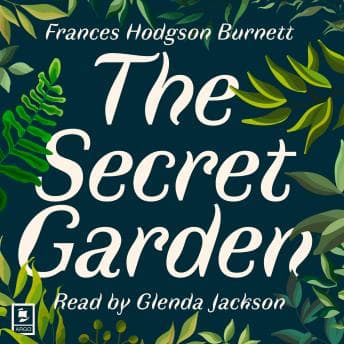

Three hours. This audiobook is three hours long and I'm genuinely annoyed about it.
Not because it's bad - it's not - but because this is an abridged version of one of the most perfectly constructed children's novels in the English language, and someone at William Collins decided that what The Secret Garden needed was less of itself. Frances Hodgson Burnett spent pages - careful, deliberate, Yorkshire-mud-under-your-fingernails pages - building Mary Lennox from a sour, unloved child into someone capable of wonder, and we're going to cut that journey down to a brisk afternoon listen. It's like speed-walking through an actual garden. You'll see the flowers but you won't smell them.
Okay. Rant over. Deep breath. Because here's the thing: what survives the trimming is still pretty wonderful, and that's almost entirely because of who's reading it.
Glenda Jackson Doesn't Read to Children - She Reads to Everyone
Glenda Jackson was an Academy Award-winning actress, a member of Parliament, and apparently the kind of person who could make the sentence "It was the lock of the door which had been closed ten years" sound like the most important revelation in English literature. Her voice here carries genuine authority without ever condescending to the material. This is what I always tell my students about great literature for young people: the "for young people" part is a marketing category, not a quality indicator. Burnett wrote a novel about grief, isolation, and the stubborn refusal of living things to stay buried. Jackson reads it like she understands that.
What struck me most - and I was listening during one of those gray Saturday mornings on the lakefront, Denise walking ahead of me because I'd stopped to replay a section - was how Jackson handles the Yorkshire dialect. Dickon and Martha and Ben Weatherstaff all speak in this thick country English that can trip up modern listeners, kids especially. Jackson doesn't do broad character voices or cartoonish accents. Instead she shifts her rhythm, lets the dialect words sit in the air a beat longer so your ear catches up. It's pedagogical in the best sense. The narrator understands that pause is punctuation. She's teaching you how to hear the book without you realizing you're being taught.
That Old Radio Play Problem
Now. The production. This is where we need to talk, because this recording comes from the ARGO Classics catalogue - originally vinyl records - and it carries all the charms and all the baggage of that era. There's period-appropriate music threaded throughout. Sound effects. The creak of a door, wind on the moor, that kind of thing. And sometimes it works beautifully, giving the whole experience this warm BBC-radio-drama quality that fits a story set in Edwardian Yorkshire.
But sometimes - and this is a real issue - the music swells right over Jackson's voice. There were moments where I had to rewind because a string arrangement decided it was more important than the actual text. If you're listening in a noisy environment, on a bus or in a busy kitchen, you're going to lose words. At home with headphones, it's manageable. On the lakefront with wind off Lake Michigan? I missed things. It's frustrating because the narration is genuinely excellent, and the production choices occasionally sabotage it.
This reminds me of what Hemingway said about prose being architecture - you don't hang curtains so heavy they block the windows. The music here is occasionally a very heavy curtain.
Who This Garden Is Actually For
If you want the complete Secret Garden experience, this isn't it. The abridgment means you lose some of Burnett's patient accumulation of detail - the slow greening of the garden mirroring Mary's slow emotional thawing. You lose some of Colin's tantrums, some of Dickon's quiet animal magic. What you get instead is the skeleton of that story, performed by someone who genuinely understood its bones.
This is a good entry point for kids who might be intimidated by the full novel's length or dialect. My review of Treasury of Greek Mythology makes a similar point — there's real value in a production that gets a reluctant young reader through the door before you hand them the unabridged thing. It's a lovely nostalgic listen for adults who read this as children and want to revisit it in an hour and a half before bed. It's not the version I'd assign to my AP students - my students would hate this, actually, the old-fashioned production would make them think it was homework from 1975 - but it's the version I'd play for a child who'd never heard the story before and needed to fall in love with it first.
The prose deserves to be savored. Burnett's central metaphor - that neglected things can bloom again if someone bothers to care for them - is so simple it almost sounds trite until you're listening to Jackson describe Mary pushing open that ivy-covered door, and suddenly you're ten years old and the whole world is behind a wall you haven't found yet.
Three hours. It should've been six. But the three hours you get? Worth pausing the faculty meeting for.
The Assignment I'd Give This Recording
Listen to it once for the story. Listen again for Jackson's pacing - the way she lets silence do work that most narrators fill with vocal filler. Accept the production quirks as the price of admission for a recording with genuine historical character. And then, honestly, go find an unabridged version and listen to the whole thing. Because this garden deserves its full acreage.